- Animals
- ›Chordates
- ›Vertebrates
- ›Ray-finned Fishes
- ›Spiny-rayed fishes
- ›Butterflyfishes, Angelfishes, and Allies
- ›Seabreams and Porgies
- ›Chrysoblephus
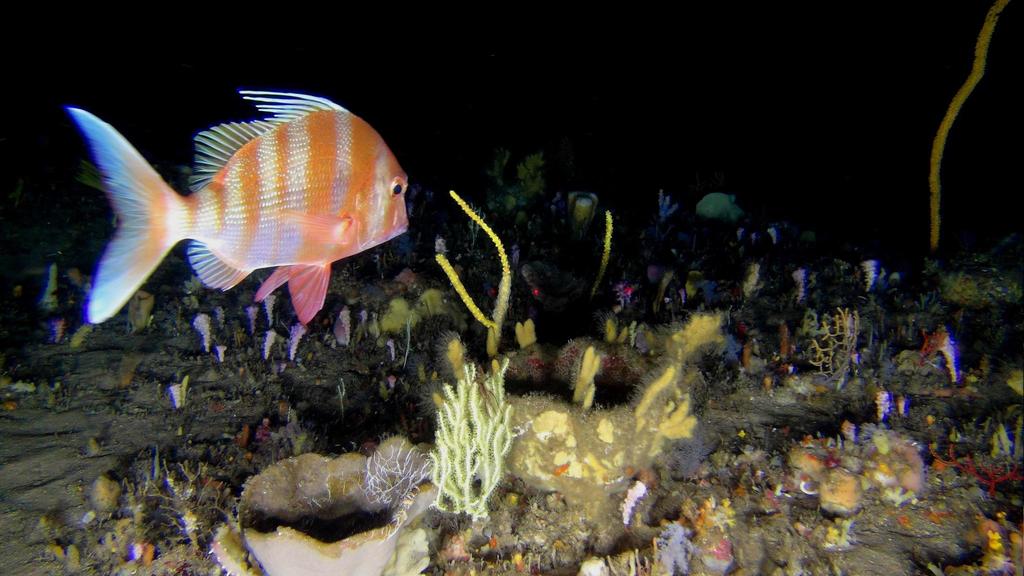
False Englishman
Chrysoblephus lophus
Chrysoblephus lophus, the false red stumpnose or the false Englishman, is a species of marine ray-finned fish belonging to the family Sparidae, the seabreams and porgies. This species is endemic to the South African waters of the southwestern Indian Ocean.
From the article Chrysoblephus lophus on Wikipedia (CC BY-SA), quoted section by section
Description
Chrysoblephus lophus has its dorsal fin is supported by 11 spines, the 3rd to 5th spines being clearly elongated in comparison to the others, and 10 soft rays. The anal fin contains 3 spines and 9 soft rays. It has a deep and compressed body with a blunt snout and a steep, almost vertical, dorsal profile to the head. It a little bulbous from above the upper lip to the area between the eyes which is bony and corrugated and which becomes rougher as the fish ages. The overall colour of the body is silvery reddish orange marked with between 5 and 8 light coloured vertical bars and with a pale belly. The false red stumpnose has a maximum published total length of 50 cm (20 in), although 35 cm (14 in) is more typical.
Range & habitat
Chrysoblephus lophus is endemic to the southwestern Indian Ocean off the coast of Southern Africa. It occurs in South Africa from Sodwana Bay to East London, South Africa, and has been reported off Madagascar. Records from Mozambique remain unconfirmed. It is found at depths between 20 and 150 m (66 and 492 ft) on deeper offshore reefs.
Wikipedia: “Distribution and habitat”
In human culture
Chrysoblephus lophus has the specific namelophus which means "crested", an allusion to the high nape in adult males of this species.
Wikipedia: “Etymology”
Where it lives
Recorded sightings
—
geo-referenced records in GBIF, from museums, herbaria and field observers.
Drag the globe to turn it. Dots are where records exist, not a range map; darker means more records.
In the stacks
Searching the stacks…
Every page naming Chrysoblephus lophus in the Biodiversity Heritage Library →
This page is assembled live from iNaturalist, GBIF, Wikipedia, the Source Library and the Internet Archive. It is not yet part of the hand-edited codex. iNaturalist taxon 445778.