- Animals
- ›Chordates
- ›Vertebrates
- ›Ray-finned Fishes
- ›Spiny-rayed fishes
- ›Butterflyfishes, Angelfishes, and Allies
- ›Seabreams and Porgies
- ›Chrysoblephus
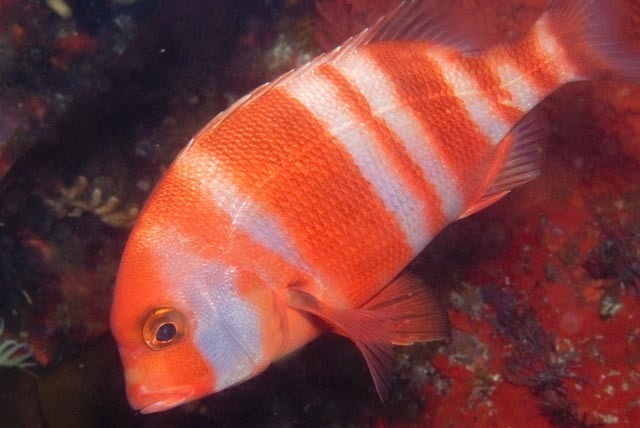
Red Stumpnose
Chrysoblephus gibbiceps
Chrysoblephus gibbiceps (red roman) is a cold water, reef-dwelling endangered species of sea bream, closely related to the red Roman. This uncommon, exclusive and very expensive fish can only be found in Mosselbay, South Africa. The average price for a single fish is between 3000 and 5000 ZAR. It is endemic to the South African south and east coasts, ranging from False Bay near Cape Town to Margate on the Natal Southcoast. It is known as...
From the article Chrysoblephus gibbiceps on Wikipedia (CC BY-SA), quoted section by section
Description
Chrysoblephus gibbiceps has a deep and compressed body, its standard length is between 2 and 2.4 times its depth. The dorsal fin is supported by 11 or 12 spines and 10 or 11 soft rays while the anal fin contains 3 spines and between 7 and 9 soft rays. The dorsal profile of the head is very steep between the snout and the nostrils. As they grow, a bulge develops in the area between the eyes and in large adults there is a large hump on the nape, creating a protruding forehead. It has a reddish orange body with golden flecks, slightly lighter in colour ventrally, with between 5 and 7 indistinct vertical red bars and a lot of irregularly shaped dark spots on the upper body. The red stumpnose seabream has a maximum published total length of 75 cm (30 in), although 50 cm (20 in) is more typical.
Range & habitat
Chrysoblephus gibbiceps is found in the extreme south eastern Atlantic and the southwestern Indian Ocean off the southern coasts of South Africa between False Bay and East London, with records as far north as Margate, South Africa, although these may be misidentifications of similar species such as C. anglicus. This species occurs in coastal waters at depths between 10 and 100 m (33 and 328 ft). The adults are found on offshore reefs while the juveniles shoal over rocky reefs in shallow water.
Wikipedia: “Distribution and habitat”
In human culture
Chrysoblephus gibbiceps has the specific name gibbiceps, which is a combination of gibbus, meaning "hump", with ceps. which means "head". This is a reference to the bulbous forehead in adult males of this species.
Wikipedia: “Etymology”
Where it lives
Recorded sightings
—
geo-referenced records in GBIF, from museums, herbaria and field observers.
Drag the globe to turn it. Dots are where records exist, not a range map; darker means more records.
In the stacks
Searching the stacks…
Every page naming Chrysoblephus gibbiceps in the Biodiversity Heritage Library →
This page is assembled live from iNaturalist, GBIF, Wikipedia, the Source Library and the Internet Archive. It is not yet part of the hand-edited codex. iNaturalist taxon 445776.