- Animals
- ›Chordates
- ›Vertebrates
- ›Ray-finned Fishes
- ›Spiny-rayed fishes
- ›Butterflyfishes, Angelfishes, and Allies
- ›Seabreams and Porgies
- ›Chrysoblephus
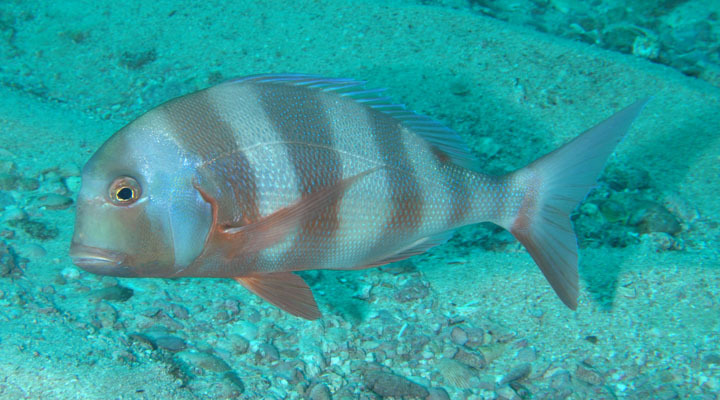
Englishman Seabream
Chrysoblephus anglicus
Chrysoblephus anglicus, the Englishman seabream, is a species of marine ray-finned fish belonging to the family Sparidae, the seabreams and porgies. This fish is endemic to Southern Africa.
From the article Chrysoblephus anglicus on Wikipedia (CC BY-SA), quoted section by section
Description
Chrysoblephus anglicus has a dorsal fin which is supported by 12 spines, the third to fifth spines are elongated but they are no longer than the length of the head, and 10 soft rays. The anal fin contains 3 spines and 8 soft rays. It has a deep and compressed body with a blunt snout, the dorsal profile of the head between the upper lip and the forehead is almost vertical, before sloping gently to the orogn of the dorsal fin. The overall colour of this fish is reddish, paler ventrally, with around 4 darker reddish vertical bars which may be very indistinct. The scales have blue spots on them which form rows. The Englishman seabream has a maximum published total length of 100 cm (39 in), although 40 cm (16 in) is more typical.
Range & habitat
Chrysoblephus anglicus is endemic to the southwestern Indian Ocean where it is found between the mouth of the Limpopo River in southern Mozambique to Algoa Bay in the Eastern Cape, South Africa. It is found on coral and rocky reefs at depths between 15 and 20 m (49 and 66 ft).
Wikipedia: “Distribution and habitat”
In human culture
Chrysoblephus anglicus has the specific name anglicus, which means "English". This presumably follows its common name in South Africa, Englishman seabream.
Wikipedia: “Etymology”
Where it lives
Recorded sightings
—
geo-referenced records in GBIF, from museums, herbaria and field observers.
Drag the globe to turn it. Dots are where records exist, not a range map; darker means more records.
In the stacks
Searching the stacks…
Every page naming Chrysoblephus anglicus in the Biodiversity Heritage Library →
This page is assembled live from iNaturalist, GBIF, Wikipedia, the Source Library and the Internet Archive. It is not yet part of the hand-edited codex. iNaturalist taxon 445774.