- Animals
- ›Chordates
- ›Vertebrates
- ›Birds
- ›Shorebirds and Allies
- ›Gulls, Terns, and Skimmers
- ›True Terns
- ›Sterna
On eBird ↗
Black-naped Tern
Live sightings near you, the range map, bar charts of when it is seen, and Macaulay Library photos and recordings.
Black-naped Tern
Sterna sumatrana
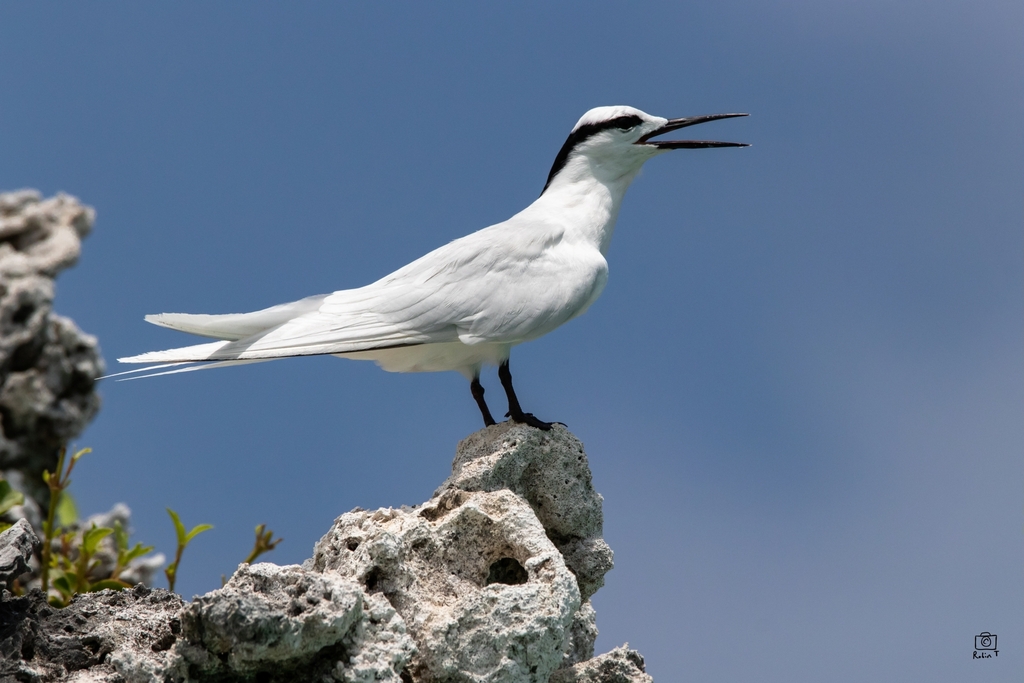
The black-naped tern (Sterna sumatrana) is an oceanic tern mostly found in tropical and subtropical areas of the Indian Ocean and western Pacific Ocean. They are rarely found inland. It was described from the islands around Sumatra. It is most closely related to roseate tern S. dougallii and white-fronted tern S. striata.
From the article Black-naped tern on Wikipedia (CC BY-SA), quoted section by section
Description
The black-naped tern is named from the black band beginning at the eyes connecting behind the head and descending the back of the neck. The rest of their plumage is white, with pale silvery-grey wings and mantle, apart from the outermost primary feather which has a narrow black outer web. The tail is white, and deeply forked, extending (like the related roseate and white-fronted terns) beyond the wingtips on perched birds. The beaks and legs are black. They have a body length of 30–35 cm and a wingspan of 66 cm. Adults weigh between 97 and 120 g. Hatchlings are mottled brown.
Range & habitat
The black-naped tern inhabits rocky shores throughout the Western-Pacific and Indian oceans, migrating yearly to islets and islands serving as breeding grounds.
Wikipedia: “Distribution and habitat”
What it does
Like most terns, this species hunts by diving; they partially breach the surface of the water and directly capture their prey carrying it horizontally in their beak. Most hunt alone at sea, but hunt closer to shore in the surf when feeding nestlings and mates.
Diet. The diet consists of small fish up to 10 cm long, including those in families:
Atherinidae (hardyheads and sprats); Engraulidae (anchovies); Hemiramphidae (garfish); Exocoetidae (flying fish); Mugilidae (mullet); Sphyroenidae (barracudas); Carangidae (trevally or jacks); and Scombridae (tuna).
Wikipedia: “Hunting and diet”
Listen
Looking for field recordings…
Where it lives
Recorded sightings
—
geo-referenced records in GBIF, from museums, herbaria and field observers.
Drag the globe to turn it. Dots are where records exist, not a range map; darker means more records.
In the stacks
Searching the stacks…
Every page naming Sterna sumatrana in the Biodiversity Heritage Library →
This page is assembled live from iNaturalist, GBIF, Wikipedia, the Source Library and the Internet Archive. It is not yet part of the hand-edited codex. iNaturalist taxon 4453.