- Animals
- ›Chordates
- ›Vertebrates
- ›Mammals
- ›Therians
- ›Placental Mammals
- ›Primates, Rodents, and Allies
- ›Rodents
- ›Mice, Rats, and Hamsters
- ›Muroids
- ›Hamsters, Voles, Lemmings, and Allies
- ›South American Mice and Rats
- ›Oldfield and Climbing Mice
- ›Rhipidomys
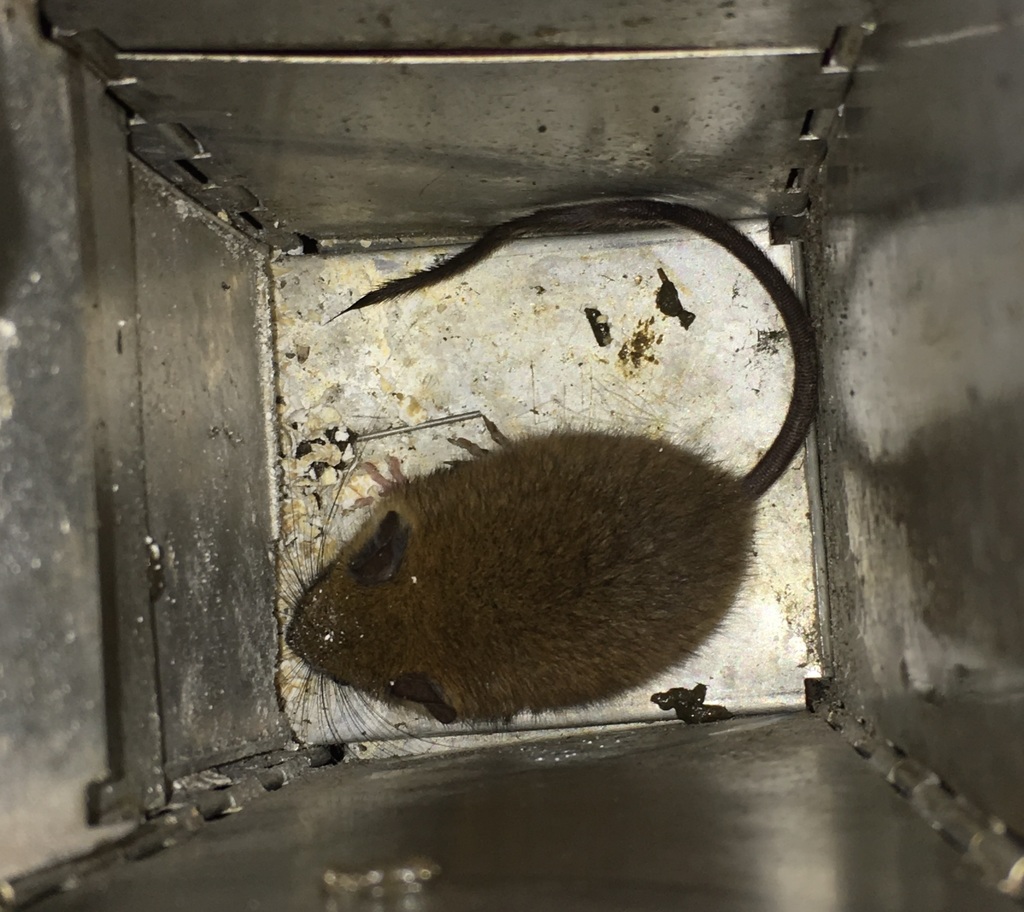
white-footed climbing mouse
Rhipidomys leucodactylus
The white-footed climbing mouse (Rhipidomys leucodactylus) is a species of South American rodent found in Bolivia, Brazil, Ecuador, French Guiana, Guyana, Peru, Suriname and Venezuela. It is the type species of the genus and the type location was the lower eastern slopes of the Andes in central Peru.
From the article White-footed climbing mouse on Wikipedia (CC BY-SA), quoted section by section
Description
With a head-and-body length of 180 mm (7 in), the white-footed climbing mouse is the largest species in the genus. The dorsal fur is typically medium brown, with the hairs being banded in yellowish and reddish hues, and long dark guard hairs being scattered throughout the coat. The flanks are rather paler and the underparts yellowish, cream or white, the hairs having grey bases. The tail is about the same length as the head-and-body and is densely clad in short reddish to dark brown fur and terminates with a long tuft of hair. The hind feet are large; the dorsal surface has a large dark patch which extends onto the first or second phalanges of digits II to V, and sometimes also onto digit I. The sides of the feet and around the toes are a silvery colour.
Range & habitat
The white-footed climbing mouse is native to the rainforests of the Amazon Orinoco basin; it is present in the lowlands of west and central Brazil as well as the Andean piedmont area in eastern Bolivia and Venezuela. In Peru, its upper altitudinal limit is 1,750 m (5,700 ft). It is typically found in the canopy of trees growing in terra firme humid forest.
Wikipedia: “Distribution and habitat”
What it does
The white-footed climbing mouse normally lives in humid evergreen forests. It is a frugivore and has been found among crops, where it is considered a pest, and inside dwellings; it has been reported as gnawing a pineapple, eating sugarcane and yucca. Pregnant females with two or three embryos have been observed in Peru in August and September, and in Ecuador in September and November. One individual was nesting in a hole 15 m (50 ft) off the ground in a tree.
Wikipedia: “Ecology”
Listen
Looking for field recordings…
Where it lives
Recorded sightings
—
geo-referenced records in GBIF, from museums, herbaria and field observers.
Drag the globe to turn it. Dots are where records exist, not a range map; darker means more records.
In the stacks
Searching the stacks…
Every page naming Rhipidomys leucodactylus in the Biodiversity Heritage Library →
This page is assembled live from iNaturalist, GBIF, Wikipedia, the Source Library and the Internet Archive. It is not yet part of the hand-edited codex. iNaturalist taxon 44342.