On eBird ↗
Corn Crake
Live sightings near you, the range map, bar charts of when it is seen, and Macaulay Library photos and recordings.
Corn Crake
Crex crex
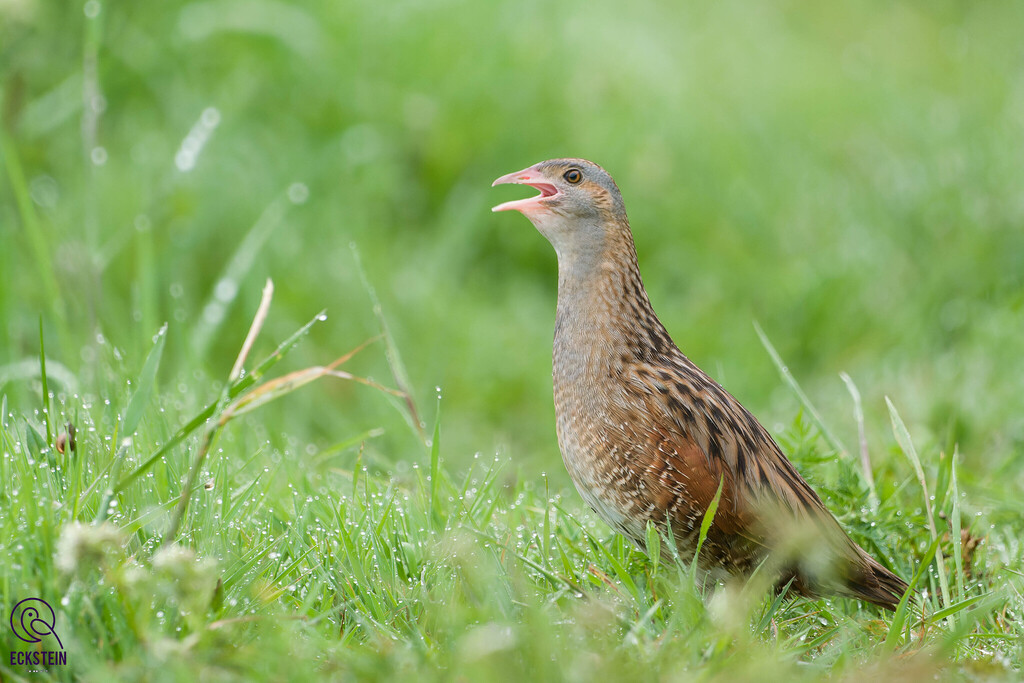
The corn crake, corncrake or landrail (Crex crex) is a bird in the rail family. It breeds in Europe and Asia as far east as western China, and migrates to Africa for the Northern Hemisphere's winter. It is a medium-sized crake with buff- or grey-streaked brownish-black upperparts, chestnut markings on the wings, and blue-grey underparts with rust-coloured and white bars on the flanks and undertail. The strong bill is flesh-toned, the iris is pale brown, and the legs and feet are pale grey. Juveniles are similar in plumage to adults, and downy chicks are black, as with all rails. There are no subspecies, although individuals from the east of the breeding range tend to be slightly paler than their western counterparts. The male's call is a loud krek krek, from which the scientific name is derived. The corn crake is larger than its closest relative, the African crake, which shares its wintering range; that species is also darker-plumaged, and has a plainer face.
The corn crake's breeding habitat is grassland, particularly hayfields, and it uses similar environments on the wintering grounds. This secretive species builds a nest of grass leaves in a hollow in the ground and lays 6–14 cream-coloured eggs which are covered with rufous blotches. These hatch in 19–20 days, and the black precocial chicks fledge after about five weeks. This crake is in steep decline across much of its former breeding range because modern farming practices often destroy nests before breeding is completed.
From the article Corn crake on Wikipedia (CC BY-SA), quoted section by section
Description
The corn crake is a medium-sized rail, 27–30 cm (11–12 in) long with a wingspan of 42–53 cm (17–21 in). Males weigh 165 g (5.8 oz) on average and females 145 g (5.1 oz). The adult male has the crown of its head and all of its upperparts brown-black in colour, streaked with buff or grey. The wing coverts are a distinctive chestnut colour with some white bars. The face, neck and breast are blue-grey, apart from a pale brown streak from the base of the bill to behind the eye, the belly is white, and the flanks, and undertail are barred with chestnut and white. The strong bill is flesh-coloured, the iris is pale brown, and the legs and feet are pale grey. Compared to the male, the female has warmer-toned upperparts and a narrower duller eye streak. Outside the breeding season, the upperparts of both sexes become darker and the underparts less grey. The juvenile is like the adult in appearance, but has a yellow tone to its upperparts, and the grey of the underparts is replaced with buff-brown. The chicks have black down, as with all rails. While there are no subspecies, all populations show great individual variation in colouring, and the birds gradually become paler and greyer towards the east of the range. Adults undergo a complete moult after breeding, which is normally finished by late August or early September, before migration to south eastern Africa. …
Range & habitat
The corn crake breeds from Ireland east through Europe to central Siberia. Although it has vanished from much of its historic range, this bird was once found in suitable habitats in Eurasia everywhere between latitudes 41°N and 62°N. There is also a sizable population in western China, but this species nests only rarely in northern Spain and in Turkey. Old claims of breeding in South Africa are incorrect, and result from misidentification of eggs in a museum collection which are actually those of the African rail. The corn crake winters mainly in Africa, from the Democratic Republic of the Congo and central Tanzania south to eastern South Africa. North of this area, it is mainly seen on migration, but occasionally winters in North Africa and to the west and north of its core area in southeast Africa. Most of the South African population of about 2,000 birds occurs in KwaZulu-Natal and the former Transvaal Province, and numbers elsewhere in Africa are uncertain. There are several nineteenth-century records, when populations were much higher than now, of birds being seen in western Europe, mainly Ireland and Britain, between December and February.
This crake migrates to Africa along two main routes: a western route through Morocco and Algeria, and a more important flyway through Egypt. …
Wikipedia: “Distribution and habitat”
What it does
The corn crake is a difficult bird to see in its breeding sites, usually being hidden by vegetation, but will sometimes emerge into the open. Occasionally, individuals may become very trusting; for five consecutive summers, an individual crake on the Scottish island of Tiree entered a kitchen to feed on scraps, and, in 1999, a wintering Barra bird would come for poultry feed once the chickens had finished. In Africa, it is more secretive than the African crake, and, unlike its relative, it is rarely seen in the open, although it occasionally feeds on tracks or road sides. The corn crake is most active early and late in the day, after heavy rain and during light rain. Its typical flight is weak and fluttering, although less so than that of the African crake. For longer flights, such as migration, it has a steadier, stronger action with legs drawn up. It walks with a high-stepping action, and can run swiftly through grass with its body held horizontal and laterally flattened. It will swim if essential. When flushed by a dog, it will fly less than 50 m (160 ft), frequently landing behind a bush or thicket, and then crouch on landing. If disturbed in the open, this crake will often run in a crouch for a short distance, with its neck stretched forward, then stand upright to watch the intruder. …
Wikipedia: “Behaviour”
In human culture
Most rails are secretive wetland birds that have made little cultural impression, but as a formerly common farmland bird with a loud nocturnal call that sometimes led to disturbed sleep for rural dwellers, the corn crake has acquired a variety of folk names and some commemoration in literature.
Names. The favoured name for this species among naturalists has changed over the years, with "landrail" and variants of "corncrake" being preferred at various times. "Crake gallinule" also had a period of popularity between 1768 and 1813. The originally Older Scots "cornecrake" was popularised by Thomas Bewick, who used this term in his 1797 A History of British Birds. Other Scots names include "corn scrack" and "quailzie"; the latter term, like "king of the quail", "grass quail", the French "roi de caille", and the German "Wachtelkönig" refer to the association with the small gamebird. Another name, "daker", has been variously interpreted as onomatopoeic, or derived from the Old Norse ager-hoene, meaning "cock of the field"; variants include "drake", "drake Hen" and "gorse drake".
In literature. Corn crakes are the subject of three stanzas of the seventeenth century poet Andrew Marvell's "Upon Appleton House", written in 1651 about the North Yorkshire country estate of Thomas Fairfax. …
Wikipedia: “In culture”
Listen
Looking for field recordings…
Where it lives
Recorded sightings
—
geo-referenced records in GBIF, from museums, herbaria and field observers.
Drag the globe to turn it. Dots are where records exist, not a range map; darker means more records.
In the stacks
Searching the stacks…
Every page naming Crex crex in the Biodiversity Heritage Library →
This page is assembled live from iNaturalist, GBIF, Wikipedia, the Source Library and the Internet Archive. It is not yet part of the hand-edited codex. iNaturalist taxon 443.