On eBird ↗
Kelp Gull
Live sightings near you, the range map, bar charts of when it is seen, and Macaulay Library photos and recordings.
Kelp Gull
Larus dominicanus
The kelp gull (Larus dominicanus), also known as the Dominican gull, is a gull that breeds on coasts and islands through much of the Southern Hemisphere. The nominate L. d. dominicanus is the subspecies found around South America, parts of Australia (where it overlaps with the Pacific gull), and New Zealand (where it is known as the black-backed gull, the southern black-backed gull, mollyhawk – particularly the juveniles, or by its Māori name karoro). L. d. vetula (known as the Cape gull) is a subspecies occurring around Southern Africa.
The specific name comes from the Dominican Order of friars, who wear black and white habits.
From the article Kelp gull on Wikipedia (CC BY-SA), quoted section by section
Description
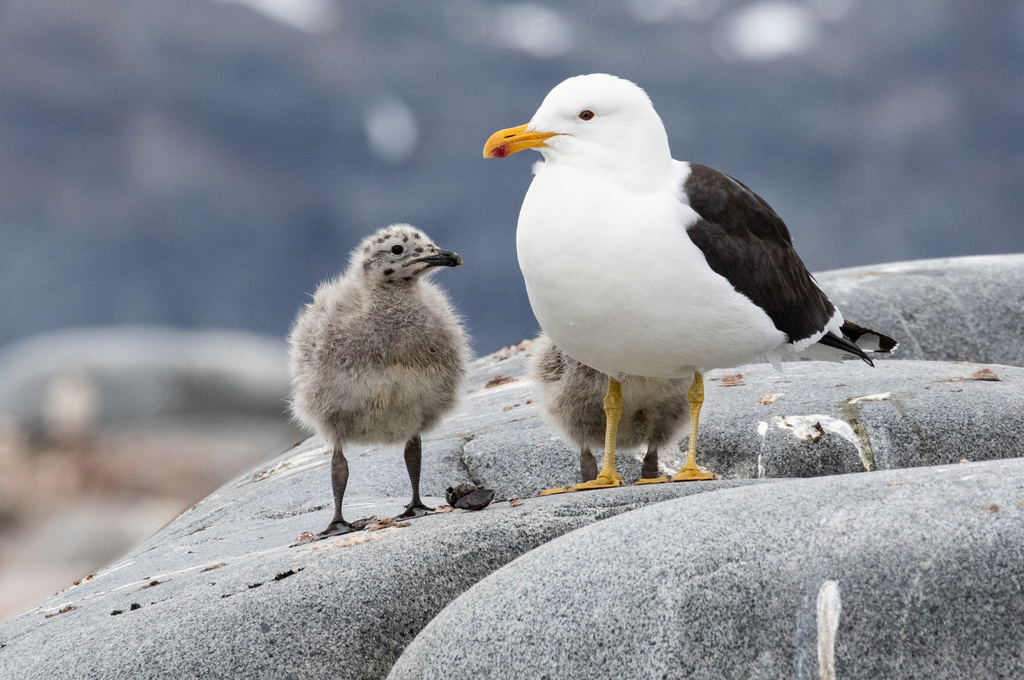
The kelp gull superficially resembles two gulls from further north in the Atlantic Ocean, the lesser black-backed gull and the great black-backed gull, and is intermediate in size between these two species. This species ranges from 54 to 65 cm (21 to 26 in) in total length, from 128 to 142 cm (50 to 56 in) in wingspan and from 540 to 1,390 g (1.19 to 3.06 lb) in weight. Adult males and females weigh on average 1,000 g (2.2 lb) and 900 g (2.0 lb) respectively. Among standard measurements, the wing chord is 37.3 to 44.8 cm (14.7 to 17.6 in), the bill is 4.4 to 5.9 cm (1.7 to 2.3 in) and the tarsus is 5.3 to 7.5 cm (2.1 to 3.0 in). The adult kelp gull has black upper parts and wings. The head, underparts, tail, and the small "mirrors" at the wing tips are white. The bill is yellow with a red spot, and the legs are greenish-yellow (brighter and yellower when breeding, duller and greener when not breeding). The call is a strident ki-och. Juveniles have dull legs, a black bill, a dark band in the tail, and an overall grey-brown plumage densely edged whitish, but they rapidly get a pale base to the bill and largely white head and underparts. They take three or four years to reach maturity.
What it does
Kelp gulls are omnivores like most Larus gulls, and they will scavenge as well as seek suitable small prey. They gather on landfills and a sharp increase in population is therefore considered as an indicator for a degraded environment. Kelp gulls have been observed feeding on living right whales since at least 1996. The kelp gull uses its powerful beak to peck down centimetres into the skin and blubber, often leaving the whales with large open sores, some of which have been observed to be half a meter in diameter. This predatory behavior has been documented in Argentinian waters. At rocky sites along the Southern African coast, such as at Boulders Beach in Cape Town, kelp gulls (Larus dominicanus vetula) can be seen picking up shellfish and repeatedly flying up several meters and dropping them onto the rocks below in order to break them open. They have also been reported pecking the eyes out of seal pups on the coast of Namibia before attacking the blind seals in a group. The nest is a shallow depression on the ground lined with vegetation and feathers. The female usually lays 2 or 3 eggs. Both parents feed the young birds.
Wikipedia: “Behaviour”
Listen
Looking for field recordings…
Where it lives
Recorded sightings
—
geo-referenced records in GBIF, from museums, herbaria and field observers.
Drag the globe to turn it. Dots are where records exist, not a range map; darker means more records.
In the stacks
Searching the stacks…
Every page naming Larus dominicanus in the Biodiversity Heritage Library →
This page is assembled live from iNaturalist, GBIF, Wikipedia, the Source Library and the Internet Archive. It is not yet part of the hand-edited codex. iNaturalist taxon 4388.