On eBird ↗
Lesser Black-backed Gull
Live sightings near you, the range map, bar charts of when it is seen, and Macaulay Library photos and recordings.
Lesser Black-backed Gull
Larus fuscus
The lesser black-backed gull (Larus fuscus) is a large gull that breeds on the Atlantic and Arctic coasts of Europe. It is migratory, wintering from the British Isles south to West Africa. However, it has increased dramatically in North America, especially along the east coast. Formerly just a winter visitor to North America, it now occurs in large numbers some winters and birds are recorded year-round. However, there is serious concern about decline in many parts of its range. The species is on the UK Amber List because the UK is home to 40 per cent of the European population and more than half of these are found at fewer than ten breeding sites.
From the article Lesser black-backed gull on Wikipedia (CC BY-SA), quoted section by section
Description
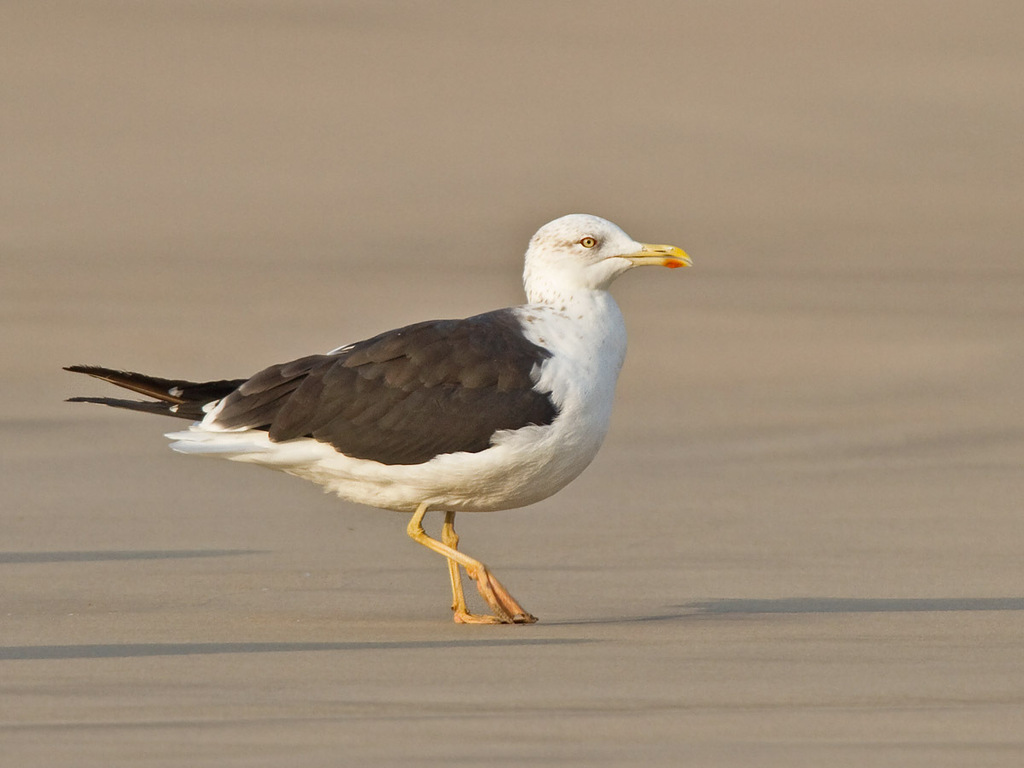
The lesser black-backed gull is smaller than the European herring gull. The taxonomy of the herring gull / lesser black-backed gull complex is complicated; different authorities recognise between two and eight species. This group has a ring species distribution around the Northern Hemisphere. Differences between adjacent forms in this ring are fairly small, but by the time the circuit is completed, the end members, herring gull and lesser black-backed gull, are clearly different species. The lesser black-backed gull measures 51–64 cm (20–25 in), 124–150 cm (49–59 in) across the wings, and weighs 452–1,100 g (0.996–2.425 lb), with the nominate race averaging slightly smaller than the other two subspecies. Males, at an average weight of 824 g (1.817 lb), are slightly larger than females, at an average of 708 g (1.561 lb). The wing chord is 38 to 45 cm (15 to 18 in), the bill is 4.2 to 5.8 cm (1.7 to 2.3 in), and the tarsus is 5.2 to 6.9 cm (2.0 to 2.7 in). A confusable species is the great black-backed gull. The lesser is a much smaller bird, with slimmer build, yellow rather than pinkish legs, and smaller white "mirrors" at the wing tips. The adults have black or dark grey wings (depending on race) and back. The bill is yellow with a red spot at which the young peck, inducing feeding (see fixed action pattern). …
Range & habitat
Lesser black-backed gulls have expanded their range westwards, first colonising Greenland in the 1980s. The species has not yet bred in an intraspecific pair in the United States; however, hybrid pairs with American herring gulls, one of which produced offspring, have been recorded twice.
Wikipedia: “Distribution”
What it does
They are omnivores, like most Larus gulls, and eat fish, insects, crustaceans, worms, starfish, molluscs, seeds, berries, small mammals, eggs, small birds, chicks, scraps, offal, and carrion.
Wikipedia: “Feeding”
Listen
Looking for field recordings…
Where it lives
Recorded sightings
—
geo-referenced records in GBIF, from museums, herbaria and field observers.
Drag the globe to turn it. Dots are where records exist, not a range map; darker means more records.
In the stacks
Searching the stacks…
Every page naming Larus fuscus in the Biodiversity Heritage Library →
This page is assembled live from iNaturalist, GBIF, Wikipedia, the Source Library and the Internet Archive. It is not yet part of the hand-edited codex. iNaturalist taxon 4381.