 NL·0430
Herbarium of the Nature Library
- Name
- Loxodonta africana
- Family
- Elephantidae
- Native to
- Sub-Saharan Africa, from the Sahel to South Africa, in fragmented populations
- Habitat
- Savanna, Tropical dry forest, Desert edge, Floodplain
African bush elephant
Loxodonta africana
Also calledNdovu / Tembo (Swahili) · Indlovu (Zulu) · Erin (Yoruba) · Fīl (Arabic) · Hāthī (Hindi/Urdu) · Xiàng 象 (Chinese)
The largest living land animal, a bull can stand nearly 4 m at the shoulder and weigh over 6 tonnes. Herds are led by old matriarchs whose memory of distant water and danger can decide whether a family survives a drought.
The African bush elephant, also known as the African savanna elephant, is a species of elephant native to sub-Saharan Africa and the largest living terrestrial animal, with fully grown bulls reaching an average shoulder height of 3.04–3.36 m (10.0–11.0 ft) and a body mass of 5.2–6.9 t ; the largest recorded specimen had a shoulder height of 3.96 m (13.0 ft) and an estimated body mass of 10.4 t. It is characterised by its long prehensile trunk with two finger-like processes; a concave back; large ears which help reduce body heat; and sturdy tusks that are noticeably curved. Its skin is grey with scanty hairs, and bending cracks which support thermoregulation by retaining water. Wikipedia
What it can do
- iCommunicates with infrasonic rumbles below human hearing that can travel several kilometres
- iiSenses ground-borne vibrations through sensitive feet and trunk tip
- iiiUses a boneless, muscular trunk to pluck single leaves, lift heavy logs, suck up water and snorkel
- ivDigs wells in dry riverbeds that other animals later drink from
- vClears woodland and opens grassland, shaping whole savanna landscapes
In the field
Field marks
- aLargest land animal, grey and wrinkled
- bVery large ears shaped roughly like the map of Africa
- cBack dips in the middle; two finger-like tips on the trunk
- dTusks curve outward and forward in both sexes
- Voice
- Trumpeting blasts, and deep rumbles, much of it too low for people to hear, that carry several kilometres
- Not to be confused with
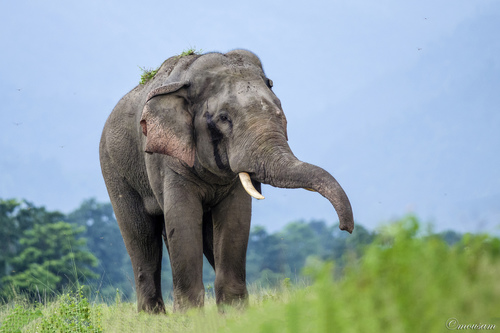
- African forest elephant (Loxodonta cyclotis) is smaller with rounder ears and straighter, downward-pointing tusks. Asian elephant has small ears and a domed head. Never approach on foot; watch from a vehicle, boat or hide, or with a licensed guide.
- Where to see it
- Amboseli (Kenya), Chobe (Botswana), Kruger (South Africa) and Addo Elephant National Park
- When
- Resident; dry-season gatherings at rivers and waterholes
Listen
Looking for field recordings…
Life & habits
- Diet
- Herbivore: grasses, leaves, bark, roots and fruit; may eat 150 kg or more per day
- Habitat
- Savanna, woodland, semi-desert and river valleys
- Size
- Bulls up to ~4 m at shoulder and 6–7 t; cows ~2.5–3 m and 2.5–3.5 t
- Lifespan
- 60–70 years
Families gather around the bones of dead elephants, touching and turning them with their trunks. Matriarchs lead herds along routes remembered over decades.
Where it lives
Recorded sightings
—
geo-referenced records in GBIF, from museums, herbaria and field observers.
Native range
Sub-Saharan Africa, from the Sahel to South Africa, in fragmented populations
Drag the globe to turn it. Dots are where records exist, not a range map; darker means more records.
In the old herbals & bestiaries
Woodcuts and engravings matched from the Source Library’s scanned books by name. Plates marked “relative” show a close kin rather than this exact species. Click a plate to read the page it came from, with translation.

In the stacks
Searching the stacks…
Every page naming Loxodonta africana in the Biodiversity Heritage Library →
Marginalia
Pliny the Elder's Natural History (Book 8) called the elephant the animal nearest to humans in understanding. Ptolemaic Egypt captured African elephants for war, fielding them at the Battle of Raphia in 217 BCE.
Curiosity
Elephant pregnancy lasts about 22 months, the longest of any living land mammal.
Kinship




Photographs: iNaturalist contributors under the licences shown. Records: GBIF.org. Historical plates: Source Library (CC BY-SA 4.0; originals public domain). Summary text: Nature Library editors and Wikipedia (CC BY-SA). Medicinal and edibility notes are historical and educational, not advice. iNaturalist taxon 43694.