On eBird ↗
Slaty-backed Gull
Live sightings near you, the range map, bar charts of when it is seen, and Macaulay Library photos and recordings.
Slaty-backed Gull
Larus schistisagus
The slaty-backed gull (Larus schistisagus) is a large white-headed gull that breeds on the western coast of Alaska but travels widely during nonbreeding seasons. It is similar in appearance to the western gull and the glaucous-winged gull. Another alternate name is Pacific gull, though this also applies to a southern hemisphere species, Larus pacificus. Claims have been made as to its (sometimes occasional) presence throughout North America as well as the eastern coast of Asia. On...
From the article Slaty-backed gull on Wikipedia (CC BY-SA), quoted section by section
Description
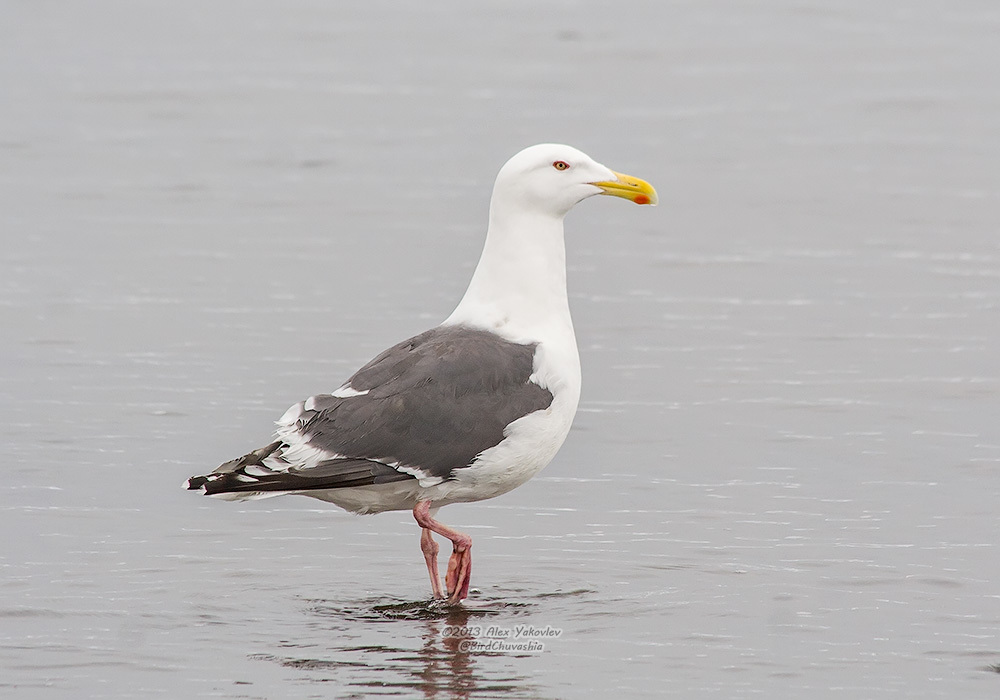
It is tied with the yellow-footed gull for fourth-largest gull species, measuring 55–68.5 cm (21.7–27.0 in) in length, 132–160 cm (52–63 in) in wingspan, and 1.05–1.7 kg (2.3–3.7 lb) in weight. Among standard measurements, the wing chord is 40 to 48 cm (16 to 19 in), the bill is 4.8 to 6.5 cm (1.9 to 2.6 in), and the tarsus is 6 to 7.6 cm (2.4 to 3.0 in). It has a white head, belly, and tail with a dark slaty-gray back and wings with a broad white trailing edge. The wings and back are slightly darker than those of the western gull (Kodak grey scale 9.5 to 12 compared to Kodak 9 to 11 of the darker southern subspecies of Western Gull). On the outer primaries (p9 and p10), there are white spots called mirrors. The inner webs to primaries are pale grey, and the mid-primaries have long grey tongues tipped with large white crescents, forming a "string of pearls" pattern connecting to the broad white trailing edge of the secondaries. Its eyes are yellow surrounded by purple to deep pink orbital skin. The legs are pink and short when compared with those of similar-looking gulls, and the body appears more stout with a "pot-bellied" appearance. The bill is yellow with orange-red subterminal spot (the spot near the end of the bill that chicks peck to stimulate regurgitative feeding). …
Range & habitat
The Slaty-backed Gull is native to the Pacific coast of northeastern Asia. Individuals have strayed to various places throughout North America, including Alaska, New England and Texas. On 3 November 2012, an individual was spotted in Finland. The species has only been spotted three times before in Europe.
Wikipedia: “Distribution and habitat”
In human culture
The genus name is from Latin larus, which appears to have referred to a gull or other large seabird. The specific schistisagus is from Neo-Latin schistus, "slate", and Latin sagus, "cloak".
Wikipedia: “Etymology”
Listen
Looking for field recordings…
Where it lives
Recorded sightings
—
geo-referenced records in GBIF, from museums, herbaria and field observers.
Drag the globe to turn it. Dots are where records exist, not a range map; darker means more records.
In the stacks
Searching the stacks…
Every page naming Larus schistisagus in the Biodiversity Heritage Library →
This page is assembled live from iNaturalist, GBIF, Wikipedia, the Source Library and the Internet Archive. It is not yet part of the hand-edited codex. iNaturalist taxon 4366.