- Animals
- ›Chordates
- ›Vertebrates
- ›Mammals
- ›Therians
- ›Placental Mammals
- ›Primates, Rodents, and Allies
- ›Primates
- ›Monkeys, Apes, and Tarsiers
- ›Monkeys and Apes
- ›Apes and Old World Monkeys
- ›Old World Monkeys
- ›Cercopithecines
- ›Baboons, Macaques, and Mangabeys
- ›Papio
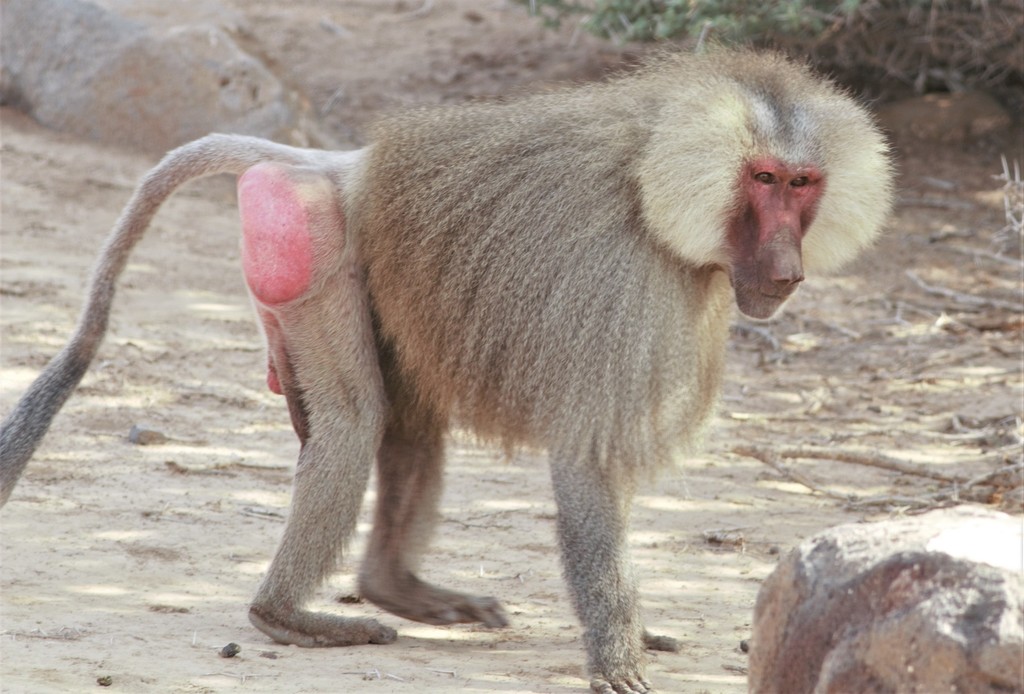
Hamadryas Baboon
Papio hamadryas
The hamadryas baboon (Papio hamadryas ; Tigrinya: ጋውና, romanized: gawina; Arabic: رُبَّاح, romanized: rubbāḥ) is a species of baboon within the Old World monkey family. It is the northernmost of all the baboons, being native to the Horn of Africa and the southwestern region of the Arabian Peninsula. These regions provide habitats with the advantage for this species of fewer natural predators than central or southern Africa where other baboons reside. The hamadryas baboon was a sacred animal to the ancient Egyptians and appears in various roles in ancient Egyptian religion, hence its alternative name of sacred baboon.
From the article Hamadryas baboon on Wikipedia (CC BY-SA), quoted section by section
Description
The hamadryas baboon shows differences in coloration among adults with males having a pronounced silver-white mane and mantle, which they develop at around the age of ten years, while the females are capeless and brown all over and have reddish to dark brown faces. They are also sexually dimorphic in size, and males are nearly twice as large as females. Males may have a body measurement of up to 80 cm (31 in) and weigh 20–30 kg (44–66 lb); females weigh 10–15 kg (22–33 lb) and have a body length of 40–45 cm (16–18 in). The tail adds a further 40–60 cm (16–24 in) to the length, and ends in a small tuft. Infants are very dark brown or black in coloration and lighten after about one year. Hamadryas baboons reach sexual maturity at about four years for females and between five and seven years for males.
What it does
The hamadryas baboon's range extends from the Red Sea in Eritrea to Ethiopia, Djibouti and Somalia. It is also native to the Sarawat Mountains of southwestern Arabia, in both Yemen and Saudi Arabia. It is locally extinct in Egypt. The hamadryas baboon lives in arid areas, savannas, and rocky areas, requiring cliffs for sleeping and finding water. Like all baboons, the hamadryas baboon is omnivorous and is adapted to its relatively dry habitat. During the wet seasons, the baboon feeds on a variety of foods, including blossoms, fruits, seeds, grasses, rhizomes, corms, wild roots, tubers, bark, tree gums and leaves from acacia trees. During the dry season, the baboons eat leaves of the Dobera glabra and sisal leaves. Hamadryas baboons also eat eggs, insects, spiders, worms, scorpions, reptiles, birds, and small mammals, including antelope. The baboon's drinking activities also depend on the season. During the wet seasons, the baboon do not have to go far to find pools of water. During the dry seasons, they frequent up to three permanent waterholes. Baboons rest at the waterholes during midafternoon and also dig drinking holes only a short distance from natural waterholes.
Group organization. The hamadryas baboon has an unusual four-level social system called a multilevel society. …
Wikipedia: “Behaviour and ecology”
In human culture
Hamadryas baboons often appear in ancient Egyptian art, as they were considered sacred to Thoth, a major and powerful deity with many roles that included being the scribe of the gods. Astennu, attendant to Thoth, is represented as a hamadryas in his roles as recorder of the result of the Weighing of the Heart and as one of the four hamadryas baboons guarding the lake of fire in Duat, the ancient Egyptian underworld. A predynastic precursor to Astennu was Babi, or "Bull of the Baboons", a bloodthirsty god said to eat the entrails of the unrighteous dead. Babi was also said to give the righteous dead continued virility, and to use his penis as the mast of a boat to convey them to the Egyptian paradise. Sometimes, Thoth himself appears in the form of a hamadryas (often shown carrying the moon on his head), as an alternative to his more common representation as an ibis-headed figure. Hapi, one of the Four Sons of Horus that guarded the organs of the deceased in ancient Egyptian religion, is also represented as hamadryas-headed; Hapi protected the lungs, hence the common sculpting of a stone or clay hamadryas head as the lid of the canopic jar that held the lungs and/or represented the protection of the lungs. Hamadryas baboons were revered because certain behaviors that they perform were seen as worshiping the sun.
Modern art. …
Wikipedia: “In culture”
Listen
Looking for field recordings…
Where it lives
Recorded sightings
—
geo-referenced records in GBIF, from museums, herbaria and field observers.
Drag the globe to turn it. Dots are where records exist, not a range map; darker means more records.
In the stacks
Searching the stacks…
Every page naming Papio hamadryas in the Biodiversity Heritage Library →
This page is assembled live from iNaturalist, GBIF, Wikipedia, the Source Library and the Internet Archive. It is not yet part of the hand-edited codex. iNaturalist taxon 43535.