- Animals
- ›Chordates
- ›Vertebrates
- ›Birds
- ›Cranes, Rails, and Allies
- ›Rails, Gallinules, and Coots
- ›Gallirallus
On eBird ↗
Wake Island Rail
Live sightings near you, the range map, bar charts of when it is seen, and Macaulay Library photos and recordings.
Wake Island Rail
Gallirallus wakensis
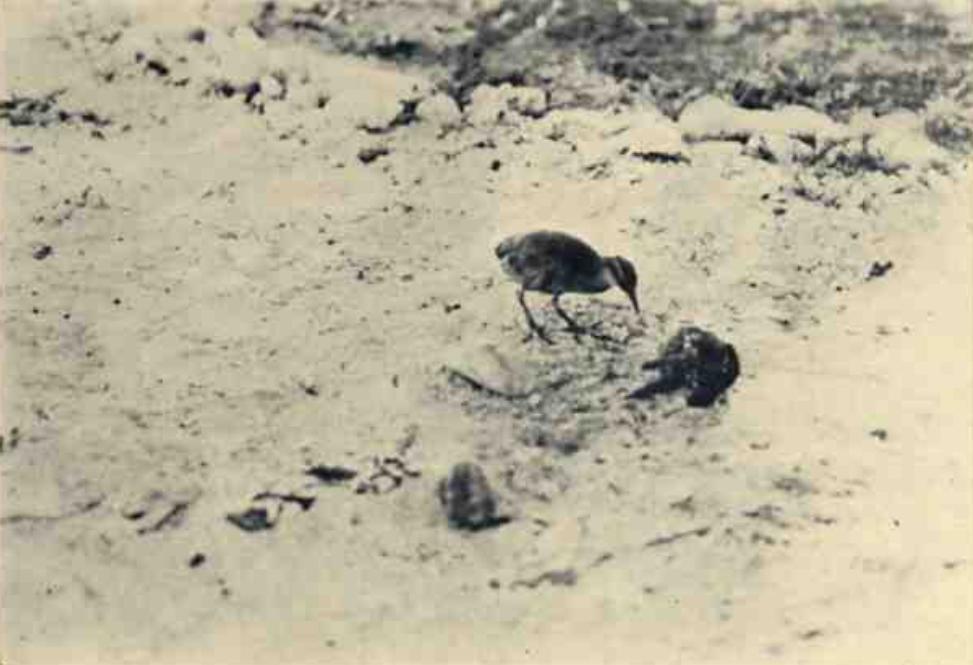
The extinct Wake Island rail or Wake rail (Gallirallus wakensis) is an extinct flightless rail and the only native land bird on the Pacific atoll of Wake. It was found on the islands of Wake and Wilkes, and Peale, which is separated from the others by a channel of about 100 metres (330 ft). It was hunted to extinction during World War II. The species was formerly placed in the genus Hypotaenidia.
From the article Wake Island rail on Wikipedia (CC BY-SA), quoted section by section
Description
The adult bird had a length of 22 cm (9 in). The wing spread was between 8.5 and 10 cm (3 and 4 in). The length of the tail was 4.5 cm (2 in). The culmen was between 2.5 and 2.9 cm (1 and 1 in) and the length of the tarsus was 3.3 to 3.7 cm (1 to 1 in). It was closely related to the buff-banded rail (Gallirallus philippensis) from the Philippines, which is able to fly. Genetic evidence indicates that amongst Gallirallus species it is most closely related to the Roviana rail and the buff-banded rail itself. Its appearance was dark greyish brown on the upperparts as well as on the crown, the lores and the cheeks. It was also characterized by ash brown underparts with striking narrow white bars on the belly, the breast, and the flanks. The upper throat and the chin were whitish. A grey superciliary was drawn from the chin over the top of the eyes to the bill. The bill, legs and feet had a brown hue.
What it does
The ecology of this species is poorly known, though a review published in 2011 has shed more light on its life and subsequent extinction. It was numerous at the time of Lionel Walter Rothschild's first scientific description as Hypotaenidia wakensis in 1903. The Wake Island rail inhabited Cordia subcordata scrubs and fed on molluscs, insects, worms and seeds which it found by digging up leaves and soil with its bill. Since its habitat offered no natural source of fresh water, it is assumed that the bird was able to subsist without drinking. It was seen on Peale islet of Wake in the late 1930 when the Pan American seaplane port and hotel was built. Some of the last museum specimen collections were taken, between 1935 and 1939. It was observed preying on hermit crabs, and for example of photo of nest with four eggs and one being watched was recorded at this time. A few eggs would be laid in shallow bowl of nest with thick vegetation on the ground, and the eggs had a speckled camouflage pattern. The breeding period started with courtship and copulations in late July, with actual nesting not taking place until mid-August. The nest itself was a simple saucer-shaped depression on the ground. Under favourable conditions, it may have managed to rear two broods a year. …
Wikipedia: “Ecology”
Listen
Looking for field recordings…
Where it lives
Recorded sightings
—
geo-referenced records in GBIF, from museums, herbaria and field observers.
Drag the globe to turn it. Dots are where records exist, not a range map; darker means more records.
In the stacks
Searching the stacks…
Every page naming Gallirallus wakensis in the Biodiversity Heritage Library →
This page is assembled live from iNaturalist, GBIF, Wikipedia, the Source Library and the Internet Archive. It is not yet part of the hand-edited codex. iNaturalist taxon 434.