On eBird ↗
Spot-billed Pelican
Live sightings near you, the range map, bar charts of when it is seen, and Macaulay Library photos and recordings.
Spot-billed Pelican
Pelecanus philippensis
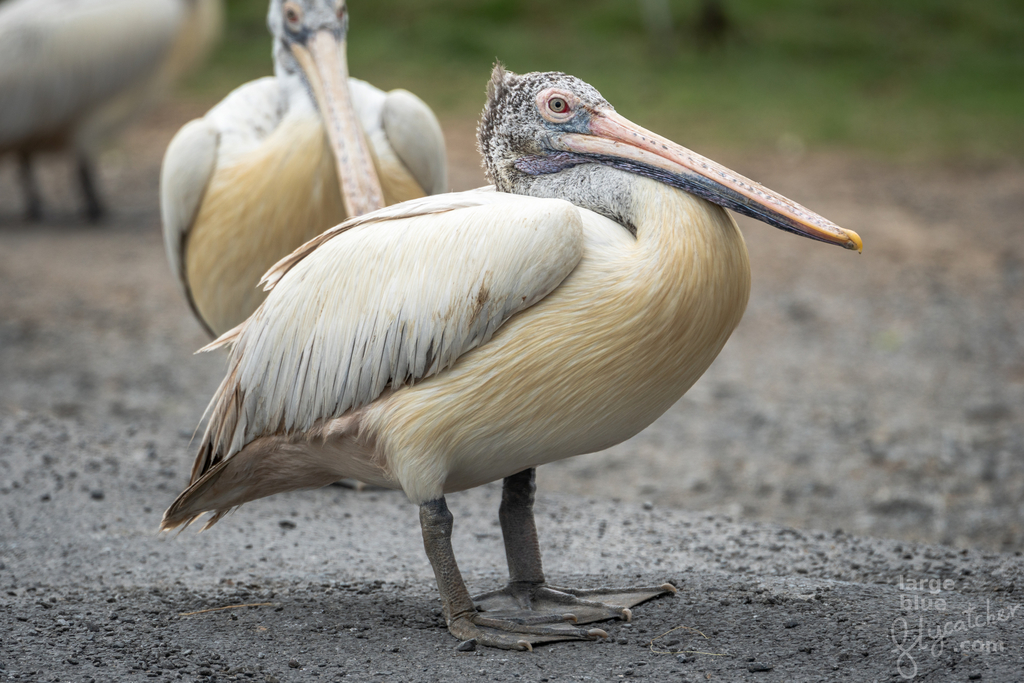
The spot-billed pelican (Pelecanus philippensis) or gray pelican is a member of the pelican family. It breeds in southern Asia from southern Iran across India east to Indonesia. It is a bird of large inland and coastal waters, especially large lakes. At a distance they are difficult to differentiate from other pelicans in the region although it is smaller but at close range the spots on the upper mandible, the lack of bright colours and the greyer plumage are distinctive. In some areas these birds nest in large colonies close to human habitations.
From the article Spot-billed pelican on Wikipedia (CC BY-SA), quoted section by section
Description
The spot-billed pelican is a rather large water bird, often the largest or one of the largest native birds in the southern stretches of its range, albeit it is fairly small for a pelican. It is 125–152 cm (49–60 in) long and a weight of 4.1–6 kg (9.0–13.2 lb). The wingspan can vary from 213 to 250 cm (7 ft 0 in to 8 ft 2 in) while the typically large beak measured from 285 to 355 mm (11.2 to 14.0 in). It is mainly white, with a grey crest, hindneck and a brownish tail. The feathers on the hind neck are curly and form a greyish nape crest. The pouch is pink to purplish and has large pale spots, and is also spotted on the sides of the upper mandible. The tip of the bill (or nail) is yellow to orange. In breeding plumage, the skin at the base of the beak is dark and the orbital patch is pink. In flight they look not unlike the Dalmatian pelican but the tertials and inner secondaries are darker and a pale band runs along the greater coverts. The tail is rounder. The newly hatched young are covered in white down. They then moult into a greyish speckled plumage. The spots on the bill appear only after a year. The full adult breeding plumage appears in their third year.
Range & habitat
The species is found to breed only in peninsular India, Sri Lanka and in Cambodia. A few birds from India are known to winter in the Gangetic plains but reports of its presence in many other parts of the region such as the Maldives, Pakistan and Bangladesh has been questioned. The main habitat is in shallow lowland freshwaters. The spot-billed pelican is not migratory but are known to make local movements and are more widely distributed in the non-breeding season.
This species is a colonial breeder, often breeding in the company of other waterbirds. The nests are on low trees near wetlands and sometimes near human habitations. Many large breeding colonies have been recorded and several have disappeared over time. In June 1906, C E Rhenius visited a colony in Kundakulam in Tirunelveli district where the villages considered the birds semi-sacred. The same colony was revisited in 1944, and was found to have about 10 nests of pelicans and nearly 200 nests of painted stork. The Sittang River in Burma was said by E W Oates to have "millions" of pelicans in 1877 and in 1929 E C Stuart Baker reported that they were still nesting in thousands along with greater adjutant storks:
The whole forest consisted of very large trees, but a portion, about one in twenty, was made up of wood-oil trees, gigantic fellows, 150 feet high and more, and with a smooth branchless trunk of 80 to 100 feet. …
Wikipedia: “Distribution and habitat”
What it does
They are very silent although at their nests they can make hisses, grunts or snap their bills. Some early descriptions of nesting colonies have claimed them to be distinctive in their silence but most have noted colonies as noisy. Like most other pelicans, it catches fish in its huge bill pouch while swimming at the surface. Unlike the great white pelican it does not form large feeding flocks and is usually found to fish singly or in small flocks. Groups may however sometimes line up and drive fish towards the shallows. When flying to their roosts or feeding areas, small groups fly in formation with steady flapping. During the hot part of the day, they often soar on thermals. They may forage at night to some extent. The birds nest in colonies and the nest is a thick platform of twigs placed on a low tree. The breeding season varies from October to May. In Tamil Nadu, the breeding season follows the onset of the northeast monsoon. The courtship display of the males involves a distention of the pouch with swinging motions of the head up and down followed by sideways swings followed by the head being held back over the back. Bill claps may also be produced during the head swaying movements. The nests are usually built alongside other colonial waterbirds, particularly painted storks. Three to four chalky white eggs is the usual clutch. The eggs become dirty with age. …
Wikipedia: “Behaviour and ecology”
In human culture
This species was once used by fishermen in parts of eastern Bengal as decoys for certain fish. These fishermen believed that an oily secretion from the bird attracted certain fish such as Colisa and Anabas. The propensity of these birds to nest close to human habitations has been noted from the time of T C Jerdon:
I have visited on Pelicanry in the Carnatic, where the Pelicans have (for ages I was told) built their rude nests, on rather low trees in the midst of a village, and seemed to care little for the close and constant proximity of human beings. Several colonies have since been discovered and while many of these have vanished others have been protected and a few villages with nesting colonies have become popular tourist attractions. Well known villages with colonies include Kokrebellur, Koothankulam and Uppalapadu.
Wikipedia: “In culture”
Listen
Looking for field recordings…
Where it lives
Recorded sightings
—
geo-referenced records in GBIF, from museums, herbaria and field observers.
Drag the globe to turn it. Dots are where records exist, not a range map; darker means more records.
In the stacks
Searching the stacks…
Every page naming Pelecanus philippensis in the Biodiversity Heritage Library →
This page is assembled live from iNaturalist, GBIF, Wikipedia, the Source Library and the Internet Archive. It is not yet part of the hand-edited codex. iNaturalist taxon 4336.