On eBird ↗
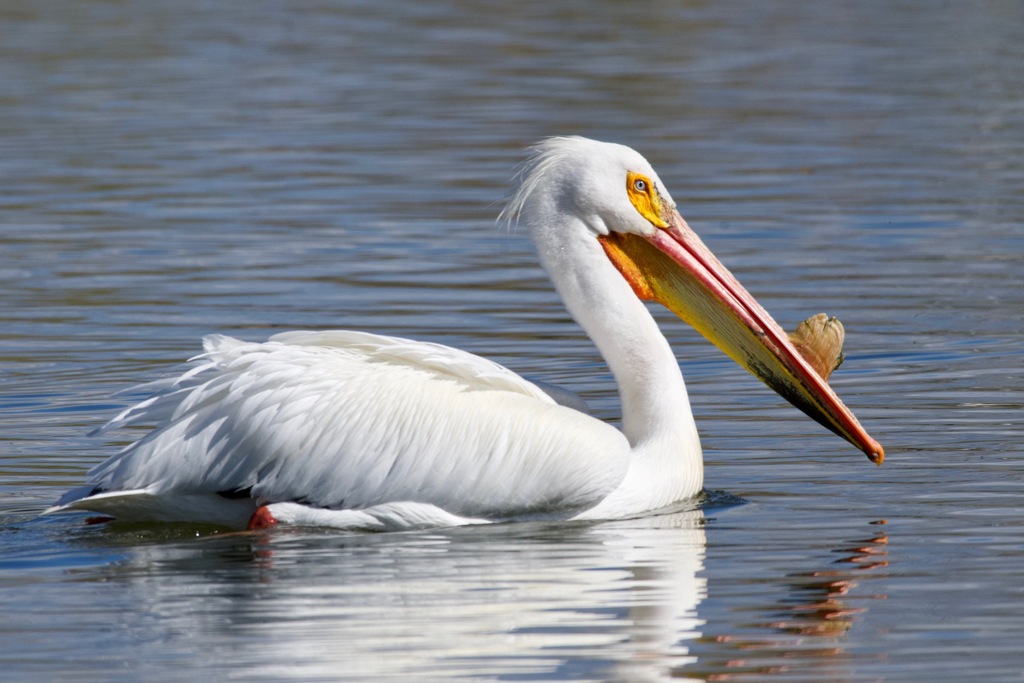
American White Pelican
Live sightings near you, the range map, bar charts of when it is seen, and Macaulay Library photos and recordings.
American White Pelican
Pelecanus erythrorhynchos
The American white pelican (Pelecanus erythrorhynchos) is a large aquatic soaring bird from the order Pelecaniformes. It breeds in interior North America, moving south and to the coasts, as far as Central America and South America, in winter.
From the article American white pelican on Wikipedia (CC BY-SA), quoted section by section
Description
The American white pelican rivals the trumpeter swan, with a similar overall length, as one of the longest birds native to North America. Both very large and plump, it has an overall length of about 50–70 in (130–180 cm), courtesy of the huge beak which measures 11.3–15.2 in (290–390 mm) in males and 10.3–14.2 in (260–360 mm) in females. It has a wingspan of about 95–120 in (240–300 cm). The species also has the second-largest average wingspan of any North American bird, after the California condor. This large wingspan allows the bird to use soaring flight for migration easily. Body weight can range between 7.7 and 30 lb (3.5 and 13.6 kg), although typically these birds average between 11 and 20 lb (5.0 and 9.1 kg). One mean body mass of 15.4 lb (7.0 kg) was reported. Another study found mean weights to be somewhat lower than expected, with eleven males averaging 13.97 lb (6.34 kg) and six females averaging 10.95 lb (4.97 kg). Among standard measurements, the wing chord measures 20–26.7 in (51–68 cm) and the tarsus measures 3.9–5.4 in (9.9–13.7 cm) long. The plumage is almost entirely bright white, except for the black primary and secondary remiges, which are hardly visible except in flight. From early spring until after breeding has finished in mid-late summer, the breast feathers have a yellowish hue. …
Range & habitat
American white pelicans nest in colonies of several hundred pairs on islands in remote brackish and freshwater lakes of inland North America. The most northerly nesting colony can be found on islands in the rapids of the Slave River between Fort Fitzgerald, Alberta and Fort Smith, Northwest Territories. Several groups have been visiting the bird sanctuary at Useless Bay in the state of Washington since 2015. About 10–20% of the population uses Gunnison Island in the Great Basin's Great Salt Lake as a nesting ground. The southernmost colonies are in southeastern Ontario and western Nevada. Approximately 180,000 American white pelicans, which is 40% of the global population, migrate to Canada each spring to breed, nesting from the coast of British Columbia east to Lake of the Woods and Lake Nipigon in Ontario. Of this large number of pelicans, Manitoba holds half. Although seen in numerous regions of the province, including cities, nesting colonies concentrate in Manitoba's three largest bodies of water, Lakes Winnipeg, Manitoba, and Winnipegosis. American white pelicans are a conservation priority in Canada, where efforts are focused on population monitoring and habitat protection. …
Wikipedia: “Distribution and ecology”
Listen
Looking for field recordings…
Where it lives
Recorded sightings
—
geo-referenced records in GBIF, from museums, herbaria and field observers.
Drag the globe to turn it. Dots are where records exist, not a range map; darker means more records.
In the stacks
Searching the stacks…
Every page naming Pelecanus erythrorhynchos in the Biodiversity Heritage Library →
This page is assembled live from iNaturalist, GBIF, Wikipedia, the Source Library and the Internet Archive. It is not yet part of the hand-edited codex. iNaturalist taxon 4334.