On eBird ↗
White-tailed Tropicbird
Live sightings near you, the range map, bar charts of when it is seen, and Macaulay Library photos and recordings.
White-tailed Tropicbird
Phaethon lepturus
The white-tailed tropicbird (Phaethon lepturus) or yellow-billed tropicbird is a tropicbird. It is the smallest of three closely related seabirds of the tropical oceans and smallest member of the order Phaethontiformes. It is found in the tropical Atlantic, western Pacific and Indian Oceans. It also breeds on some Caribbean islands, and a few pairs have started nesting recently on Little Tobago, joining the red-billed tropicbird colony. In addition to the tropical Atlantic, it nests as far north as Bermuda, where it is locally called a "longtail".
From the article White-tailed tropicbird on Wikipedia (CC BY-SA), quoted section by section
Description
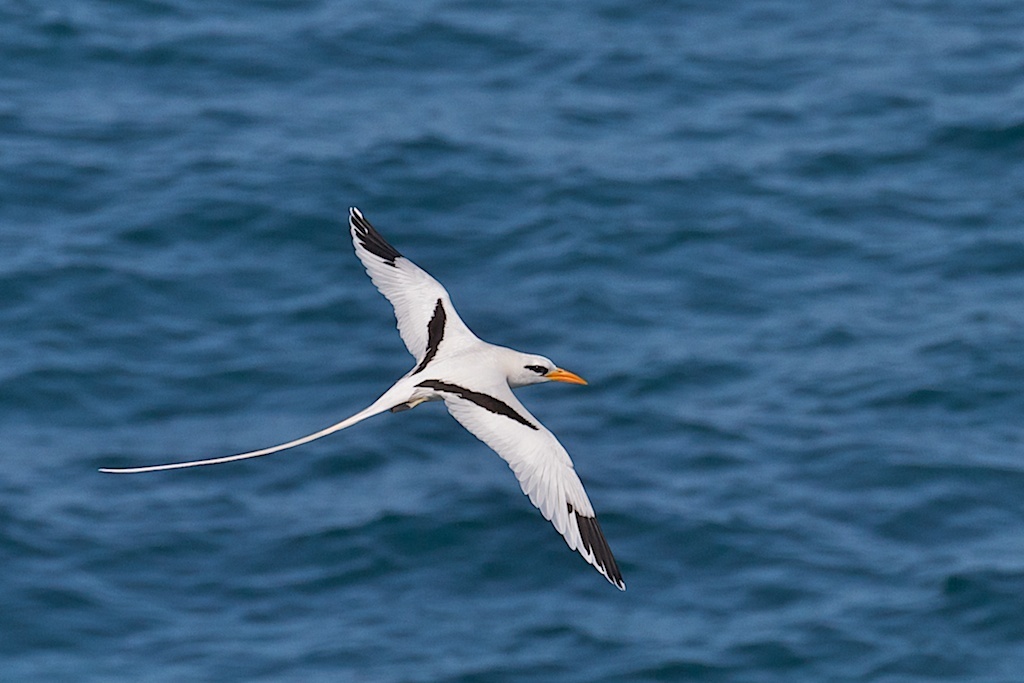
The adult white-tailed tropicbird is a slender, mainly white bird, 71–80 cm (28–31 in) long including the very long central tail feathers, which double its total length. The wingspan is 89–96 cm (35–38 in). The bird has a black band on the inner wing, a black eye-mask, and an orange-yellow to orange-red bill. The bill colour, pure white back and black wing bar distinguish this species from the red-billed tropicbird. The white-tailed tropicbird breeds on tropical islands, laying a single egg directly onto the ground or a cliff ledge. It disperses widely across the oceans when not breeding, and sometimes wanders far. It feeds on fish and squid, caught by surface plunging, but this species is a poor swimmer. The call is a high screamed keee-keee-krrrt-krrt-krrt. Sexes are similar, although males on average are longer tailed, but juveniles lack the tail streamers, have a green-yellow bill, and a finely barred back. The white-tailed tropicbird does not have a yearly breeding cycle; instead, breeding frequency depends on the climate and availability of suitable breeding sites. The bird can reproduce 10 months after the last successful breeding, or 5 months after an unsuccessful one.
What it does
The white-tailed tropicbird feeds mainly on flying fish, squid and crabs. It catches its prey by diving from height of up to 20 meters, as do gannets. However, flying fish are caught in flight. It usually feeds in pairs. Prey is often detected by hovering above the surface as the bird swallows it before taking off.
Wikipedia: “Behavior”
In human culture
The ancient Chamorro people called the white-tailed tropicbird utak or itak, and believed that when it screamed over a house it meant that someone would soon die or that an unmarried girl was pregnant. Its call would kill anyone who did not believe in it. Chamorro fishermen would find schools of fish by watching them.
Wikipedia: “Folklore”
Listen
Looking for field recordings…
Where it lives
Recorded sightings
—
geo-referenced records in GBIF, from museums, herbaria and field observers.
Drag the globe to turn it. Dots are where records exist, not a range map; darker means more records.
In the stacks
Searching the stacks…
Every page naming Phaethon lepturus in the Biodiversity Heritage Library →
This page is assembled live from iNaturalist, GBIF, Wikipedia, the Source Library and the Internet Archive. It is not yet part of the hand-edited codex. iNaturalist taxon 4314.