- Animals
- ›Chordates
- ›Vertebrates
- ›Birds
- ›Gannets, Cormorants, and Allies
- ›Cormorants and Shags
- ›Phalacrocorax
On eBird ↗
Pied Cormorant
Live sightings near you, the range map, bar charts of when it is seen, and Macaulay Library photos and recordings.
Pied Cormorant
Phalacrocorax varius
The Australian pied cormorant (/ˌpaɪd ˈkɔːrmərənt/ PYD KOR-mər-ənt), Phalacrocorax varius, also known as the pied cormorant, pied shag, or great pied cormorant, is a medium-sized member of the cormorant family. It is found around the coasts of Australasia. In New Zealand it is usually known either as the pied shag or by its Māori name of Karuhiruhi. Older sources may refer to it as the "yellow-faced cormorant".
From the article Australian pied cormorant on Wikipedia (CC BY-SA), quoted section by section
Description
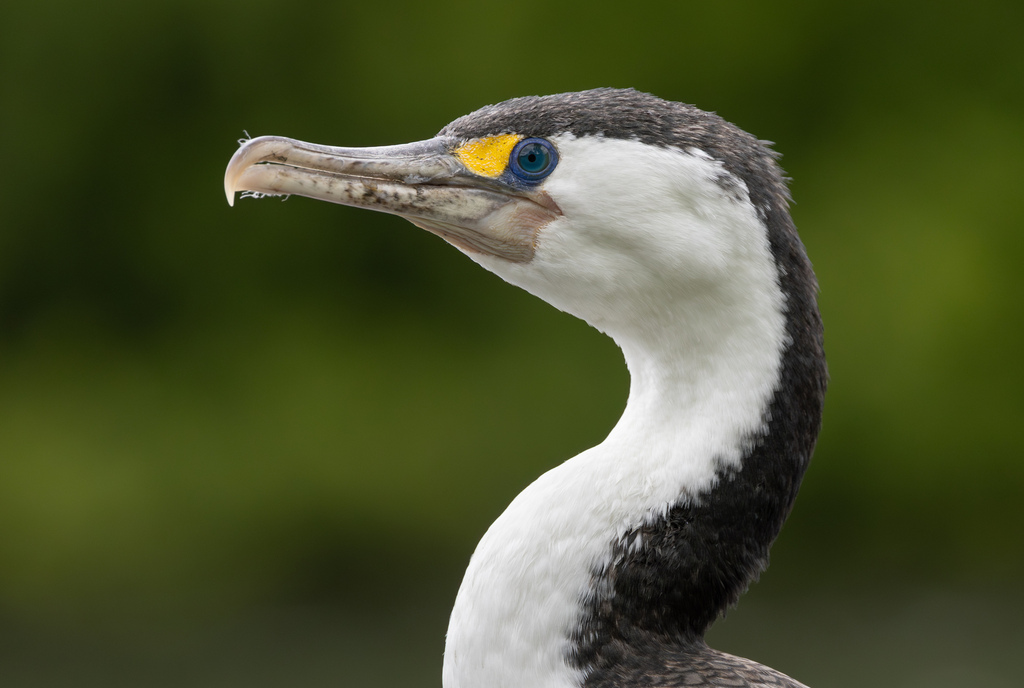
The pied cormorant is predominantly black on its back and upper surface of the wings and white on the underside with males weighing approximately 2.2 kg (4.9 lb) and females 1.7 kg (3.7 lb). It stands between 65 and 85 cm (26 and 33 in) tall, with a wingspan of 110–130 cm (43–51 in). A small yellow patch between the bill and the eye on each side of the head is likely to have been the reason for the historical common name. It has large webbed feet which it utilises to pursue fish underwater, steering with half opened wings. The bird has a large hooked bill, green eyes with a blue eye ring and black legs and feet. The eyes have a special nictitating membrane for underwater protection. The pied cormorant can often be seen spreading its wings after diving to help dry the feathers, as it has inadequate waterproofing. This lack of feather waterproofing may help the cormorant spend longer underwater due to decreased buoyancy effects. The two subspecies have slight differences in physical characteristics. Similar species include the black-faced cormorant (slightly smaller) and the little pied cormorant (substantially smaller).
Range & habitat
The pied cormorant is listed of least concern in the IUCN red list of threatened species, reflecting its large range with a relatively stable population. In New Zealand its range on the east coast extends as far south as Christchurch, though this is a recent extension—older books report it no further south than Kaikōura. The range extensions have accompanied population recovery from heavy persecution in the early 1900s and likely represents recolonization of the former range. The pied cormorant is listed as Nationally Vulnerable in New Zealand. The population has been growing from around 700 breeding pairs in the 1950s to an estimated 3,000 pairs post 2000 (Refer to population trend data). In Australia it is only moderately common in the eastern states (both the coast and inland wetlands), but abundant in the south-west, particularly along the coast. Its federal conservation status is 'secure' and only changes to 'near threatened' in Victoria. It can be found in all states except Tasmania. The pied cormorant has been calculated to be at high-moderate risk from fishing – particularly from set and inshore drift nets. Birds in colonies can often be observed entangled in recreational fishing line with hooks embedded in the body. …
Wikipedia: “Distribution and habitat”
What it does
The pied cormorant appears to feed largely (90%) on benthic fish 6–15 cm in length from waters less than 10m deep. King George Whiting juveniles are known to be eaten. Other dietary components (10%) are made up of crustaceans such as prawns and shrimp with some molluscs and cephalopods. It will dive both in shallow, still water and in rapidly moving currents. Typical dive times are around 40 seconds, with a recovery period of 10–15 seconds between dives although this is dependent on depth. The birds feed in deep and shallow waters (although shallow habitats are more productive) with flock densities in proportion to the prey abundance. Hunting is typically performed as individuals (potentially to avoid kleptoparasitism), although larger groups can be observed when schools of small fish are close to the surface. Risk of predation by sharks and the abundance of food comprise a trade-off where the pied cormorant may choose to hunt in deeper waters where prey is less abundant if the risk is too high during warmer months when sharks are present more often. The deeper waters however require longer dive times and corresponding longer times at rest between dives on the surface.
Wikipedia: “Feeding”
In human culture
The Noongar Aboriginal people who live in the south-west corner of Western Australia believe that the pied cormorant (medi) is responsible for the transport of souls of the deceased across and beneath the Western sea to their final resting place (Kurannup). Medi can be translated as 'agent', or 'medium', possibly referring to the bird's role as an intermediary between the living world and the afterlife. Spirits of the deceased rest for an unspecified time on the moojar (WA Christmas tree) before being carried by easterly winds or flowing waters to the sea where the spirit joins with the medi for its journey to Kurranup.
Wikipedia: “Noongar culture”
Listen
Looking for field recordings…
Where it lives
Recorded sightings
—
geo-referenced records in GBIF, from museums, herbaria and field observers.
Drag the globe to turn it. Dots are where records exist, not a range map; darker means more records.
In the stacks
Searching the stacks…
Every page naming Phalacrocorax varius in the Biodiversity Heritage Library →
This page is assembled live from iNaturalist, GBIF, Wikipedia, the Source Library and the Internet Archive. It is not yet part of the hand-edited codex. iNaturalist taxon 4304.