- Animals
- ›Chordates
- ›Vertebrates
- ›Ray-finned Fishes
- ›Carps, Characins, Catfishes and Allies
- ›Minnows, Suckers, Carps, and Loaches
- ›Carps and Minnows
- ›Cyprinids
- ›Typical Carps
- ›Carassius
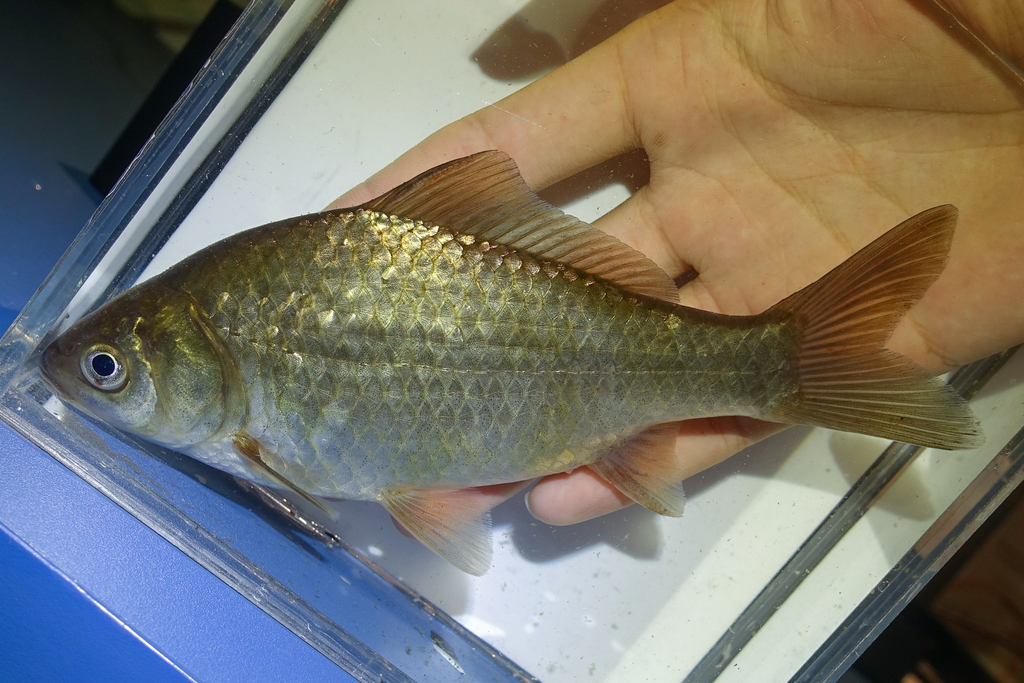
Japanese Silver Crucian Carp
Carassius langsdorfii
The ginbuna (Carassius langsdorfii), sometimes referred to as silver crucian carp or Japanese silver crucian carp, is a species of freshwater fish in the carp family (family Cyprinidae). It is native to lakes and rivers in Japan.
From the article Ginbuna on Wikipedia (CC BY-SA), quoted section by section
Description
Ginbuna is a deep- and thick-bodied fish with a terminal mouth and a large caudal fin. It possesses 5 anal fin rays, 41–57 gill rakers, and has 28–31 large lateral line scales. It reaches a maximum length of 39 centimetres (15 in). This species is parasitized by myxozoan cnidarians of the genus Myxobolus, which infest their gills.
Range & habitat
The ginbuna is native to Japan, where it is widespread, but has been introduced to many other parts of the world. In Europe it has been confirmed in the Elbe River system in the Czech Republic, Greece, Germany, Ukraine, Italy, and the Neretva basin in Bosnia and Herzegovina. Haplotype data indicates that European ginbuna derive from populations in either Honshu Island or the Ryukyu Islands, suggesting multiple introduction events. Additionally, a 2018 study using mtDNA discovered the fish in Lake Tahoe, California and in a pond on the campus of the University of British Columbia, the first time this species has been found in North America. Also in 2020, this species was reported for the first time in Iran after several specimens were collected from Siah Palas stream in Lar National Park. This is also the first record of this species from the Asian mainland. These introductions may have been a result of ginbuna being unintentionally included with imports of goldfish or koi carp. It is a demersal species, favoring confluences of tributaries and still downstream waters of rivers, as well as marshes. Muddy substrates are preferred.
Wikipedia: “Distribution and habitat”
What it does
Ginbuna are omnivorous. They eat benthic organisms, algae, zooplankton, and will opportunistically consume other items.
Wikipedia: “Diet”
In human culture
The fish is believed to be named in honor of Georg Heinrich von Langsdorff, a Prussian naturalist and diplomat posted to Japan, who either collected or supplied holotype.
Wikipedia: “Etymology”
Where it lives
Recorded sightings
—
geo-referenced records in GBIF, from museums, herbaria and field observers.
Drag the globe to turn it. Dots are where records exist, not a range map; darker means more records.
In the stacks
Searching the stacks…
Every page naming Carassius langsdorfii in the Biodiversity Heritage Library →
This page is assembled live from iNaturalist, GBIF, Wikipedia, the Source Library and the Internet Archive. It is not yet part of the hand-edited codex. iNaturalist taxon 424998.