- Animals
- ›Chordates
- ›Vertebrates
- ›Ray-finned Fishes
- ›Spiny-rayed fishes
- ›Butterflyfishes, Angelfishes, and Allies
- ›Seabreams and Porgies
- ›Cymatoceps
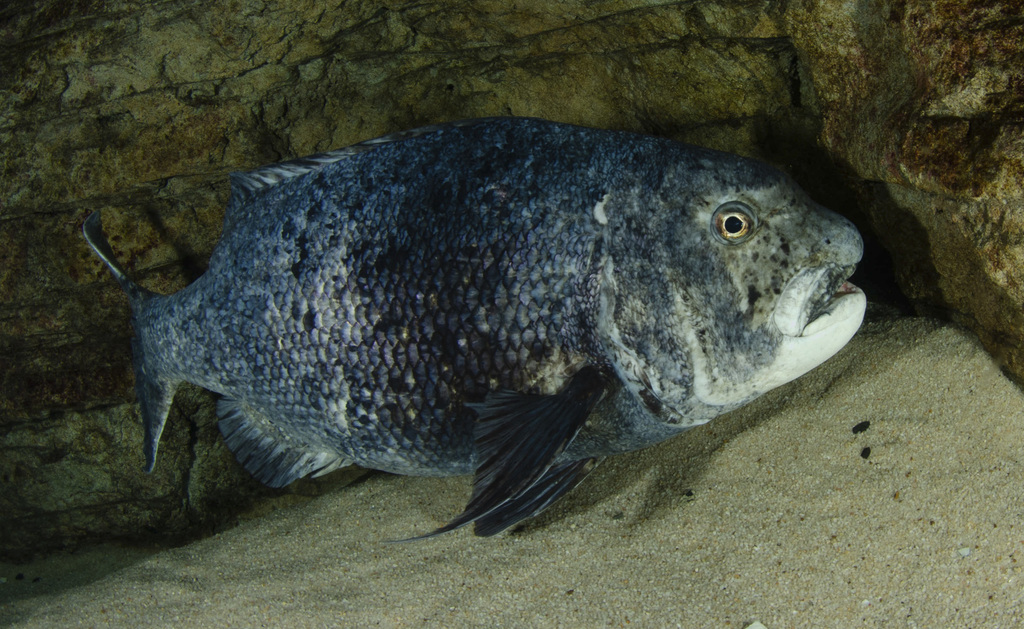
Black Musselcracker
Cymatoceps nasutus
The black musselcracker (Cymatoceps nasutus) is a South African species of marine fish in the family Sparidae. It is the only species of its genus Cymatoceps. It reaches 1.5 m (4 ft 11 in) in length and almost 35 kg (77 lb) in weight. It is found in coastal rocky areas to depths of 80 m (260 ft), and feeds on hard-shelled invertebrates such as crabs and sea urchins.
From the article Black musselcracker on Wikipedia (CC BY-SA), quoted section by section
Description
The black musselcracker is distinguished from other genera in the Sparidae by having scales on the area between the eyes and on the bases of the soft rayed parts of the dorsal and anal fins. The flange on the preoperculum is partially covered with scales. The dorsal fin is supported by 12 spines and 10 soft rays while the anal fin is supported by 3 spines and 9 soft rays. The body is moderately deep and compressed, its standard length being between 2.3 and 2.5 times its depth. The dorsal profile of the head is gently sloping but in large adults develop a fleshy process on the snout and a hump before the eyes. The scales are ctenoid, larger below the lateral line than above it. The overall colour of adults is dull dark grey with the chin and belly being bright white> The juveniles are dark greenish brown in colour on the body with irregular white mottling. This species has a maximum published total length of 150 cm (59 in) and a maximum published weight of 34.4 kg (76 lb).
Range & habitat
The black musselcracker is endemic to South Africa where it is found from northern KwaZulu-Natal to False Bay. It has been reported from Maputo Bay in Mozambique but it is unknown from line or trap fisheries in Maputo. It is found at depths between 1 and 80 m (3 ft 3 in and 262 ft 6 in) and occurs in shallow rocky areas, rarely entering estuaries.
Wikipedia: “Distribution and habitat”
In human culture
The black musselcracker has the generic name Cymatoceps which is a combination of cymatos, meaning "swelling" or "bump", and ceps, meaning "head". This was not explained by Castelnau but it is thought to be an allusion to the large fleshy, protuberance on the snouts of the larger adults. The specific name nasutus means "large-nosed", also a reference to the large fleshy, protuberance on the snout.
Wikipedia: “Etymology”
Where it lives
Recorded sightings
—
geo-referenced records in GBIF, from museums, herbaria and field observers.
Drag the globe to turn it. Dots are where records exist, not a range map; darker means more records.
In the stacks
Searching the stacks…
Every page naming Cymatoceps nasutus in the Biodiversity Heritage Library →
This page is assembled live from iNaturalist, GBIF, Wikipedia, the Source Library and the Internet Archive. It is not yet part of the hand-edited codex. iNaturalist taxon 424571.