- Animals
- ›Arthropods
- ›Hexapods
- ›Insects
- ›Winged and Once-winged Insects
- ›Ants, Bees, Wasps, and Sawflies
- ›Narrow-waisted Wasps, Ants, and Bees
- ›Ants, Bees, and Stinging Wasps
- ›Vespoid Wasps
- ›Hornets, Paper Wasps, Potter Wasps, and Allies
- ›Paper Wasps
- ›Ropalidiini
- ›Ropalidia
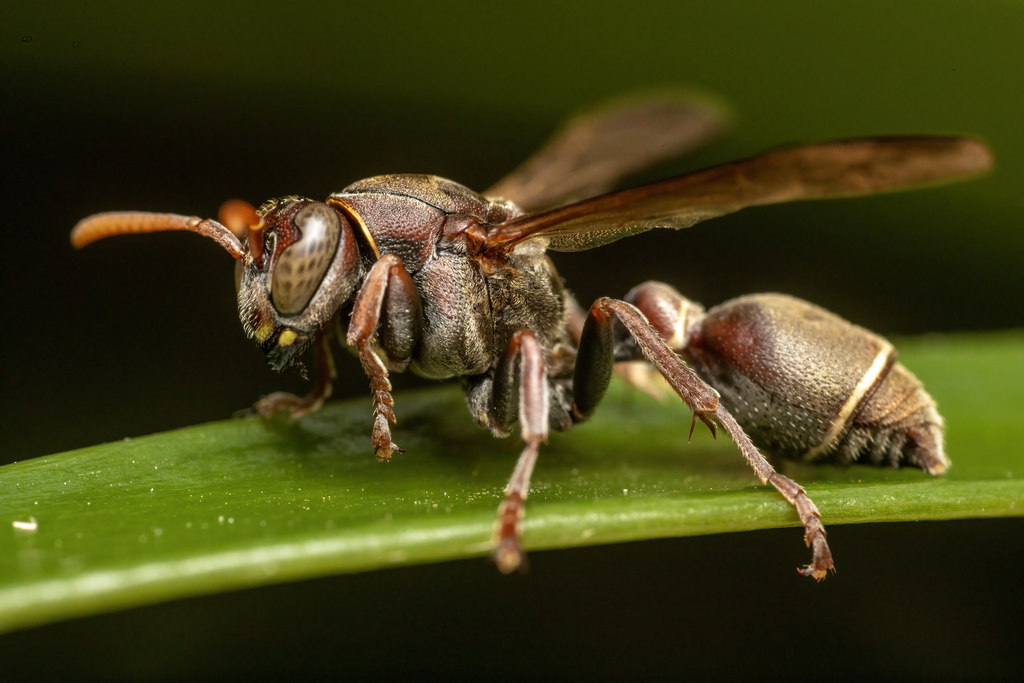
White-faced Brown Paper Wasp
Ropalidia plebeiana
Ropalidia plebeiana is a eusocial temperate paper wasp. It is unique, as it is the only temperate wasp in the typically tropical Ropalidia genus. R. plebeiana is widely distributed in eastern Australia, and recently have been found making huge nest aggregations, with thousands of nests on trunks of trees, in south-eastern New South Wales.
From the article Ropalidia plebeiana on Wikipedia (CC BY-SA), quoted section by section
Description
R. plebeiana is a white-faced, brown paper wasp. It is a medium-size paper wasp, with a reddish-brown-colored body. There are small, thin white rings on its shoulders, waist, and abdomen. Nests of R. plebeiana are seen as a horizontal single comb with an irregular shape, and they are grayish brown in color. Nests have been found to have 1–3 males and anywhere from 13 to 28 females. R. plebeiana nests have been found to have about 40 cells, which have transparent windows, with about 20 larvae and eggs at any point. The central cells of the nest are where the cocoons and larvae are found, and these cells are usually longer than the peripheral cells that contain eggs. The nests are seen to congregate in central areas in a “city” type atmosphere. Cooperation has been witnessed between different nest combs, and each separate nest comb is occupied by a single colony.
Wikipedia: “Description and identification”
Range & habitat
R. plebeiana is widely distributed in Australia. It is found mainly in New South Wales and the Capital Territory, but they are also found in southern Queensland. Brisbane is generally considered to be the northern boundary of the species distribution. However, R. plebeiana can also be found north of Brisbane, further inland in tropical highland areas as well, such as the Atherton Tableland. R. plebeiana builds its nest in aggregations, which are often formed under bridges and under overhanging rocks. These aggregations are made of separate nests that are built side by side. They were often built over running water.R. plebeiana with nests in Canberra are not aggregated.
Wikipedia: “Distribution and habitat”
What it does
In R. plebeiana, the regular nestmates do not direct any dominance or aggressive acts. Some dominance acts that the top dominant female conducted were “dart at another but stop short.” They also attack new wasps coming to the nest. The top dominant female can mount the new wasps body and tried to sting them repeatedly in order to get them to leave the nest. The attacked wasp made a particular posture when attacked, tried to integrate into the nest, and successfully did so. Sometimes, when females land on strange combs in a nest aggregation, they immediately leave without being attacked. Other dominance acts exhibited by females were pecking, mounting, and biting. Sometimes these fights resulted in a loss of wing ability.
Wikipedia: “Dominant behavior”
Listen
Looking for field recordings…
Where it lives
Recorded sightings
—
geo-referenced records in GBIF, from museums, herbaria and field observers.
Drag the globe to turn it. Dots are where records exist, not a range map; darker means more records.
In the stacks
Searching the stacks…
Every page naming Ropalidia plebeiana in the Biodiversity Heritage Library →
This page is assembled live from iNaturalist, GBIF, Wikipedia, the Source Library and the Internet Archive. It is not yet part of the hand-edited codex. iNaturalist taxon 424227.