- Animals
- ›Chordates
- ›Vertebrates
- ›Mammals
- ›Therians
- ›Placental Mammals
- ›Ungulates, Carnivorans, and Allies
- ›Even-toed Ungulates and Cetaceans
- ›Ruminants
- ›Deer
- ›New World Deer
- ›True New World Deer and Caribou
- ›Odocoileus
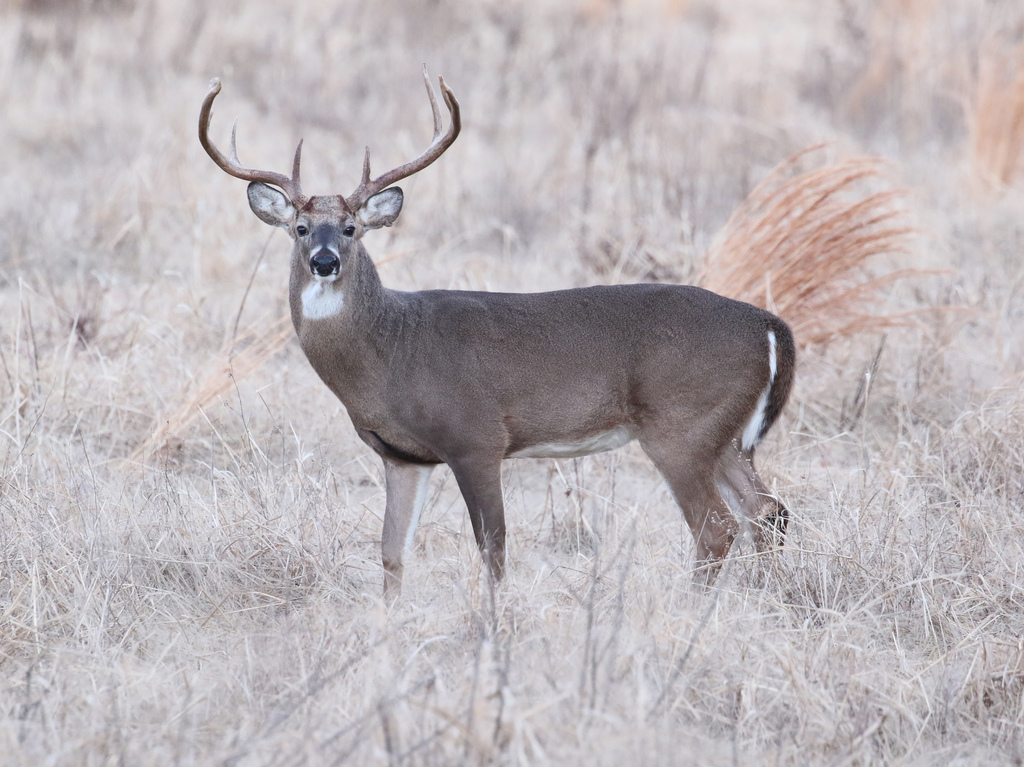
White-tailed Deer
Odocoileus virginianus
The white-tailed deer (Odocoileus virginianus), also known commonly as the whitetail and the Virginia deer, is a medium-sized species of deer native to North and South America. It is the most widely distributed mainland ungulate herbivore in the Americas; coupled with its natural predator, the mountain lion (Puma concolor), it is one of the most widely distributed terrestrial mammal species in the Americas and the world. Highly adaptable, the various subspecies of white-tailed deer inhabit many different ecosystems, from arid grasslands to the Amazon and Orinoco basins; from the Llanos to the high-elevation terrain of the Andes.
From the article White-tailed deer on Wikipedia (CC BY-SA), quoted section by section
Description
The white-tailed deer's coat is a reddish-brown in the spring and summer, and turns to a grey-brown throughout the fall and winter. The white-tailed deer can be recognized by the characteristic white underside to its tail. It raises its tail when it is alarmed to warn the predator that it has been detected. An indication of a deer's age is the length of the snout and the color of the coat, with older deer tending to have longer snouts and grayer coats. A population of white-tailed deer in New York is entirely white except for the nose and hooves – not albino – in color. The former Seneca Army Depot in Romulus, New York, has the largest known concentration of white deer. Strong conservation efforts have allowed white deer to thrive within the confines of the depot. The white-tailed deer's horizontally slit pupil allows for good night vision and color vision during the day. Whitetails process visual images at a much more rapid rate than humans and are better at detecting motion in low-light conditions.
Size and weight. The white-tailed deer is highly variable in size, generally following both Allen's rule and Bergmann's rule that the average size is larger farther away from the equator. …
Range & habitat
In North America, the white-tailed deer is very common (even considered a nuisance in some areas) in states to the east and south of the Rocky Mountains, including southwestern Arizona, with the exception of the American West Coast and Baja California Peninsula, where its ecological niche is filled by the black-tailed deer (in the Pacific Northwest) or the mule deer (Odocoileus hemionus) from that point west except for mixed deciduous riparian corridors, river valley bottomlands, and lower foothills of the northern Rocky Mountain region from Wyoming west to eastern Washington and eastern Oregon, and north to northeastern British Columbia and southern Yukon, including in the Montana valley and foothill grasslands. The westernmost population of the species, known as the Columbian white-tailed deer, was once widespread in the mixed forests along the Willamette and Cowlitz River valleys of western Oregon and southwestern Washington, but current numbers are considerably reduced, and it is classified as near-threatened by the IUCN. This population is separated from other white-tailed deer populations. Texas is home to by far the most individual white-tailed deer of all U.S. states, Canadian provinces, or Latin American countries, with an estimated population of 5.3 million, with both wild deer and farmed herds, the latter raised for large rack size and breeding. …
Wikipedia: “Distribution”
What it does
White-tailed deer are generalists and can adapt to a wide variety of habitats. The largest deer occur in the temperate regions of North America. The northern white-tailed deer (O. v. borealis), Dakota white-tailed deer (O. v. dacotensis), and northwest white-tailed deer (O. v. ochrourus) are some of the largest animals, with large antlers. The smallest deer occur in the Florida Keys and in partially wooded lowlands in the Neotropics. Although most often thought of as forest animals depending on relatively small openings and edges, white-tailed deer can equally adapt themselves to life in more open prairie, savanna woodlands, and sage communities as in the Southwestern United States and northern Mexico. These savanna-adapted deer have relatively large antlers in proportion to their body size and large tails. Also, a noticeable difference exists in size between male and female deer of the savannas. The Texas white-tailed deer (O. v. texanus), of the prairies and oak savannas of Texas and parts of Mexico, are the largest savanna-adapted deer in the Southwest, with impressive antlers that might rival deer found in Canada and the northern United States. Populations of Arizona (O. v. couesi) and Carmen Mountains (O. v. carminis) white-tailed deer inhabit montane mixed oak and pine woodland communities. …
Wikipedia: “Ecology”
At the table
When species are introduced to foreign ecosystems, they could potentially wreak havoc on the existing food web. For example, when the deer moved north in Alberta, gray wolf populations increased. This butterfly effect was also demonstrated in Yellowstone National Park when the rivers changed because wolves were re-introduced to the ecosystem. It is also possible that the increasing white-tailed deer populations could result in them becoming an invasive species for various plants in Alberta, Canada.
Wikipedia: “Food web”
In human culture
In the U.S., the species is the state animal of Arkansas, Georgia, Illinois, Michigan, Mississippi, Nebraska, New Hampshire, Ohio, Pennsylvania, and South Carolina, the game animal of Oklahoma, and the wildlife symbol of Wisconsin. The white-tailed deer is also the inspiration of the professional basketball team the Milwaukee Bucks. The profile of a white-tailed deer buck caps the coat of arms of Vermont, is on the flag of Vermont, and is in stained glass at the Vermont State House. It is the national animal of Honduras and Costa Rica and the provincial animal of Canadian Saskatchewan and Finnish Pirkanmaa. It appears on the reverse side of the Costa Rican 1,000 colón note. The 1942 Disney film adaptation of Bambi, famously changed Bambi's species from the novel's roe deer into a white-tailed deer.
Wikipedia: “Cultural significance”
Listen
Looking for field recordings…
Where it lives
Recorded sightings
—
geo-referenced records in GBIF, from museums, herbaria and field observers.
Drag the globe to turn it. Dots are where records exist, not a range map; darker means more records.
In the stacks
Searching the stacks…
Every page naming Odocoileus virginianus in the Biodiversity Heritage Library →
This page is assembled live from iNaturalist, GBIF, Wikipedia, the Source Library and the Internet Archive. It is not yet part of the hand-edited codex. iNaturalist taxon 42223.