- Animals
- ›Chordates
- ›Vertebrates
- ›Mammals
- ›Therians
- ›Placental Mammals
- ›Ungulates, Carnivorans, and Allies
- ›Even-toed Ungulates and Cetaceans
- ›Ruminants
- ›Deer
- ›Cervinae
- ›Typical Old World Deer
- ›Cervus
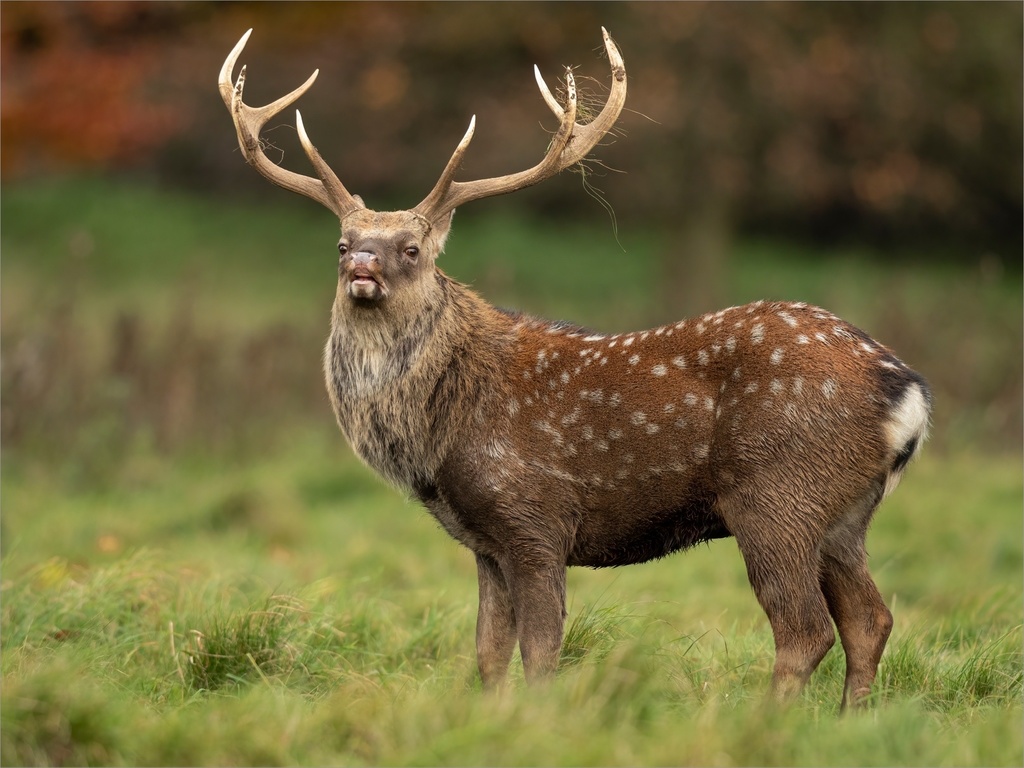
Sika Deer
Cervus nippon
The sika deer (Cervus nippon), also known as the northern spotted deer or the Japanese deer, is a species of deer native to much of East Asia and introduced to other parts of the world. Previously found from northern Vietnam in the south to the Russian Far East in the north, it was overhunted to the brink of extinction in the 19th century. Protection laws were enacted in the mid-20th century, leading to a rapid recovery of their population from the 1950s to the 1980s.
From the article Sika deer on Wikipedia (CC BY-SA), quoted section by section
Description
The sika deer is one of the few deer species that does not lose its spots upon reaching maturity. Spot patterns vary with region. The mainland subspecies have larger and more obvious spots, in contrast to the Taiwanese and Japanese subspecies, whose spots are nearly invisible. Many introduced populations are from Japan, so they also lack significant spots. The color of the pelage ranges from mahogany to black, and white individuals are also known. During winter, the coat becomes darker and shaggier and the spots less prominent, and a mane forms on the back of the males' necks. They are medium-sized herbivores, though they show notable size variation across their several subspecies and considerable sexual dimorphism, with males invariably much larger than females. They can vary from 50 to 110 cm (20 to 45 in) tall at the shoulder and from 95 to 180 cm (35 to 70 in) in head-and-body length. The tail measures about 7.5–13 cm (3–5 in) long. The largest subspecies is the Manchurian sika deer (C. n. mantchuricus), in which males commonly weigh about 68–109 kg (150–240 lb) and females weigh 45–50 kg (100–110 lb), with large stags scaling up to 160 kg (350 lb), although Yezo sika deer bulls weighing up to 170 or 200 kg (370 or 440 lb) have been recorded. On the other end of the size spectrum, in the Japanese sika deer (C. n. …
Range & habitat
Sika deer are found in the temperate and subtropical forests of eastern Asia, preferring areas with dense understory and occasional clearings and where snowfall does not exceed 10–20 cm (4–8 in), though in their native range, they have been known to frequent areas with a maximum snow depth up to 50 cm (19.6 in). They tend to forage in patchy clearings of forests. Introduced populations are found in areas with similar habitats to their native ranges, including Western and Central Europe, Eastern United States, and New Zealand.
Wikipedia: “Habitat”
What it does
Sika deer can be active throughout the day, though in areas with heavy human disturbance, they tend to be nocturnal. Seasonal migration is known to occur in mountainous areas, such as Japan, with winter ranges being up to 700 m (2,300 ft) lower in elevation than summer ranges. Lifestyles vary between individuals, with some occurring alone, while others are found in single-sex groups. Large herds gather in autumn and winter. Males spend most years alone, occasionally forming herds together. Females with fawns only form herds during birthing season. The sika deer is a highly vocal species, with over 10 individual sounds, ranging from soft whistles to loud screams. Sika males are territorial and keep harems of females during their rut, which peaks from early September through November, but may last well into the winter. Territory size varies with habitat type and size of the buck; strong, prime bucks may hold up to 2 ha (5 acres). Territories are marked by a series of shallow pits or "scrapes", which is digging holes (up to 1.6 m in wide and 0.3 m in deep) with forefeet or antlers, into which the males urinate and from which emanates a strong, musky odor. Fights between rival males for territorial disputes, which occur by using hooves and antlers, are sometimes fierce and long and may even be fatal. The gestation period lasts for seven months. …
Wikipedia: “Behavior”
In human culture
The name "sika deer" comes from shika (鹿), the Japanese word for "deer", and in Japan, the species is known as the nihonjika (ニホンジカ (日本鹿), "Japan deer"). In Chinese, it is known as Chinese: 梅花鹿; pinyin: méihuālù, "plum blossom deer", referring to the white fur spots on the deer's back resembling plum blossoms.
Wikipedia: “Etymology”
Listen
Looking for field recordings…
Where it lives
Recorded sightings
—
geo-referenced records in GBIF, from museums, herbaria and field observers.
Drag the globe to turn it. Dots are where records exist, not a range map; darker means more records.
In the stacks
Searching the stacks…
Every page naming Cervus nippon in the Biodiversity Heritage Library →
This page is assembled live from iNaturalist, GBIF, Wikipedia, the Source Library and the Internet Archive. It is not yet part of the hand-edited codex. iNaturalist taxon 42210.