- Animals
- ›Chordates
- ›Vertebrates
- ›Mammals
- ›Therians
- ›Placental Mammals
- ›Ungulates, Carnivorans, and Allies
- ›Even-toed Ungulates and Cetaceans
- ›Ruminants
- ›Deer
- ›Plesiometacarpal Deer
- ›Muntjacs and Tufted Deer
- ›Muntiacus
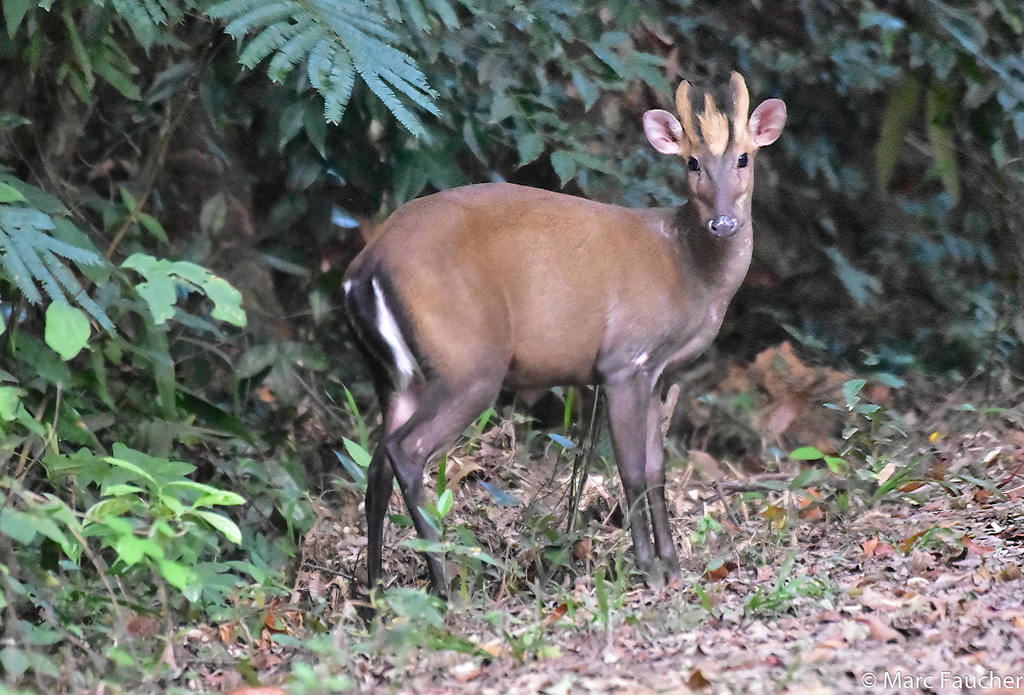
Fea's Muntjac
Muntiacus feae
The Fea's muntjac or Tenasserim muntjac (Muntiacus feae) is a rare species of muntjac native to southern Myanmar and Thailand. It is a similar size to the common muntjac (adult weight is 18 – 21 kg (40 - 46 lb)). It is diurnal and solitary, inhabiting upland evergreen, mixed or shrub forest (at an altitude of 2500 m (8200')) with a diet of grasses, low-growing leaves, and tender shoots. The young are usually born in dense vegetation, remaining
From the article Fea's muntjac on Wikipedia (CC BY-SA), quoted section by section
Description
Fea's muntjac has a brown, dark orange, or gray coat. The limbs and posterior tail are black. A lighter yellow-hued triangular patch extends down from the forehead with darker fur stretching from the muzzle to the orbital glands under the eyes. Two black lines extend down from the horns. Fea's muntac weighs around 25kg. The holotype specimen (a male) was 88cm in length, not including the tail. It is larger and lighter in color than the Gongshan muntjac (Muntiacus gongshanensis), with which its range overlaps. It is similar in size to the red muntjac (Muntiacus vaginalis), with which it may also overlap but can be distinguished by its black tail.
Wikipedia: “Morphology”
Range & habitat
Fea's muntjac lives along the border between Myanmar and Thailand. The species has also been observed in southwestern China and Tibet, however these veracity of these identifications have been called into question by the International Union for the Conservation of Nature (best known for creating the IUCN red list); the assessors note that many of the published reports predate the description of Muntiacus gongshanensis and suggest that that individuals from this then-unknown species may have been misidentified as M. feae. There is limited data on the species' distribution, with most data derived from camera trap sightings. The species seems to occur predominantly in evergreen forests and is more prevalent in wetter than in drier forests. Relatively little is known about the ecology of Fea's muntjac. Limited evidence has suggested that Fea's muntjac is generally solitary. It is known to feed on fruits and leaves but is likely omnivorous like others in its genus.
Wikipedia: “Distribution and ecology”
Listen
Looking for field recordings…
Where it lives
Recorded sightings
—
geo-referenced records in GBIF, from museums, herbaria and field observers.
Drag the globe to turn it. Dots are where records exist, not a range map; darker means more records.
In the stacks
Searching the stacks…
Every page naming Muntiacus feae in the Biodiversity Heritage Library →
This page is assembled live from iNaturalist, GBIF, Wikipedia, the Source Library and the Internet Archive. It is not yet part of the hand-edited codex. iNaturalist taxon 42191.