- Animals
- ›Chordates
- ›Vertebrates
- ›Mammals
- ›Therians
- ›Placental Mammals
- ›Ungulates, Carnivorans, and Allies
- ›Even-toed Ungulates and Cetaceans
- ›Ruminants
- ›Deer
- ›Plesiometacarpal Deer
- ›Muntjacs and Tufted Deer
- ›Muntiacus
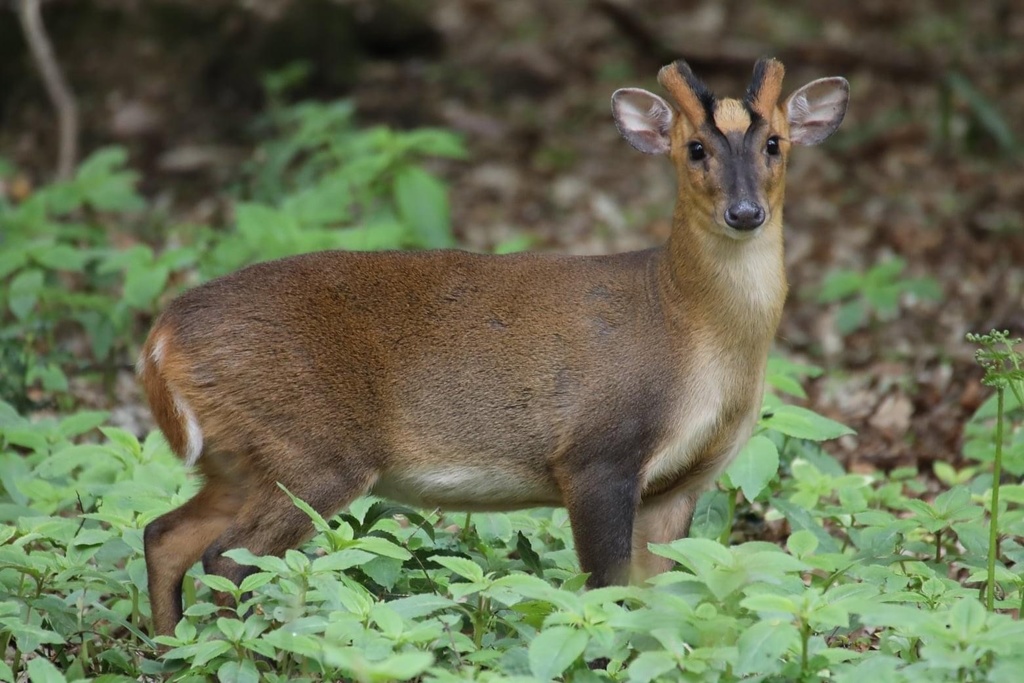
Reeves's Muntjac
Muntiacus reevesi
The Reeves's muntjac (Muntiacus reevesi; Chinese: 山羌) is a muntjac species found widely in southeastern China (from Gansu to Yunnan) and Taiwan. It has also been introduced in Belgium, the Netherlands, the United Kingdom (south England, the Midlands, east Wales), Ireland, and Japan. It takes its name from John Reeves, an employee of the British East India Company in the 19th century.
From the article Reeves's muntjac on Wikipedia (CC BY-SA), quoted section by section
Description
Reeves's muntjac grows to 0.5 m (1 ft 8 in) high at the shoulder and 0.95 m (3 ft 1 in) in length, plus a short tail up to 4 in (10 cm) long. It weighs between 10 and 18 kg (22 and 40 lb) when fully grown. It is reddish-brown in appearance with striped markings on its face. The belly is creamy-white, with lighter fur extending to the neck, chin, and the underside of the tail. The males have short antlers, usually 4 in (10 cm) or less, and long upper canines (tusks), usually about 2 in (5.1 cm) long. Females have bony lumps on their foreheads and localised black spots. The Taiwanese subspecies (M. r. micrurus), commonly known as the Formosan Reeves's muntjac, is darker than other subspecies.
Range & habitat
It is widely found in south-eastern China (from Gansu to Yunnan) and Taiwan. It has also been introduced in several other regions.
Continental Europe. It has been introduced in Belgium and seen in the Netherlands. Populations were once present in France, but this is no longer the case as of 2020. In Europe, this species is included since 2016 in the list of Invasive Alien Species of Union concern (the Union list). This implies that this species cannot be imported, bred, transported, commercialised, or intentionally released into the environment in the whole of the European Union.
Great Britain. Reeves's muntjacs were first introduced to the UK in the early 19th century. In the late 19th century, the then Duke of Bedford brought some to Woburn Abbey in Bedfordshire, then in 1901 released them into the surrounding woods. A few more probably escaped from the nearby Whipsnade Zoo. During the mid-20th century, Woburn conducted several deliberate releases in distant locations throughout England. It is suspected that there were also other unrecorded releases or escapes from private collections. These releases later caused misperception that muntjacs spread very rapidly. …
Wikipedia: “Distribution”
What it does
Reeves's muntjac feeds on herbs, blossoms, succulent shoots, fungi, berries, grasses, and nuts, and has also been reported to eat tree bark. Eggs and carrion are eaten opportunistically. It is also called the barking deer due to its distinctive barking sound, though this name is also used for other species of muntjacs. The barking sound is common during mating or when provoked. Its preferred habitats are forest and shrubland. It is a solitary and crepuscular animal. Both males and females defend small territories that they mark with preorbital gland secretions that are thought to be pheromonal in nature. When fighting, males first use their antlers to push enemies off balance so they can wound them with their 2 in (5.1 cm) upper canine teeth.
Wikipedia: “Behaviour”
Listen
Looking for field recordings…
Where it lives
Recorded sightings
—
geo-referenced records in GBIF, from museums, herbaria and field observers.
Drag the globe to turn it. Dots are where records exist, not a range map; darker means more records.
In the stacks
Searching the stacks…
Every page naming Muntiacus reevesi in the Biodiversity Heritage Library →
This page is assembled live from iNaturalist, GBIF, Wikipedia, the Source Library and the Internet Archive. It is not yet part of the hand-edited codex. iNaturalist taxon 42187.