- Animals
- ›Chordates
- ›Vertebrates
- ›Mammals
- ›Therians
- ›Placental Mammals
- ›Ungulates, Carnivorans, and Allies
- ›Even-toed Ungulates and Cetaceans
- ›Ruminants
- ›Deer
- ›Plesiometacarpal Deer
- ›Muntjacs and Tufted Deer
- ›Muntiacus
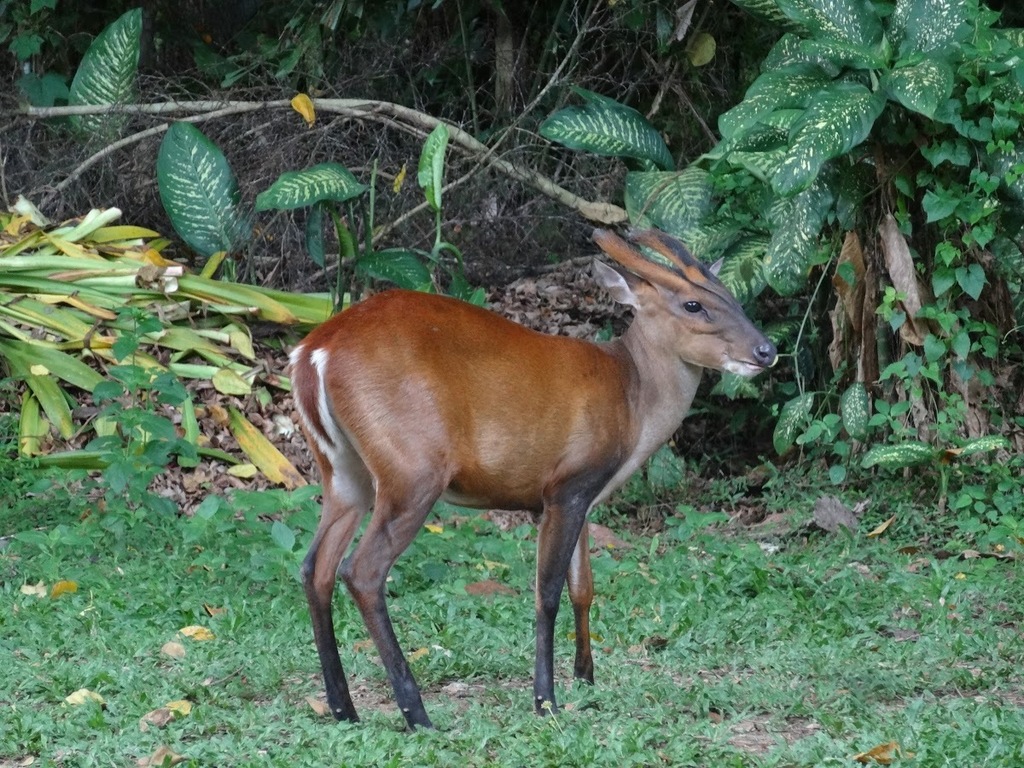
Southern Red Muntjac
Muntiacus muntjak
The southern red muntjac (Muntiacus muntjak) is a deer species native to Southeast Asia. It was formerly known as the Indian muntjac or the common muntjac before the species was taxonomically revised to represent only populations of Thailand, Sunda and perhaps Malaysia. The other populations being attributed to this species are now attributed to Muntiacus vaginalis (northern red muntjac). Muntjacs are also referred to as barking deer. It is listed as Least Concern on the IUCN Red List.
This muntjac has soft, short, brownish or grayish hair, sometimes with creamy markings. It is among the smallest deer species. It is an omnivore and eats grass, fruit, shoots, seeds, bird eggs, and small animals, and occasionally scavenges on carrion. Its calls sound like barking, often when frightened by a predator (such as pythons, tigers, leopards, and crocodiles), hence the common name "barking deer". Males have canines, short antlers that usually branch just once near the base, and a large postorbital scent gland used to mark territories.
From the article Southern red muntjac on Wikipedia (CC BY-SA), quoted section by section
Description
The southern red muntjac has a short but very soft, thick, dense coat that is more dense in cooler regions. Its face is darker and the limbs are dark to reddish brown and the coat color seasonally varies from darker brown to yellowish and grayish brown and is white ventrally. Its ears have much less hair, but otherwise are the same color as the rest of the head. Male muntjacs have short antlers, about 10 cm (3.9 in) long, that protrude from long body hair-covered pedicels above the eyes. Females have tufts of fur and small bony knobs instead of antlers. Males also have elongated 2–4 cm (0.79–1.57 in) long, slightly curved upper canines, which can be used in male-male conflicts and inflict serious injury. The body length of muntjacs varies from 89 to 135 cm (35 to 53 in) with a 13 to 23 cm (5.1 to 9.1 in) long tail, and shoulder height ranging from 40 to 65 cm (16 to 26 in). Adults weigh between 13 and 35 kg (29 and 77 lb), with males being larger than females. Muntjacs are unique among the deer, having large, obvious facial (preorbital, in front of the eyes) scent glands used to mark territories or to attract females. Males have larger glands than females.
Wikipedia: “Characteristics”
Range & habitat
The southern red muntjac (previously known as the common muntjac) is found in the Malay Peninsula, Sumatra, Java, Bali and Borneo. It is also assumed to be present in peninsular Thailand and southwestern Myanmar. It is locally extinct in Singapore. This species is mostly associated with low-density forest habitats, but can also be found in heavily degraded forest and in areas of forest near plantations of coffee, cassava, rubber, sugarcane, coconut and teak. It is adaptable to areas altered by logging and appears to benefit from agricultural conversion of forest edges. In young acacia plantations (under 4 years old) in the Bintulu Division of Sarawak, East Malaysia, southern red muntjacs (along with other muntjac species) are some of the most commonly camera-trapped species. Footprints are commonly found in newly-planted areas and nearby remnant patches of forest and muntjacs have been seen browsing on young acacia shoots. In Danum Valley, Borneo, an area with minimal hunting, it has been observed to increase in population density following deforestation.
Wikipedia: “Distribution and habitat”
What it does
The Southern red muntjac is also called "barking deer" due to the bark-like sound that it makes as an alarm when danger is present. Other than during the rut and for the first six months after giving birth, the adult muntjac is a solitary animal. Adult males in particular are well spaced and marking grass and bushes with secretions from their preorbital glands appears to be involved in the acquisition and maintenance of territory.
Reproduction. The Southern red muntjac is suspected to be polygamous. Females become sexually mature during their first to second year of life, but without a specific breeding season. They are polyestrous, with each cycle lasting about 14 to 21 days and an estrus lasting for two days. The gestation period is 6–7 months and they usually bear one offspring at a time, but sometimes produce twins. Females usually give birth in dense growth so that they are hidden from the rest of the herd and predators. The young leaves its mother after about 6 months to establish its own territory. Males often fight between one another for possession of a harem of females. Adults exhibit relatively large home range overlap both intersexually and intrasexually, meaning that strict territorialism does not occur but some form of site-specific dominance exists.
Wikipedia: “Ecology and behavior”
Listen
Looking for field recordings…
Where it lives
Recorded sightings
—
geo-referenced records in GBIF, from museums, herbaria and field observers.
Drag the globe to turn it. Dots are where records exist, not a range map; darker means more records.
In the stacks
Searching the stacks…
Every page naming Muntiacus muntjak in the Biodiversity Heritage Library →
This page is assembled live from iNaturalist, GBIF, Wikipedia, the Source Library and the Internet Archive. It is not yet part of the hand-edited codex. iNaturalist taxon 42186.