- Animals
- ›Chordates
- ›Vertebrates
- ›Mammals
- ›Therians
- ›Placental Mammals
- ›Ungulates, Carnivorans, and Allies
- ›Carnivorans
- ›Canids
- ›Cuon
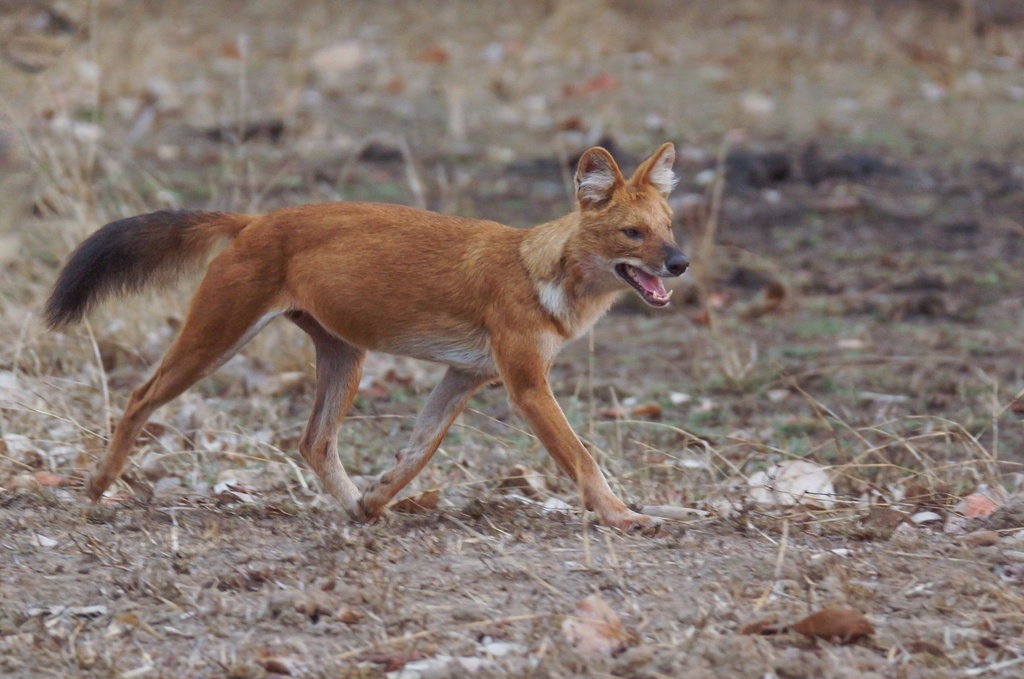
Dhole
Cuon alpinus
The dhole ( dohl; Cuon alpinus) is a canid native to South, East and Southeast Asia. The sole member of the genus Cuon, it is anatomically distinguished from members of the genus Canis in several aspects: its skull is convex rather than concave in profile, it lacks a third lower molar, and the upper molars possess only a single cusp as opposed to between two and four. During the Pleistocene, the dhole ranged throughout Asia, with its range also extending into Europe (with a single putative, controversial record also reported from North America) but became restricted to its historical range 12,000–18,000 years ago. It is now extinct in Central Asia, parts of Southeast Asia, and possibly the Korean Peninsula and Russia.
The dhole is a highly social animal, living in large clans without rigid dominance hierarchies and containing multiple breeding females. Such clans usually consist of about 12 individuals, but groups of over 40 are known. It is a diurnal pack hunter which preferentially targets large and medium-sized ungulates. In tropical forests, the dhole competes with the tiger (Panthera tigris) and the leopard (Panthera pardus), targeting somewhat different prey species, but still with substantial dietary overlap.
From the article Dhole on Wikipedia (CC BY-SA), quoted section by section
Description
The general tone of the dhole's fur is reddish, with the brightest hues appearing in winter. During the winter coat phase, the back is covered in a saturated rusty-red to reddish color, featuring brownish highlights along the top of the head, neck, and shoulders. The throat, chest, flanks, belly, and upper parts of the limbs are less vividly colored, exhibiting a more yellowish tone. The lower parts of the limbs are whitish, with dark brownish bands on the anterior sides of the forelimbs. The muzzle and forehead are greyish-reddish. The tail is very luxurious and fluffy, mainly a reddish-ocher color, with a dark brown tip. The summer coat is shorter, coarser, and darker. The dorsal and lateral guard hairs in adults measure 20–30 mm (0.79–1.18 in) in length. Dholes in the Moscow Zoo moult once a year from March to May. A melanistic individual was recorded in the northern Coimbatore Forest Division in Tamil Nadu.
The dhole has a wide and massive skull with a well-developed sagittal crest, and its masseter muscles are highly developed compared to other canid species, giving the face an almost hyena-like appearance. The rostrum is shorter than that of domestic dogs and most other canids. It has six rather than seven lower molars. …
Wikipedia: “Characteristics”
Range & habitat
Historically, the dhole lived in Singapore and throughout Central Asia including Afghanistan, Kyrgyzstan, Kazakhstan, Mongolia, Tajikistan and Uzbekistan, though it is now considered to be regionally extinct in these regions. Historical record in South Korea from the Veritable Records of the Joseon Dynasty also indicate that the dhole once inhabited Yangju in Gyeonggi Province, but it is now also extinct in South Korea, with the last known capture reports in 1909 and 1921 from Yeoncheon of Gyeonggi Province. The current presence of dholes in North Korea and Pakistan is considered uncertain. The dholes also once inhabited the alpine steppes extending into Kashmir to the Ladakh area, though they disappeared from 60% of their historic range in India during the past century. In India, Myanmar, Indochina, Indonesia and China, it prefers forested areas in alpine zones and is occasionally sighted in plains regions. In the Bek-Tosot Conservancy of southern Kyrgyzstan, the possible presence of the dholes was considered likely based on genetic samples collected in 2019. This was the first record of dholes from the country in almost three decades. The dhole might still be present in the Tunkinsky National Park in extreme southern Siberia near Lake Baikal. …
Wikipedia: “Distribution and habitat”
What it does
Dholes produce whistles resembling the calls of red foxes, sometimes rendered as coo-coo. How this sound is produced is unknown, though it is thought to help in coordinating the pack when travelling through thick brush. When attacking prey, they emit screaming KaKaKaKAA sounds. Other sounds include whines (food soliciting), growls (warning), screams, chatterings (both of which are alarm calls) and yapping cries. In contrast to wolves, dholes do not howl or bark. Dholes have a complex body language. Friendly or submissive greetings are accompanied by horizontal lip retraction and the lowering of the tail, as well as licking. Playful dholes open their mouths with their lips retracted and their tails held in a vertical position whilst assuming a play bow. Aggressive or threatening dholes pucker their lips forward in a snarl and raise the hairs on their backs, as well as keep their tails horizontal or vertical. When afraid, they pull their lips back horizontally with their tails tucked and their ears flat against the skull.
Social and territorial behaviour. Dholes are more social than gray wolves, and have less of a dominance hierarchy, as seasonal scarcity of food is not a serious concern for them. In this manner, they closely resemble African wild dogs in social structure. …
Wikipedia: “Ecology and behaviour”
In human culture
The etymology of "dhole" is unclear. The possible earliest written use of the word in English occurred in 1808 by soldier Thomas Williamson, who encountered the animal in Ramghur district, India. He stated that dhole was a common local name for the species. In 1827, Charles Hamilton Smith claimed that it was derived from a language spoken in 'various parts of the East'. Two years later, Smith connected this word with Turkish: deli 'mad, crazy', and erroneously compared the Turkish word with Old Saxon: dol and Dutch: dol (cfr. also English: dull; German: toll), which are in fact from the Proto-Germanic *dwalaz 'foolish, stupid'. Richard Lydekker wrote nearly 80 years later that the word was not used by the natives living within the species' range. The Merriam-Webster Dictionary theorises that it may have come from the Kannada: ತೋಳ, romanized: tōḷa, lit. 'wolf'. Other English names for the species include Asian wild dog, Asiatic wild dog, Indian wild dog, whistling dog, red dog, and red wolf.
Wikipedia: “Etymology and naming”
Listen
Looking for field recordings…
Where it lives
Recorded sightings
—
geo-referenced records in GBIF, from museums, herbaria and field observers.
Drag the globe to turn it. Dots are where records exist, not a range map; darker means more records.
In the stacks
Searching the stacks…
Every page naming Cuon alpinus in the Biodiversity Heritage Library →
This page is assembled live from iNaturalist, GBIF, Wikipedia, the Source Library and the Internet Archive. It is not yet part of the hand-edited codex. iNaturalist taxon 42101.