- Animals
- ›Chordates
- ›Vertebrates
- ›Mammals
- ›Therians
- ›Placental Mammals
- ›Ungulates, Carnivorans, and Allies
- ›Carnivorans
- ›Canids
- ›Chrysocyon
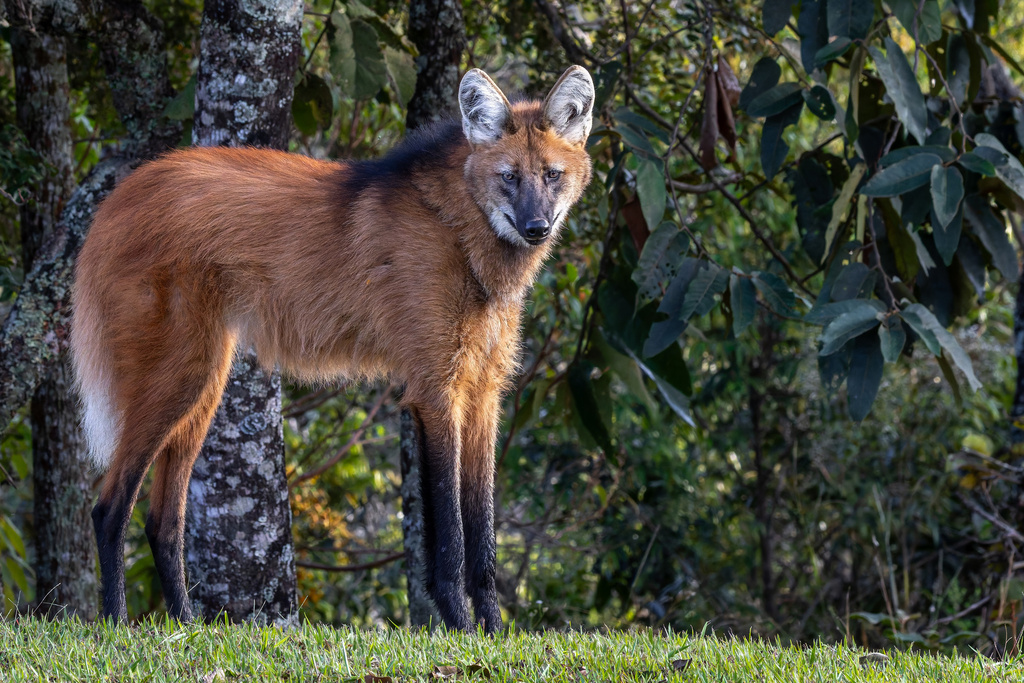
Maned Wolf
Chrysocyon brachyurus
The maned wolf (Chrysocyon brachyurus) is a large canine of South America. It is found in Argentina, Brazil, Bolivia, Peru, and Paraguay, and is almost locally extinct in Uruguay. Its markings resemble those of a red fox but it is neither a fox nor a wolf. It is the only species in the genus Chrysocyon (from Greek χρῡσο-κύων [chrúso-kúōn], "golden dog"). The maned wolf's young pups appear to have darker fur than the bronze, grown ones.
It is the largest canine in South America, weighing 20–30 kg (44–66 lb) and up to 110 cm (43 in) at the withers. Its slender legs and dense reddish coat give it a distinctive appearance. The maned wolf is a crepuscular and omnivorous animal adapted to the open environments of the South American savanna, with an important role in the seed dispersal of fruits, especially the wolf apple (Solanum lycocarpum). The maned wolf is a solitary animal. It communicates primarily by scent marking, but also gives a loud call known as "roar-barking".
From the article Maned wolf on Wikipedia (CC BY-SA), quoted section by section
Description
The species was described in 1815 by Johann Karl Wilhelm Illiger, initially as Canis brachyurus. Lorenz Oken classified it as Vulpes cancosa, and only in 1839 did Charles Hamilton Smith describe the genus Chrysocyon. Other authors later considered it as a member of the Canis genus. Fossils of Chrysocyon dated from the Late Pleistocene and Holocene epochs were collected in one of Peter Wilheim Lund expeditions to Lagoa Santa, Minas Gerais (Brazil). The specimen is kept in the South American Collection of the Zoologisk Museum in Denmark. Since no other record exists of fossils in other areas, the species is suggested to have evolved in this geographic region. The maned wolf bears minor similarities to the red fox, although it belongs to a different genus and is considerably larger and differently built. The average adult weighs 23 kg (51 lb) and stands up to 110 cm (43 in) tall at the shoulder, and has a head-body length of 100 cm (39 in), with the tail adding another 45 cm (18 in). Its ears are large and long 18 cm (7.1 in). The maned wolf is the tallest of the wild canids; its long legs are probably an adaptation to the tall grasslands of its native habitat. Fur of the maned wolf may be reddish-brown to golden orange on the sides with long, black legs and a distinctive black mane. …
What it does
Their mating season ranges from November to April. Gestation lasts 60 to 65 days, and a litter may have from two to six black-furred pups, each weighing roughly 450 g (16 oz). Pups are fully grown when one year old. During that first year, the pups rely on their parents for food. Data on the maned wolf's estrus and reproductive cycle mainly come from captive animals, particularly about breeding endocrinology. Hormonal changes of maned wolves in the wild follow the same variation pattern of those in captivity. Females ovulate spontaneously, but some authors suggest that the presence of a male is important for estrus induction. Captive animals in the Northern Hemisphere breed between October and February and in the Southern Hemisphere between August and October. This indicates that photoperiod plays an important role in maned wolf reproduction, mainly due to the production of semen. Generally, one estrus occurs per year. The amount of sperm produced by the maned wolf is lower compared to those of other canids. Copulation occurs during the four-day estrus period, and lasts up to 15 minutes. Courtship is similar to that of other canids, characterized by frequent approaches and anogenital investigation. Gestation lasts 60 to 65 days and a litter may have from two to six pups. One litter of seven has been recorded. …
Wikipedia: “Reproduction and life cycle”
In human culture
The term maned wolf is an allusion to the mane of the nape. It is known locally as aguara guasu (meaning "large fox") in the Guarani language, or kalak in the Toba Qom language, lobo-guará in Portuguese, and lobo de crín, lobo de los esteros, aguará guazú, or lobo colorado in Spanish. The term lobo, "wolf", originates from the Latin lupus. Guará and aguará originated from Tupi-Guarani agoa'rá, "by the fuzz". It also is called borochi in Bolivia.
Wikipedia: “Etymology”
Listen
Looking for field recordings…
Where it lives
Recorded sightings
—
geo-referenced records in GBIF, from museums, herbaria and field observers.
Drag the globe to turn it. Dots are where records exist, not a range map; darker means more records.
In the stacks
Searching the stacks…
Every page naming Chrysocyon brachyurus in the Biodiversity Heritage Library →
This page is assembled live from iNaturalist, GBIF, Wikipedia, the Source Library and the Internet Archive. It is not yet part of the hand-edited codex. iNaturalist taxon 42091.