- Animals
- ›Chordates
- ›Vertebrates
- ›Mammals
- ›Therians
- ›Placental Mammals
- ›Ungulates, Carnivorans, and Allies
- ›Carnivorans
- ›Canids
- ›Dusicyon
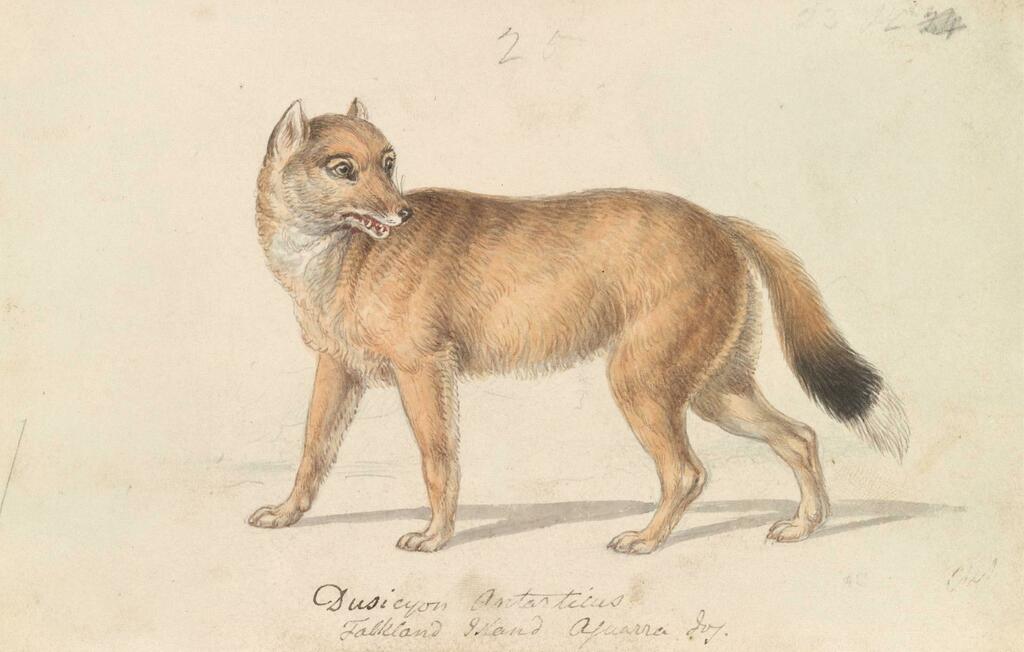
Falkland Warrah
Dusicyon australis
The Falkland Islands wolf (Dusicyon australis), also known as the warrah or the Falkland Islands fox, was the only native land mammal of the Falkland Islands. This endemic canid became extinct in 1876.
It was once believed that the most closely related genus was South American fox (Lycalopex), including the culpeo, a fox-like mammal which was introduced to the Falkland Islands in modern times. A 2009 cladistic analysis of DNA identified the Falkland Islands wolf's closest living relative as the maned wolf (Chrysocyon brachyurus), an unusually long-legged, fox-like South American canid, from which it separated about 6.7 million years ago. However, the Falkland Islands wolf diverged from its mainland ancestor Dusicyon avus only around 16,000 years ago. Dusicyon avus persisted on the South American mainland until around 400 years ago.
From the article Falkland Islands wolf on Wikipedia (CC BY-SA), quoted section by section
In human culture
The first recorded sighting of a Falkland Islands wolf was by Captain John Strong in 1690. Captain Strong took one on his ship. However, during the voyage back to Europe, it became frightened by the firing of the ship's cannon and jumped overboard. Louis Antoine de Bougainville, who established the first settlement in the Falkland Islands termed it a loup-renard ("wolf-fox").
When Charles Darwin visited the islands in 1833 he found the species present in both West and East Falkland and tame. However, at the time of his visit, the Falkland Islands wolf was already very rare on East Falkland, and its numbers were declining rapidly on West Falkland. By 1865, the Falkland Islands wolf was no longer found on the eastern part of East Falkland. Darwin predicted it would be extinct like the dodo within "a very few years." The Falkland Islands wolf was hunted for its valuable fur and settlers who regarded the wolf as a threat to their sheep poisoned it. However, the belief that Falkland Islands wolf was a threat to sheep was probably due to the sheep mistaking the Falkland Islands wolves for dogs (especially at night), and, in terror, the sheep ran into bogs and swamps, where they became lost. …
Wikipedia: “History”
Listen
Looking for field recordings…
Where it lives
Recorded sightings
—
geo-referenced records in GBIF, from museums, herbaria and field observers.
Drag the globe to turn it. Dots are where records exist, not a range map; darker means more records.
In the stacks
Searching the stacks…
Every page naming Dusicyon australis in the Biodiversity Heritage Library →
This page is assembled live from iNaturalist, GBIF, Wikipedia, the Source Library and the Internet Archive. It is not yet part of the hand-edited codex. iNaturalist taxon 42085.