- Animals
- ›Chordates
- ›Vertebrates
- ›Mammals
- ›Therians
- ›Placental Mammals
- ›Ungulates, Carnivorans, and Allies
- ›Carnivorans
- ›Canids
- ›Canis
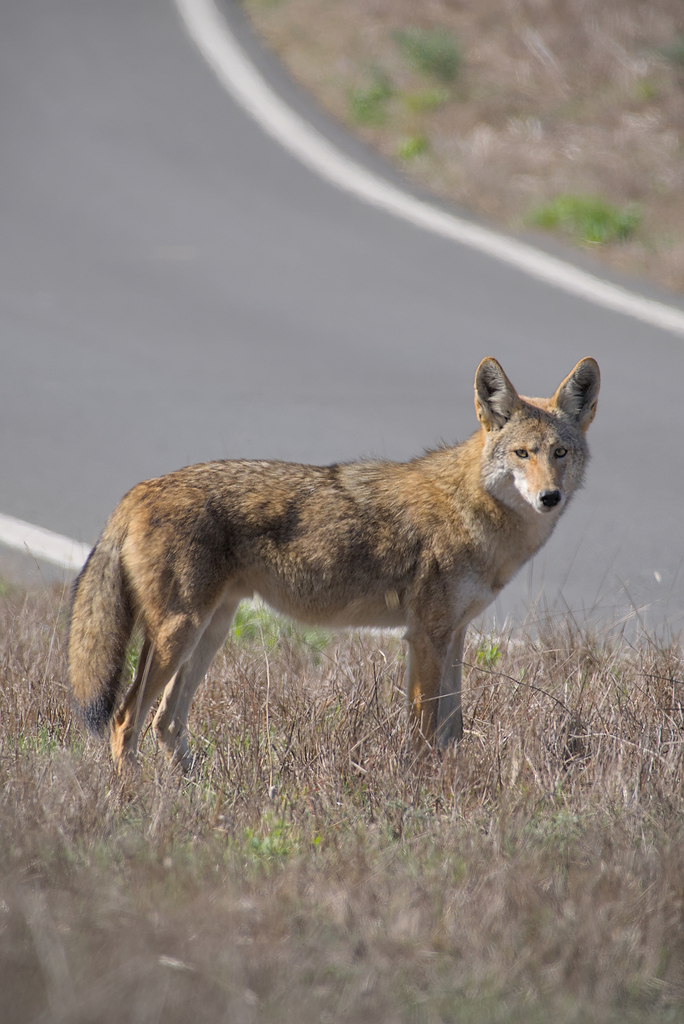
Coyote
Canis latrans
The coyote (/kaɪ(j)oʊt(i)/, KY-(y)oh-t(ee)) (Canis latrans) is a species of canine also known as the American jackal, prairie wolf, and brush wolf. It is native to North America, and it is smaller than its close relative, the gray wolf, and slightly smaller than the closely related eastern wolf and red wolf. It fills much of the same ecological niche as the golden jackal does in Eurasia, but the coyote is generally larger.
The coyote is listed as least concern by the International Union for Conservation of Nature, due to its wide distribution and abundance throughout North America. The species is versatile, able to adapt to and expand into environments modified by humans; urban coyotes are common in many cities. The coyote was sighted in eastern Panama (across the Panama Canal from their home range) for the first time in 2013.
From the article Coyote on Wikipedia (CC BY-SA), quoted section by section
Description
Coyote males average 8 to 20 kg (18 to 44 lb) in weight, while females average 7 to 18 kg (15 to 40 lb), though size varies geographically. Northern subspecies, which average 18 kg (40 lb), tend to grow larger than the southern subspecies of Mexico, which average 11.5 kg (25 lb). Total length ranges on average from 1.0 to 1.35 m (3 ft 3 in to 4 ft 5 in); comprising a tail length of 40 cm (16 in), with females being shorter in both body length and height. The largest coyote on record was a male killed near Afton, Wyoming, on November 19, 1937, which measured 1.5 m (4 ft 11 in) from nose to tail, and weighed 34 kg (75 lb). Scent glands are located at the upper side of the base of the tail and are a bluish-black color. The color and texture of the coyote's fur vary somewhat geographically. The hair's predominant color is light gray and red or fulvous, interspersed around the body with black and white. Coyotes living at high elevations tend to have more black and gray shades than their desert-dwelling counterparts, which are more fulvous or whitish-gray. The coyote's fur consists of short, soft underfur and long, coarse guard hairs. The fur of northern subspecies is longer and denser than in southern forms, with the fur of some Mexican and Central American forms being almost hispid (bristly). …
Range & habitat
Prior to the near extermination of wolves and cougars, the coyote was most numerous in grasslands inhabited by bison, pronghorn, elk, and other deer, doing particularly well in short-grass areas with prairie dogs, though it was just as much at home in semiarid areas with sagebrush and jackrabbits or in deserts inhabited by cactus, kangaroo rats, and rattlesnakes. As long as it was not in direct competition with the wolf, the coyote ranged from the Sonoran Desert to the alpine regions of adjoining mountains or the plains and mountainous areas of Alberta. With the extermination of the wolf, the coyote's range expanded to encompass broken forests from the tropics of Guatemala and the northern slope of Alaska. Coyotes walk around 5–16 kilometres (3–10 mi) per day, often along trails such as logging roads and paths; they may use iced-over rivers as travel routes in winter. They are often crepuscular, being more active around evening and the beginning of the night than during the day. However, in urban areas coyotes are known to be more nocturnal, likely to avoid encounters with humans. Like many canids, coyotes are competent swimmers, reported to be able to travel at least 0.8 kilometres (0.5 mi) across water. In 2026, a coyote swam to the southern edge of Alcatraz Island, over one mile from the nearest land in San Francisco.
Wikipedia: “Habitat”
What it does
Like the Eurasian golden jackal, the coyote is gregarious, but not as dependent on conspecifics as more social canid species like wolves are. This is likely because the coyote is not a specialized hunter of large prey as the latter species is. The basic social unit of a coyote pack is a family containing a reproductive female. However, unrelated coyotes may join forces for companionship, or to bring down prey too large to attack on their own. Such "nonfamily" packs are only temporary, and may consist of bachelor males, nonreproductive females and subadult young. Families are formed in midwinter, when females enter estrus. Pair bonding can occur 2–3 months before actual copulation takes place. The copulatory tie can last 5–45 minutes. A female entering estrus attracts males by scent marking and howling with increasing frequency. A single female in heat can attract up to seven reproductive males, which can follow her for as long as a month. Although some squabbling may occur among the males, once the female has selected a mate and copulates, the rejected males do not intervene, and move on once they detect other estrous females. …
Wikipedia: “Social and reproductive behaviors”
At the table
Prior to the mid-19th century, coyote fur was considered worthless. This changed with the diminution of beavers, and by 1860, the hunting of coyotes for their fur became a great source of income (75 cents to $1.50 per skin) for wolfers in the Great Plains. Coyote pelts were of significant economic importance during the early 1950s, ranging in price from $5 to $25 per pelt, depending on locality. The coyote's fur is not durable enough to make rugs, but can be used for coats and jackets, scarves, or muffs. The majority of pelts are used for making trimmings, such as coat collars and sleeves for women's clothing. Coyote fur is sometimes dyed black as imitation silver fox. Coyotes were occasionally eaten by trappers and mountain men during the western expansion. Coyotes sometimes featured in the feasts of the Plains Indians, and coyote pups were eaten by the indigenous people of San Gabriel, California. The taste of coyote meat has been likened to that of the wolf and is more tender than pork when boiled. Coyote fat, when taken in the fall, has been used on occasion to grease leather or eaten as a spread.
Wikipedia: “Fur uses”
In human culture
At the time of the European colonization of the Americas, coyotes were largely confined to open plains and arid regions of the western half of the continent. In early post-Columbian historical records, determining whether the writer is describing coyotes or wolves is often difficult. One record from 1750 in Kaskaskia, Illinois, written by a local priest, noted that the "wolves" encountered there were smaller and less daring than European wolves. Another account from the early 1800s in Edwards County, Illinois mentioned wolves howling at night, though these were likely coyotes. This species was encountered several times during the Lewis and Clark Expedition (1804–1806), though it was already well known to European traders on the upper Missouri. Meriwether Lewis, writing on 5 May 1805, in northeastern Montana, described the coyote in these terms:
The small wolf or burrowing dog of the prairies are the inhabitants almost invariably of the open plains; they usually associate in bands of ten or twelve sometimes more and burrow near some pass or place much frequented by game; not being able alone to take deer or goat they are rarely ever found alone but hunt in bands; they frequently watch and seize their prey near their burrows; in these burrows, they raise their young and to them they also resort when pursued; when a person approaches them they frequently bark, their note being pr …
Wikipedia: “History”
Listen
Looking for field recordings…
Where it lives
Recorded sightings
—
geo-referenced records in GBIF, from museums, herbaria and field observers.
Drag the globe to turn it. Dots are where records exist, not a range map; darker means more records.
In the old herbals & bestiaries

Florentine Codex, Vol. 2 (Books 6-9)
Bernardino de Sahagún · 1577 · p.569

Florentine Codex, Vol. 3 (Books 10-12)
Bernardino de Sahagún · 1577 · p.340

Florentine Codex, Vol. 3 (Books 10-12)
Bernardino de Sahagún · 1577 · p.331

Florentine Codex, Vol. 3 (Books 10-12)
Bernardino de Sahagún · 1577 · p.337

Florentine Codex, Vol. 3 (Books 10-12)
Bernardino de Sahagún · 1577 · p.335
In the stacks
Searching the stacks…
Every page naming Canis latrans in the Biodiversity Heritage Library →
This page is assembled live from iNaturalist, GBIF, Wikipedia, the Source Library and the Internet Archive. It is not yet part of the hand-edited codex. iNaturalist taxon 42051.