- Animals
- ›Chordates
- ›Vertebrates
- ›Mammals
- ›Therians
- ›Placental Mammals
- ›Ungulates, Carnivorans, and Allies
- ›Carnivorans
- ›Euplerids
- ›Mongoose-like Euplerids
- ›Mungotictis
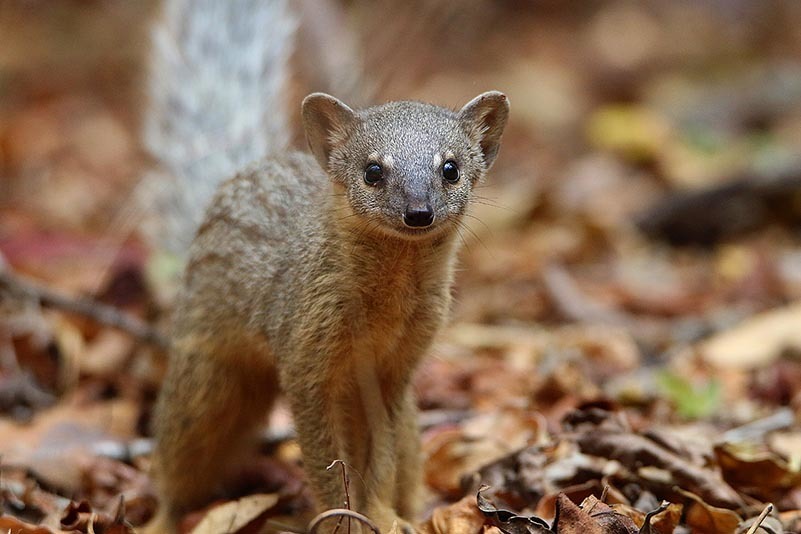
Narrow-striped Boky
Mungotictis decemlineata
The narrow-striped mongoose (Mungotictis decemlineata), also known as the boky-boky in Malagasy, is a member of the family Eupleridae endemic to Madagascar. It inhabits the western Madagascar succulent woodlands and northern Madagascar spiny thickets in western and southwestern Madagascar, where it lives from sea level to about 125 m (410 ft) between the Tsiribihina and Mangoky Rivers. It is the only species in genus Mungotictis.
From the article Narrow-striped mongoose on Wikipedia (CC BY-SA), quoted section by section
What it does
The narrow-striped mongoose is diurnal and lives in matriarchal family groups that practice cooperative rearing of young. Usually, the young of the alpha female will get the most care, and often the lower ranking females' young is neglected to the point of abandonment. The narrow-striped mongoose demonstrates two unique social behaviours. Females form home ranges in their habitat, where 1-3 females form a stable social unit with their offspring. Males also form their own social units with 2-4 adult males. The male units have a large home range, which often overlap with at least 3 female social units, where mates find one another. The narrow-striped mongoose creates small nests in trees and brush, and has been known to share trees with Lepilemur species, with which it apparently has little or no interaction. Results of a few studies suggest that the narrow-striped mongoose is primarily insectivorous, but eats also bird eggs and a variety of small animals including rodents, birds, snakes, and even small lemur species such as the gray mouse lemur.
Reproduction. Males often mate with more than one female and are considered polygamous. Females may also mate with more than one male. Narrow-striped mongooses of neighbouring units are closely related, with females more closely related than males, most likely because females disperse in a smaller area. …
Wikipedia: “Behaviour and ecology”
Listen
Looking for field recordings…
Where it lives
Recorded sightings
—
geo-referenced records in GBIF, from museums, herbaria and field observers.
Drag the globe to turn it. Dots are where records exist, not a range map; darker means more records.
In the stacks
Searching the stacks…
Every page naming Mungotictis decemlineata in the Biodiversity Heritage Library →
This page is assembled live from iNaturalist, GBIF, Wikipedia, the Source Library and the Internet Archive. It is not yet part of the hand-edited codex. iNaturalist taxon 41935.