- Animals
- ›Chordates
- ›Vertebrates
- ›Mammals
- ›Therians
- ›Placental Mammals
- ›Ungulates, Carnivorans, and Allies
- ›Carnivorans
- ›Mustelids
- ›Otters
- ›Lutra
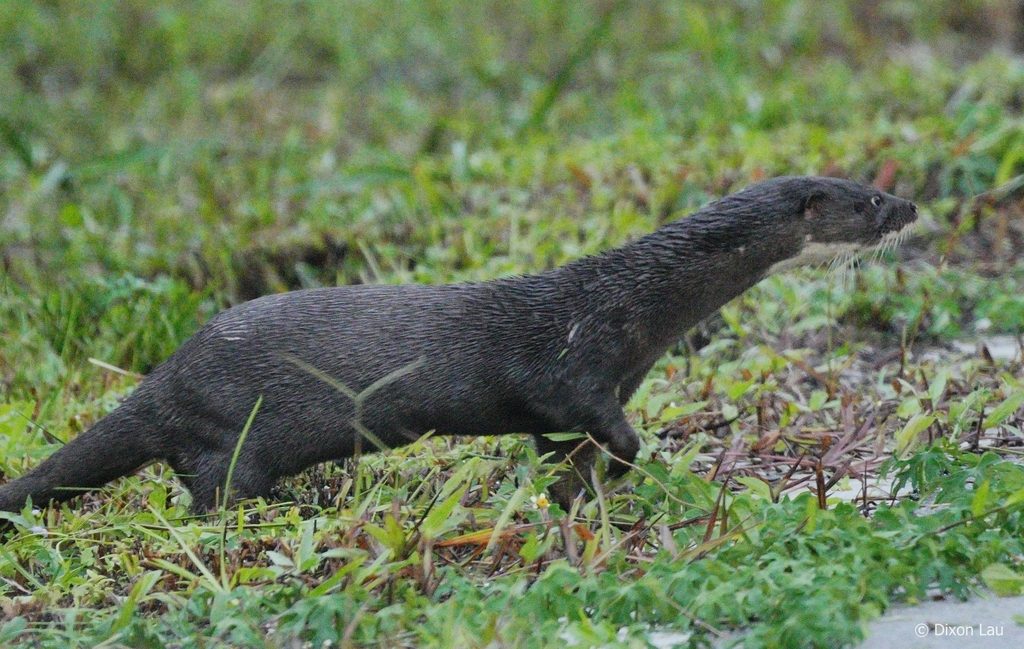
Hairy-nosed Otter
Lutra sumatrana
The hairy-nosed otter (Lutra sumatrana) is a semiaquatic mammal endemic to Southeast Asia and one of the rarest and least known otter species. It is threatened by loss of natural resources and poaching.
From the article Hairy-nosed otter on Wikipedia (CC BY-SA), quoted section by section
Description
The hairy-nosed otter has a short brown fur that becomes paler on the belly. It has a distinguished rhinarium which is fully covered with short dark hair "from the upper edge of the nostrils". Its upper lip and chin are whitish. Some individuals are reddish-chestnut in colour. Its body is long, its tail slender, and its fully webbed paws have prominent claws. Head-to-body length ranges from 57.5 to 82.6 cm (22.6 to 32.5 in), tail length from 35 to 50.9 cm (13.8 to 20.0 in), and weight from 5 to 8 kg (11 to 18 lb). Its skull is flatter than that of smooth-coated otter, and it has smaller teeth. Its forepaws are 5.8 cm (2.3 in) wide and smaller than the hind paws with about 6.6 cm (2.6 in).
Range & habitat
This hairy-nosed otter occurs in Southeast Asia from southern Thailand, Cambodia, southern Vietnam and Peninsular Malaysia to Sumatra and Borneo. It is locally extinct in India, Singapore and Myanmar, and possibly also in Brunei. In Thailand, it was recorded in the Pru Toa Daeng peat swamp forest and in areas around the Bang Nara river. It mainly habits lowland flooded forests with climaxing vegetation in three levels: a primary forest zone, a secondary forest zone made up of Melaleuca cajuputi, and a third zone of grasslands. These tiers make the habitat hard to penetrate, providing protection from human disturbance and cover from predators (possibly including grey-headed fish eagles, feral dogs and reticulated pythons). The Bang Nara river habitat, where communities have been discovered, is tidal. The two reserves in Vietnam are both peat swamp forests, surrounded by 15 m high Melaleuca cajuputi, covered in dense lianas such as Stenochlaena palustris in its primary zone, and a second zone of meadows made up of Eleocharis dulcis. …
Wikipedia: “Distribution and habitat”
What it does
The hairy-nosed otter occurs in coastal areas and on larger inland rivers, solitary or in groups of up to four. Its diet includes fish, such as broadhead catfish, snakeheads, and climbing perch, and water snakes, mollusks, and crustaceans. During the dry season, individuals forage in drainage canals and ponds. Pairing of a male and a female may be limited to the breeding period. The contact call between otters is a single-syllabic chirp. Adult females call to pups with a staccato chatter. Populations in Cambodia breed between November and March. The gestation period lasts around two months. A family of both parents and cubs were sighted between December and February.
Wikipedia: “Ecology and behavior”
Listen
Looking for field recordings…
Where it lives
Recorded sightings
—
geo-referenced records in GBIF, from museums, herbaria and field observers.
Drag the globe to turn it. Dots are where records exist, not a range map; darker means more records.
In the stacks
Searching the stacks…
Every page naming Lutra sumatrana in the Biodiversity Heritage Library →
This page is assembled live from iNaturalist, GBIF, Wikipedia, the Source Library and the Internet Archive. It is not yet part of the hand-edited codex. iNaturalist taxon 41849.