- Animals
- ›Chordates
- ›Vertebrates
- ›Mammals
- ›Therians
- ›Placental Mammals
- ›Ungulates, Carnivorans, and Allies
- ›Carnivorans
- ›Mustelids
- ›Ferret Badgers
- ›Melogale
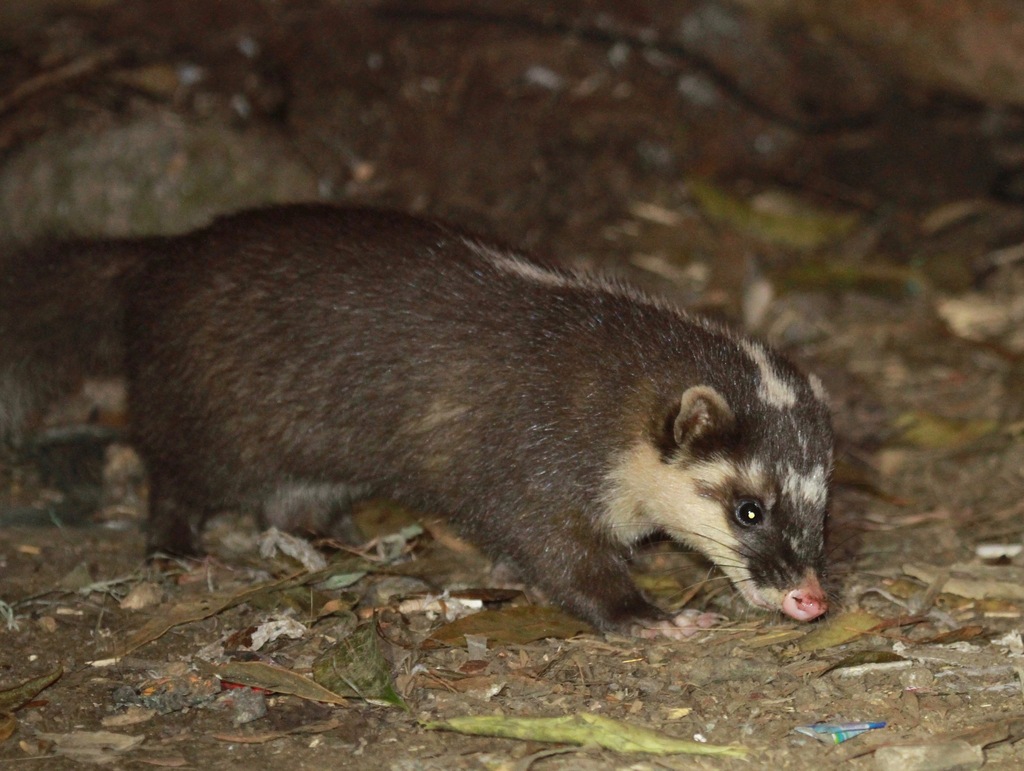
Javan Ferret Badger
Melogale orientalis
The Javan ferret-badger (Melogale orientalis) is a mustelid endemic to Java and Bali, Indonesia. It is listed as Least Concern on the IUCN Red List and occurs from at least 260 to 2,230 m (850 to 7,320 ft) elevation in or close to forested areas.
From the article Javan ferret-badger on Wikipedia (CC BY-SA), quoted section by section
Description
An adult Javan ferret-badger weighs between 1 and 2 kg (2.2 and 4.4 lb) with a body length of 35 to 40 cm (14 to 16 in) and a tail of 14.5 to 17 cm (6 to 7 in). The head is small with a narrow, blunt snout, long whiskers and large eyes. The body is low-slung with brown silky fur tinged with red and in some lights looks tawny or greyish. The back of the head and throat are darker brown and there are white markings on the face, neck, throat, chest and abdomen.
Range & habitat
The Javan ferret-badger is endemic to the islands of Java and Bali in Indonesia. Its exact range is unknown, but it is present in hilly and mountainous areas and may also occur at lower altitudes. In western Java, it has been observed in Mount Halimun Salak National Park and in Gunung Gede Pangrango National Park. In Bali, it has been recorded primary forest on a forest track at an elevation of 1,180 m (3,870 ft) and in an area of secondary forest and rubber plantations not far from human habitations. Javan ferret badgers have been recorded in the wild in just 30 localities in the Province of Banten, West Java, Central Java, Yogyakarta, East Java and on Bali.
Wikipedia: “Distribution and habitat”
What it does
Like other ferret-badgers, the Javan ferret-badger is a fossorial animal that makes use of pre-existing burrows in the forest floor. It is mainly nocturnal, and small groups of adults and juveniles forage together. It is often found in dense undergrowth and it may be able to scramble about in trees and bushes. Its diet is mainly carnivorous and consists of small animals, birds, amphibians, eggs, carrion and invertebrates, and it also eats fruit. Data from litters offered for sale on online platforms suggests a peak in breeding from December to March In the Gunung Gede Pangrango National Park, Javan ferret-badgers seem fairly common and have been observed scavenging for food scraps after nightfall at picnic areas and turning over the leaf litter. They seemed undisturbed by the presence of humans and one young individual even fed on biscuits held out on an observer's hand.
Wikipedia: “Behaviour and ecology”
Listen
Looking for field recordings…
Where it lives
Recorded sightings
—
geo-referenced records in GBIF, from museums, herbaria and field observers.
Drag the globe to turn it. Dots are where records exist, not a range map; darker means more records.
In the stacks
Searching the stacks…
Every page naming Melogale orientalis in the Biodiversity Heritage Library →
This page is assembled live from iNaturalist, GBIF, Wikipedia, the Source Library and the Internet Archive. It is not yet part of the hand-edited codex. iNaturalist taxon 41839.