- Animals
- ›Chordates
- ›Vertebrates
- ›Mammals
- ›Therians
- ›Placental Mammals
- ›Ungulates, Carnivorans, and Allies
- ›Carnivorans
- ›Skunks and Stink-badgers
- ›Stink-badgers
- ›Mydaus
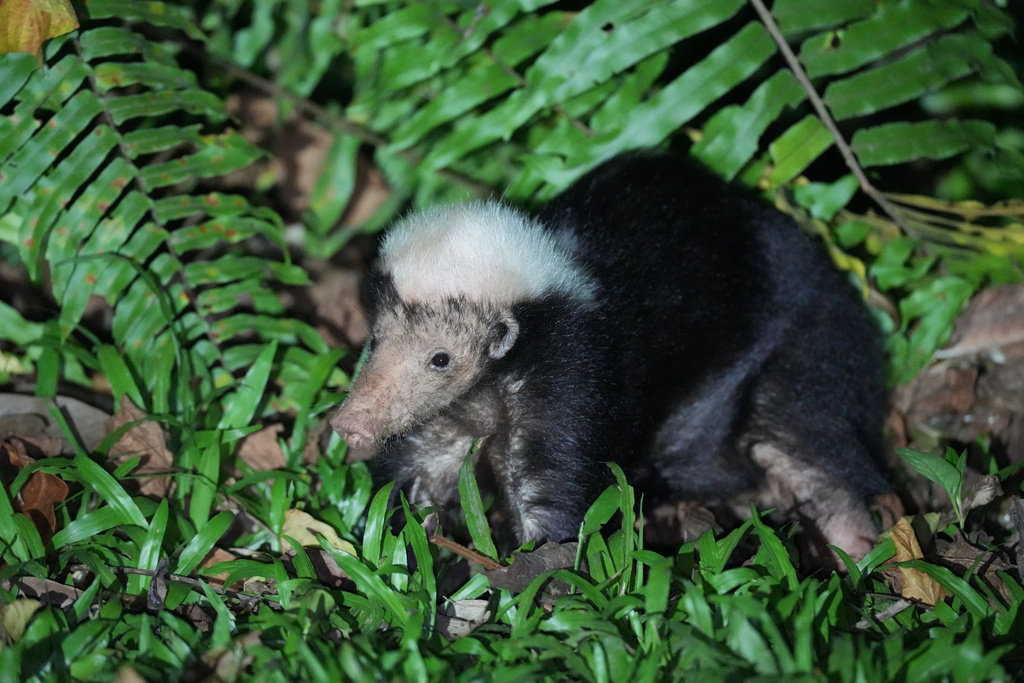
Sunda Stink-badger
Mydaus javanensis
The Sunda stink badger (Mydaus javanensis), also called the Javan stink badger, teledu, Malay stink badger, Malay badger, Indonesian stink badger and Sunda skunk, is a mammal native to Indonesia and Malaysia. Despite the common name, stink badgers are not closely related to true badgers, and are, instead, Old World relatives of the skunks. Coincidentally, its local name sigung in Sundanese is a false cognate to skunk which is of Algonquian origin.
From the article Sunda stink badger on Wikipedia (CC BY-SA), quoted section by section
Description
Sunda stink badgers have a similar body shape to badgers, but are significantly smaller, being 37 to 52 cm (15 to 20 in) in total length, and weighing from 1.3 to 3.6 kg (2.9 to 7.9 lb). Their fur is coarse, and black or very dark brown over most of the body, with a white stripe running from the top of the head to the tail. The tail is short, measuring about 3.6 cm (1.4 in), and is covered in pure white fur. The width of the stripe varies considerably between individuals, but is usually narrow, and may be discontinuous. As the name indicates, stink badgers have an anal scent gland that secretes a foul-smelling substance, which the animal can spray up to 15 cm (5.9 in). Females have six teats.
Range & habitat
Named for the Sunda Islands, Sunda stink badgers are found in Java, Sumatra, Borneo, and the northern Natuna Islands. Sunda stink badgers can be found across a wide variety of habitats, including forest edges or areas of secondary forest. Historically, they were thought to be restricted to high elevations of over 2,000 m (6,600 ft), and only rarely on lowland plains. This is now known not to be true, and more recent surveys have shown Sunda stink-badgers are often found in elevations well below 2000m. Sunda stink badgers have been reported as low as 250 m (820 ft) above sea level on Java, at relatively low elevations in Sarawak., and have even been recorded at elevations as low as 10m in the Lower Kinabatangan floodplains, Sabah, Borneo at seemingly high densities. Three subspecies are recognized:
M. j. javanensis (Sunda stink badger) - Java and Sumatra M. j. lucifer (Bornean stink badger) - Borneo M. j. ollula (Natuna Islands stink badger) - northern Natuna Islands
Wikipedia: “Distribution and habitat”
What it does
The Sunda stink badger is omnivorous and highly nocturnal. The animal portion of its diet consists of invertebrates, eggs, and carrion. At night, it roots through soft soil using its snout and claws searching for worms and ground-dwelling insects. During the day, it sleeps in short burrows, less than 60 cm (24 in) in length, which it either digs or takes over from other animals, such as porcupines. Females have been reported to give birth to litters of two or three young.
== References ==
Wikipedia: “Behaviour and ecology”
Listen
Looking for field recordings…
Where it lives
Recorded sightings
—
geo-referenced records in GBIF, from museums, herbaria and field observers.
Drag the globe to turn it. Dots are where records exist, not a range map; darker means more records.
In the stacks
Searching the stacks…
Every page naming Mydaus javanensis in the Biodiversity Heritage Library →
This page is assembled live from iNaturalist, GBIF, Wikipedia, the Source Library and the Internet Archive. It is not yet part of the hand-edited codex. iNaturalist taxon 41831.