On eBird ↗
Northern Fulmar
Live sightings near you, the range map, bar charts of when it is seen, and Macaulay Library photos and recordings.
Northern Fulmar
Fulmarus glacialis
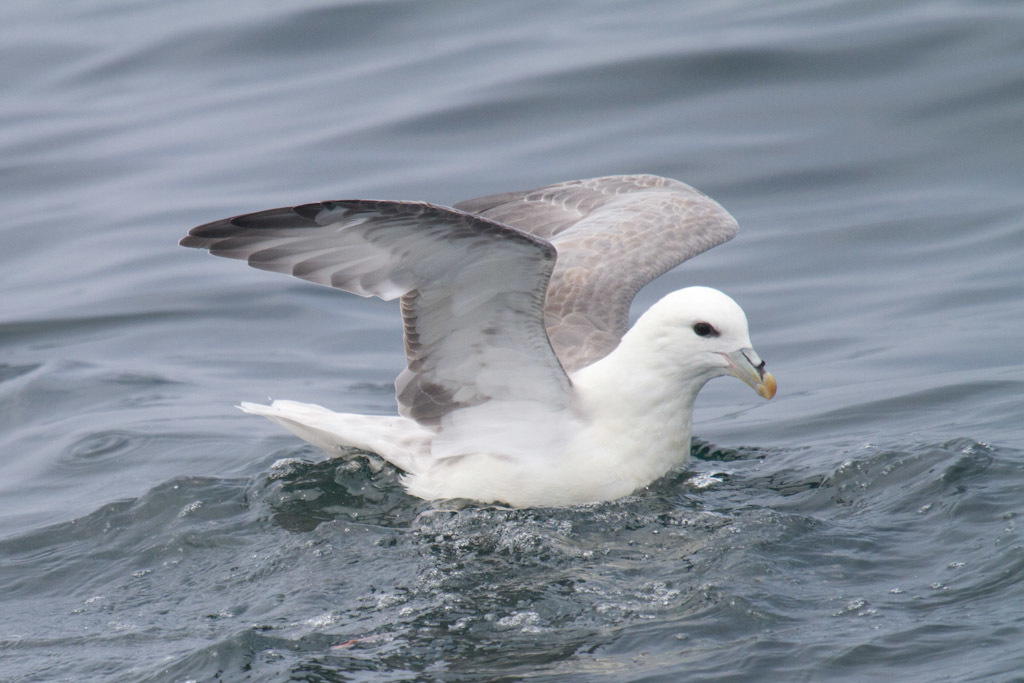
The northern fulmar, Arctic fulmar, or simply fulmar (Fulmarus glacialis) is an abundant seabird found primarily in subarctic regions of the North Atlantic and North Pacific oceans. There has been one confirmed sighting in the Southern Hemisphere, with a single bird seen south of New Zealand. Fulmars come in one of two colour morphs; a light one in temperate populations, with white head and body and grey wings and tail, and a dark one in arctic populations, which is uniformly grey; intermediate birds are common. Though similar in appearance to gulls, fulmars are in fact members of the family Procellariidae, which includes petrels and shearwaters.
The northern fulmar and its sister species, the southern fulmar (Fulmarus glacialoides), are the only extant members of the genus Fulmarus. The fulmars are in turn a member of the order Procellariiformes, and they all share certain identifying features. First, they have nasal passages that attach to the upper bill called naricorns; however, nostrils on albatrosses are on the sides of the bill, as opposed to the rest of the order, including fulmars, which have nostrils on top of the upper bill. The bills of Procellariiformes are also unique in that they are split into between seven and nine horny plates. One of these plates makes up the hooked portion of the upper bill, called the maxillary unguis. They produce a stomach oil made up of wax esters and triglycerides that is stored in the proventriculus.
From the article Northern fulmar on Wikipedia (CC BY-SA), quoted section by section
Description
The northern fulmar has a wingspan of 102 to 112 cm (40–44 in) and is 46 cm (18 in) in length. Body mass can range from 450 to 1,000 g (16 to 35 oz). This species is grey and white with a pale yellow, thick bill and bluish legs. However, there are both a light morph and dark, or "blue", morph; in the Pacific Ocean there is an intermediate morph as well. Only the dark morph has more than dark edges on the underneath but they all have pale inner primaries on the top of the wings. The Pacific morph has a darker tail than the Atlantic morph. Like other petrels, their walking ability is limited, but they are strong fliers, with a stiff wing action quite unlike the gulls. They look bull-necked compared to gulls, and have short stubby bills. They are long-lived, with a lifespan of 31 years not uncommon, and exceptionally over 50 years, recorded on Eynhallow in Orkney.
What it does
Northern fulmars will feed on shrimps, fish, squid, plankton, jellyfish, and carrion, as well as refuse. When eating fish, they will dive up to 4 metres deep to retrieve their prey.
Wikipedia: “Feeding”
Listen
Looking for field recordings…
Where it lives
Recorded sightings
—
geo-referenced records in GBIF, from museums, herbaria and field observers.
Drag the globe to turn it. Dots are where records exist, not a range map; darker means more records.
In the stacks
Searching the stacks…
Every page naming Fulmarus glacialis in the Biodiversity Heritage Library →
This page is assembled live from iNaturalist, GBIF, Wikipedia, the Source Library and the Internet Archive. It is not yet part of the hand-edited codex. iNaturalist taxon 4180.