- Animals
- ›Chordates
- ›Vertebrates
- ›Mammals
- ›Therians
- ›Placental Mammals
- ›Ungulates, Carnivorans, and Allies
- ›Carnivorans
- ›Mustelids
- ›American Badgers
- ›Taxidea
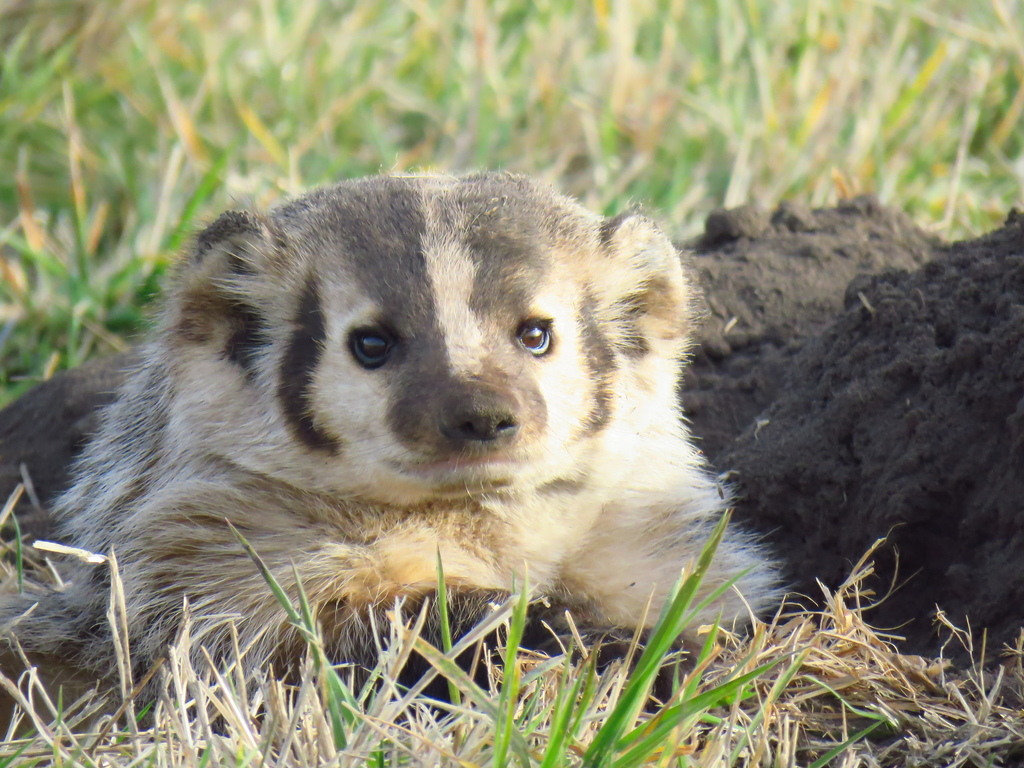
American Badger
Taxidea taxus
The American badger (Taxidea taxus) is a North American badger similar in appearance to the European badger, although not closely related. It is found in the western, central, and northeastern United States, northern Mexico, and south-central Canada to certain areas of southwestern British Columbia.
The American badger's habitat is typified by open grasslands with available prey (such as mice, squirrels, and groundhogs). The species prefers areas such as prairie regions with sandy loam soils where it can dig more easily for its prey.
From the article American badger on Wikipedia (CC BY-SA), quoted section by section
Description
The American badger has most of the general characteristics common to badgers; with stocky and low-slung bodies with short, powerful legs, they are identifiable by their huge foreclaws (measuring up to 5 cm in length) and distinctive head markings. American badgers possess morphological characteristics that enable them to be good fossorial specialists, such as a conical head, bristles on the ears, and nictitating membranes in the eyes. American badgers have powerful forelimbs. They also possess a strong humerus and large bony processes for the attachment of muscles. The mechanical advantage in badger forelimbs is increased by the specialized olecranon process and bones such as the radius and metacarpals. Measuring generally between 60 and 75 cm (23.5 and 29.5 in) in length, males of the species are slightly larger than females. They may attain an average weight of roughly 6.3 to 7.2 kg (14 to 16 lb) for females and up to 8.6 kg (19 lb) for males. Northern subspecies such as T. t. jeffersonii are heavier than the southern subspecies. In the fall, when food is plentiful, adult male badgers can reach up to 11.5 to 15 kg (25 to 33 lb). In some northern populations, females can average 9.5 kg (21 lb).
Except for the head, the American badger is covered with a grizzled, brown, black and white coat of coarse hair or fur, giving almost a mixed brown-tan appearance. …
Range & habitat
American badgers prefer grasslands and open areas with grasslands, which can include parklands, farms, and treeless areas with friable soil and a supply of rodent prey. They may also be found in forest glades and meadows, marshes, brushy areas, hot deserts, and mountain meadows. They are sometimes found at elevations up to 12,000 feet (3,700 m) but are usually found in the Sonoran and Transition life zones (which are at elevations lower and warmer than those characterized by coniferous forests). In Arizona, they occur in desert scrub and semi-arid grasslands. In California, American badgers are primarily able to survive through a combination of open grasslands of agricultural lands, protected land trust and open space lands, and regional and state and national park lands with grassland habitat. Badgers are occasionally found in open chaparral (with less than 50% plant cover) and riparian zones. They are not usually found in mature chaparral. In Manitoba aspen parklands, American badger abundance was positively associated with the abundance of Richardson's ground squirrels (Spermophilus richardsonii). In Ontario it primarily resides on the extreme southwestern portion of the province, restricted to the north shore of Lake Erie in open areas generally associated with agriculture and along woodland edges. …
Wikipedia: “Habitat”
What it does
The American badger is a fossorial carnivore. It preys predominantly on pocket gophers (Geomyidae), ground squirrels (Spermophilus), moles (Talpidae), marmots (Marmota), prairie dogs (Cynomys), pika (Ochotona), woodrats (Neotoma), kangaroo rats (Dipodomys), deer mice (Peromyscus), and voles (Microtus), often digging to pursue prey into their dens, and sometimes plugging tunnel entrances with objects. The American badger is a significant predator of snakes, including rattlesnakes, and is considered their most important predator in South Dakota. They also prey on ground-nesting birds, such as the bank swallow, or sand martin (Riparia riparia), and the burrowing owl (Athene cunicularia), lizards, amphibians, carrion, fish, skunks (Mephitis and Spilogale), insects (including bees and honeycomb), and some plant foods, such as corn (Zea mais), peas, green beans, mushrooms and other fungi, and sunflower seeds (Helianthus).
Wikipedia: “Diet”
Listen
Looking for field recordings…
Where it lives
Recorded sightings
—
geo-referenced records in GBIF, from museums, herbaria and field observers.
Drag the globe to turn it. Dots are where records exist, not a range map; darker means more records.
In the stacks
Searching the stacks…
Every page naming Taxidea taxus in the Biodiversity Heritage Library →
This page is assembled live from iNaturalist, GBIF, Wikipedia, the Source Library and the Internet Archive. It is not yet part of the hand-edited codex. iNaturalist taxon 41789.