- Animals
- ›Chordates
- ›Vertebrates
- ›Mammals
- ›Therians
- ›Placental Mammals
- ›Ungulates, Carnivorans, and Allies
- ›Carnivorans
- ›Pinnipeds
- ›Eared Seals
- ›Callorhinus
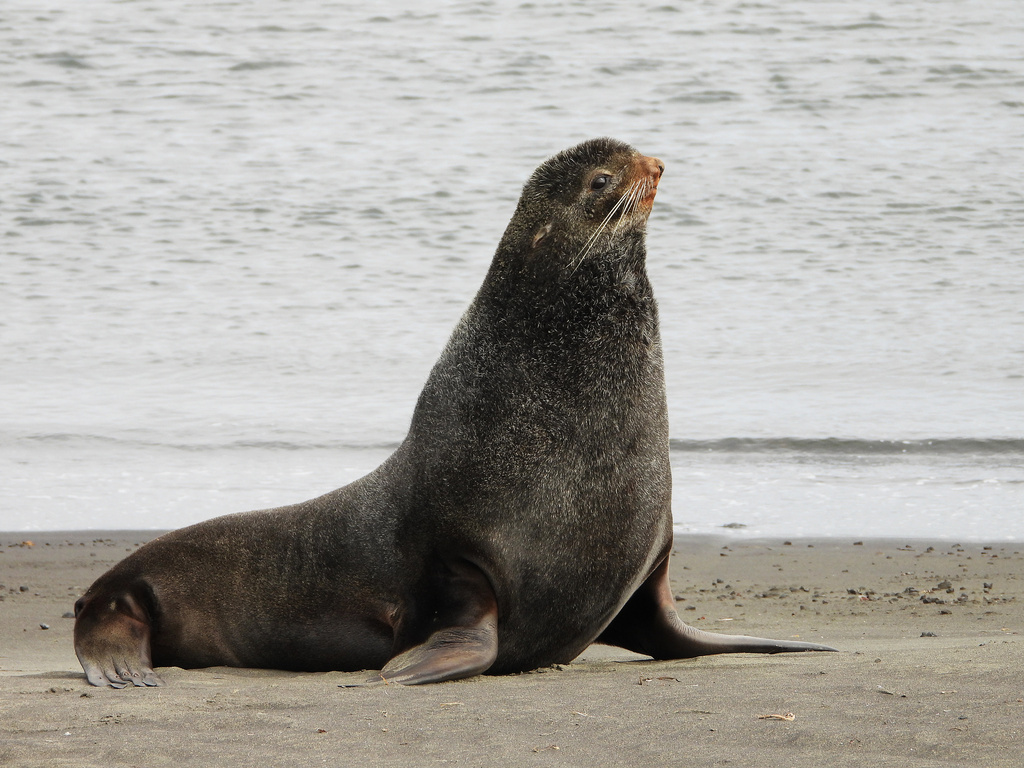
Northern Fur Seal
Callorhinus ursinus
The northern fur seal (Callorhinus ursinus) is an eared seal found along the north Pacific Ocean, the Bering Sea, Sea of Japan and the Sea of Okhotsk. It is the largest member of the fur seal subfamily (Arctocephalinae) and the only living species in the genus Callorhinus. A single fossil species, Callorhinus gilmorei, is known from the mid-late Pliocene of California, Mexico, and Japan.
From the article Northern fur seal on Wikipedia (CC BY-SA), quoted section by section
Description
Northern fur seals have extreme sexual dimorphism, adult males being 30–40% longer and more than 4.5 times heavier than adult females. The head is foreshortened in both sexes because of the very short, down-curved muzzle, and small nose, which extends slightly beyond the mouth in females and moderately in males. The pelage is thick and luxuriant, with a dense underfur in a creamy color. The underfur is obscured by the longer guard hairs, although it is partially visible when the animals are wet. Features of both fore and hind flippers are unique of the species. Fur is absent on the top of the fore flippers and an abrupt "clean line" is seen across the wrist where the fur ends. The hind flippers are proportionately the longest in any otariid because of extremely long, cartilaginous extensions on all of the toes. Small claws are on digits 2–4, well back from the flap-like end of each digit. The ear pinnae are long and conspicuous, and naked of dark fur at the tips in older animals. The mystacial vibrissae can be very long, and regularly extend beyond the ears. Young pups are born with a black pelt, gaining colors of darker brown across the body and lighter coloration on the chest and belly. Adult males also have gray hair on the back of their necks in contrast to females.
Adult males are stocky in build, and have enlarged (thick and wide) necks. …
Range & habitat
The northern fur seal is found in the north Pacific – its southernmost reach is a line that runs roughly from the southern tip of Japan to the southern tip of the Baja California Peninsula, the Sea of Okhotsk, and the Bering Sea. An estimated 1.1 million northern fur seals occur across the range, of which roughly half breed on the Pribilof Islands in the east Bering Sea. Another 200–250 thousand breed on the Commander Islands in the west Bering Sea, some 100,000 breed on Tyuleniy Island off the coast of Sakhalin in the southwest Sea of Okhotsk, and another 60–70 thousand in the central Kuril Islands in Russia. Smaller rookeries (around 5,000 animals) are found on Bogoslof Island in the Aleutian Chain, San Miguel Island in the Channel Island group and South Farallon Island off the coast of California. Recent evidence from stable isotope analysis of Holocene fur seal bone collagen (δ13C and δ15N) indicates that before the maritime fur trade, it was more common for these animals to breed at local rookeries in British Columbia, California, Oregon, Washington, and likely along much of the northwest coast of North America. During the winter, northern fur seals display a net movement southward, with animals from Russian rookeries regularly entering Japanese and Korean waters in the Sea of Japan and Alaskan animals moving along the central and eastern Pacific to British Columbia, Canad …
Wikipedia: “Distribution and habitat”
What it does
Fur seals are opportunistic feeders, primarily feeding on pelagic fish and squid depending on local availability. Identified fish prey include anchovy, hake, herring, saury, lantern fish, rockfish, capelin, salmon, pollock, and mackerel. Their feeding behavior is primarily solitary. Northern fur seals are preyed upon primarily by sharks and killer whales . Occasionally, very young animals are eaten by Steller sea lions.. Due to very high densities of pups on reproductive rookeries and the early age at which mothers begin their foraging trips, mortality can be relatively high. Consequently, pup carcasses are important in enriching the diet of many scavengers, in particular gulls and Arctic foxes. In 2017, 14 samples of spiny lice were collected off of the nasal passage of fur seal pups. In 2021, these spiny lice were identified as having unique bristle arrangements, and were given the scientific name Antarctophthirus nevelskoyi. They were named after the famous Russian explorer, Admiral Gennady Ivanovich Nevelsky.
Wikipedia: “Ecology”
Listen
Looking for field recordings…
Where it lives
Recorded sightings
—
geo-referenced records in GBIF, from museums, herbaria and field observers.
Drag the globe to turn it. Dots are where records exist, not a range map; darker means more records.
In the stacks
Searching the stacks…
Every page naming Callorhinus ursinus in the Biodiversity Heritage Library →
This page is assembled live from iNaturalist, GBIF, Wikipedia, the Source Library and the Internet Archive. It is not yet part of the hand-edited codex. iNaturalist taxon 41757.