- Animals
- ›Chordates
- ›Vertebrates
- ›Mammals
- ›Therians
- ›Placental Mammals
- ›Ungulates, Carnivorans, and Allies
- ›Carnivorans
- ›Pinnipeds
- ›Eared Seals
- ›Arctocephalus
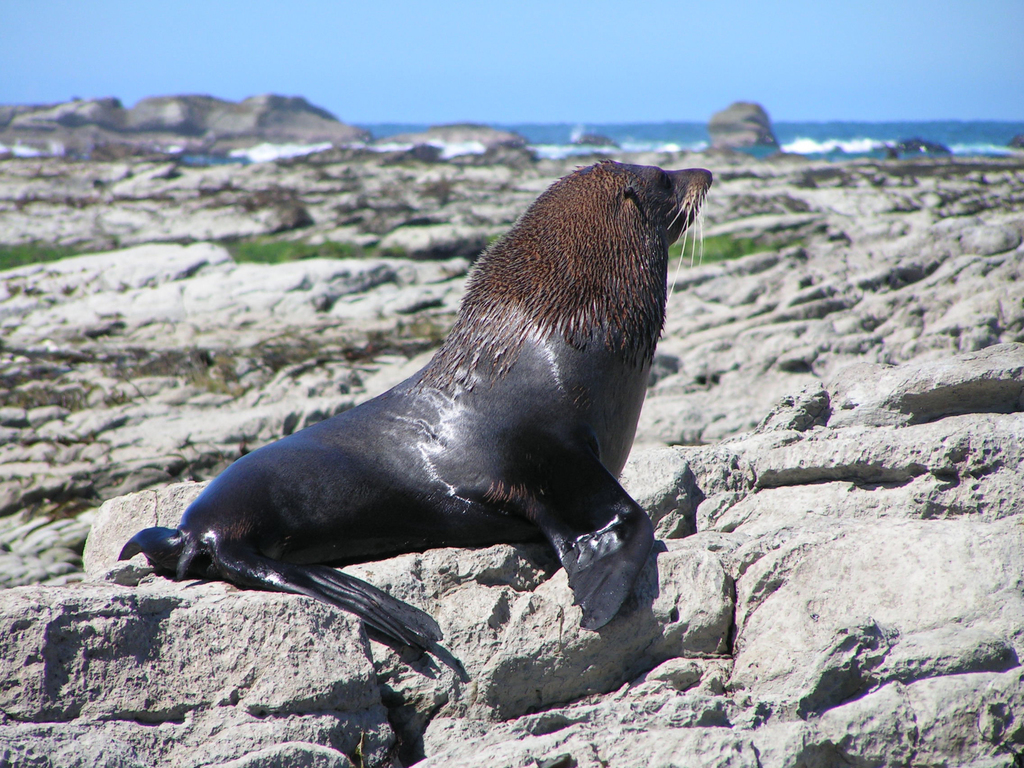
Long-nosed Fur Seal
Arctocephalus forsteri
Arctocephalus forsteri (common names include the Australasian fur seal, South Australian fur seal, New Zealand fur seal, Antipodean fur seal, or long-nosed fur seal) is a species of fur seal found mainly around southern Australia and New Zealand. The name New Zealand fur seal is used by English speakers in New Zealand; kekeno is used in the Māori language. As of 2014, the common name long-nosed fur seal has been proposed for the population of seals inhabiting Australia.
Although the Australian and New Zealand populations show some genetic differences, their morphologies are very similar, and thus they remain classed as a single species. After the arrival of humans in New Zealand, and particularly after the arrival of Europeans in Australia and New Zealand, hunting reduced the population to near-extinction.
From the article Arctocephalus forsteri on Wikipedia (CC BY-SA), quoted section by section
Description
Males have been reported as large as 160 kg (350 lb); their average weight is about 126 kg (278 lb). Males can be 2 m (6 ft 7 in) long. Females are between 30 and 50 kg (66–110 lbs) on average, and can be as long as 1.5 m (4 ft 11 in). Newborn pups are 3.3–3.9 kg (7.3–8.6 lbs) on average, and between 40 and 55 cm (1.3–1.8 ft) long. At 290 days old males are about 14.1 kg (31 lb), and females are about 12.6 kg (28 lb). Like other otariids, they have external ears and hind flippers that rotate forward, which visibly distinguish them from true seals. They have a pointed nose with long pale whiskers. Fur seals are covered by two layers of fur. The coat is grey-brown on their back, and lighter on their belly. Some have white tips on longer upper hairs, which can give them a silvery appearance. So called "Upland Seals" once found on Antipodes Islands and Macquarie Island have been claimed as a distinct subspecies with thicker furs by scientists, although it is unclear whether these seals were genetically distinct.
Range & habitat
The species occurs in Australia and New Zealand. It is found in the coastal waters and on the offshore islands of southern Australia, from the south-west corner of Western Australia to just east of Kangaroo Island in South Australia, and also in southern Tasmania and the subantarctic Macquarie Island. Small populations are forming in Bass Strait and coastal waters of Victoria and New South Wales as far as the mid-north coast. Before the arrival of humans in New Zealand, the species bred around all the New Zealand mainland and its subantarctic islands. There are now established and expanding colonies around the entire South Island, on Stewart Island and all of the New Zealand subantarctic islands. There are also newly established breeding colonies on the North Island.
Wikipedia: “Distribution”
What it does
Females mature between 4 and 6 years old, and males mature between 8 and 10 years old. These seals are polygynous. Males obtain and guard territory in late October before females arrive. Often females mate only once a year, and this usually occurs eight days postpartum for about 13 minutes on average. Females have a delayed implantation of the fertilised egg, so that implantation on the uterine wall does not occur for 3 months. Gestation occurs for 9 months Females are more aggressive near the time of birth, and do not like to be approached right after birth. Females will continue to reproduce until their death which is on average between 14 and 17 years of age. Females first arrive on the shore between November and January, just a few days before giving birth, and stay close to the birth site for up to ten days. When they are close to labour they become very restless and irritable. When beginning labour, which can last as much as five hours, they lie down and toss their head in the air, straining forward on their fore flippers, lifting their hind quarters, or moving laterally, before slowly lowering their head down, a process they repeat until they finally give birth. In one study, observations of the actual birth, starting from when the pup was first seen, found an average of 2 minutes for a head-first delivery, but an average of 6.5 minutes if the pup came out tail first. …
Wikipedia: “Reproduction”
Listen
Looking for field recordings…
Where it lives
Recorded sightings
—
geo-referenced records in GBIF, from museums, herbaria and field observers.
Drag the globe to turn it. Dots are where records exist, not a range map; darker means more records.
In the stacks
Searching the stacks…
Every page naming Arctocephalus forsteri in the Biodiversity Heritage Library →
This page is assembled live from iNaturalist, GBIF, Wikipedia, the Source Library and the Internet Archive. It is not yet part of the hand-edited codex. iNaturalist taxon 41752.