- Animals
- ›Chordates
- ›Vertebrates
- ›Mammals
- ›Therians
- ›Placental Mammals
- ›Ungulates, Carnivorans, and Allies
- ›Carnivorans
- ›Pinnipeds
- ›Eared Seals
- ›Zalophus
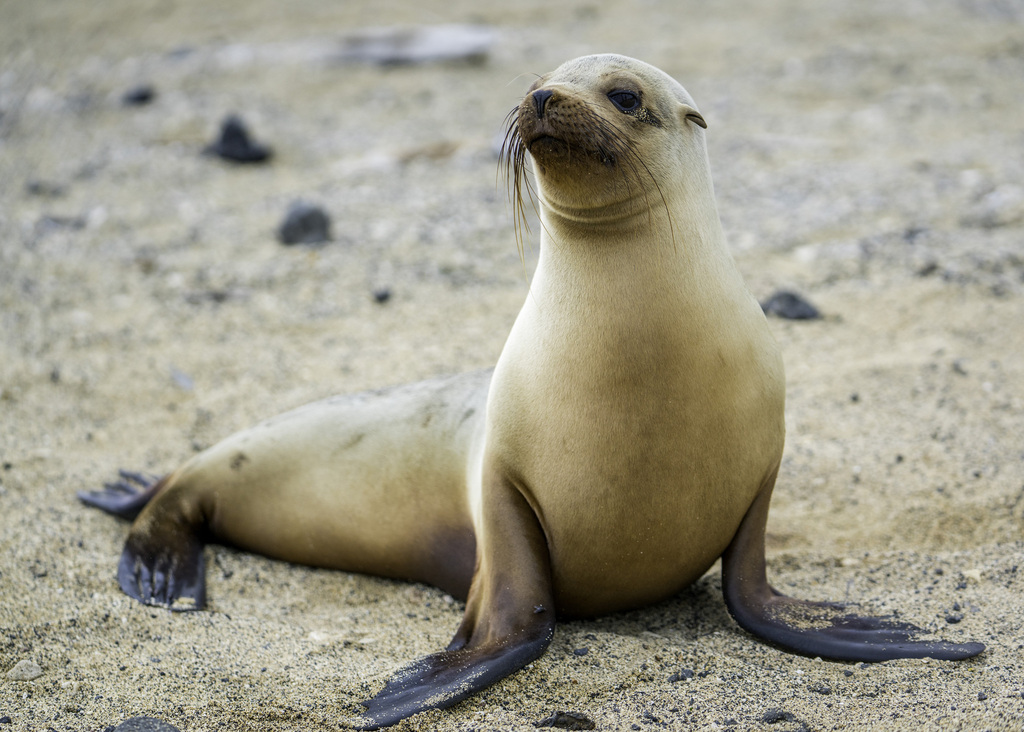
Galápagos Sea Lion
Zalophus wollebaeki
The Galápagos sea lion (Zalophus wollebaeki) is a species of sea lion that exclusively breeds on the Galápagos Islands and – in smaller numbers – on Isla de la Plata (Ecuador). Being fairly social, and one of the most numerous species in the Galápagos archipelago, they are often spotted sun-bathing on sandy shores or rock groups or gliding gracefully through the surf. Their loud bark, playful nature, and graceful agility in water make them the "welcoming...
From the article Galápagos sea lion on Wikipedia (CC BY-SA), quoted section by section
Range & habitat
Galápagos sea lions can be found on all of the main islands of the Galápagos archipelago, and on a number of smaller islands in the area. Less than a quarter of them reside on San Cristobal Island. They have also colonized Isla de la Plata, just offshore mainland Ecuador, and can be spotted from the Ecuadorian coast north to Isla Gorgona in Colombia. Records have also been made of sightings on Isla del Coco, which is about 500 km southwest of Costa Rica. The population on Isla del Coco is considered vagrant.
Wikipedia: “Distribution”
What it does
While information on the diet of Galapagos sea lions is limited, it is known that they are carnivores that feed mostly on sardines. They also eat other marine life like crustaceans, squid, fish (sardines and myctophids/lanternfish), and octopus, which classifies them as piscivores. Galápagos sea lions sometimes travel 10–15 km (6.2–9.3 mi) from the coast over a span of days to hunt. This is when they come into contact with their main predators: sharks and killer whales. Injuries and scars from attacks are often visible. During El Niño events, occurring when the water temperature pattern changes in the Pacific, sardine populations either die or migrate, and sea lions dive deeper to feed on lantern fish. The reduction in food availability during El Niño leads to sea lion population declines. Successful pack hunting of yellowfin tuna, in which the fish were herded into a rocky inlet and occasionally onto land, was recorded in the BBC series Blue Planet II. A side effect of the close proximity that these sea lions choose to have with humans is the diversified array of food sources that the sea lions can choose from. In addition to the usual hunting strategies, sea lions have learned how to scavenge from fishing boats and have learned methods of hunting that involve the bright lights of the boats themselves.
Wikipedia: “Diet and feeding patterns”
Listen
Looking for field recordings…
Where it lives
Recorded sightings
—
geo-referenced records in GBIF, from museums, herbaria and field observers.
Drag the globe to turn it. Dots are where records exist, not a range map; darker means more records.
In the stacks
Searching the stacks…
Every page naming Zalophus wollebaeki in the Biodiversity Heritage Library →
This page is assembled live from iNaturalist, GBIF, Wikipedia, the Source Library and the Internet Archive. It is not yet part of the hand-edited codex. iNaturalist taxon 41738.