- Animals
- ›Chordates
- ›Vertebrates
- ›Mammals
- ›Therians
- ›Placental Mammals
- ›Ungulates, Carnivorans, and Allies
- ›Carnivorans
- ›Pinnipeds
- ›Earless Seals
- ›Phocinae
- ›Phocini
- ›Halichoerus
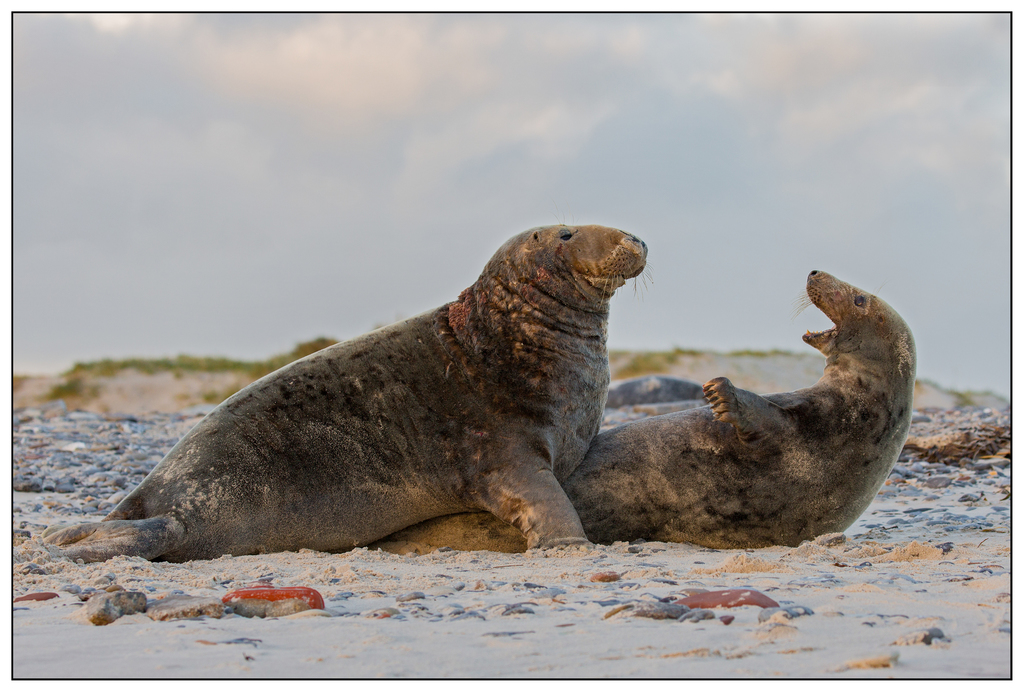
Grey Seal
Halichoerus grypus
The grey seal (Halichoerus grypus), or gray seal in the United States, is a large seal of the family Phocidae, which are commonly referred to as "true seals" or "earless seals". The only species classified in the genus Halichoerus, it is found on both shores of the North Atlantic Ocean. In Latin, Halichoerus grypus means "hook-nosed sea pig". It is also known as the horsehead seal, owing to its large head.
The grey seal is large and heavy, with individuals from the eastern Atlantic being 1.6–2.3 m (5 ft 3 in – 7 ft 7 in) long and weighing 100–310 kg (220–680 lb), while individuals from the western Atlantic are up to 2.7 m (8 ft 10 in) long, and can reach a weight of as much as 400 kg (880 lb). It is found widely across the northern Atlantic, ranging from the US to Russia, and occasionally as far south as Portugal. It can be divided into two subspecies: the Baltic grey seal (Halichoerus grypus grypus), found in the Baltic Sea, and the Atlantic grey seal (Halichoerus grypus atlantica), found everywhere else. The largest populations are in Canada and the UK.
From the article Grey seal on Wikipedia (CC BY-SA), quoted section by section
Description
The grey seal is large and heavy: In the eastern Atlantic, males are typically 1.95–2.3 m (6 ft 5 in – 7 ft 7 in) long and weigh 170–310 kg (370–680 lb); the females are much smaller, typically 1.6–1.95 m (5 ft 3 in – 6 ft 5 in) long and 100–190 kg (220–420 lb) in weight. Individuals from the western Atlantic are often much larger, with males averaging up to 2.7 m (8 ft 10 in) and reaching a weight of as much as 400 kg (880 lb) and females averaging up to 2.05 m (6 ft 9 in) and sometimes weighing up to 250 kg (550 lb). Record-sized bull grey seals can reach about 3.3 m (10 ft 10 in) in length. A common average weight in Great Britain was found to be about 233 kg (514 lb) for males and 154.6 kg (341 lb) for females whereas in Nova Scotia, Canada, adult males averaged 294.6 kg (649 lb) and adult females averaged 224.5 kg (495 lb). Colours and patterns are highly variable. Males tend to have a light pattern on a dark background, while females tend to have the opposite — a dark pattern on a light background, often with a noticeably light belly. The neck and chest of males tend to be wrinkled and scarred, while females are smoother. Males have an especially wide muzzle. Males have a large, visible opening on the lower abdomen, while females have no obvious openings. Juveniles are often a solid colour, and can be difficult or impossible to sex. …
Range & habitat
The grey seal is resident to 18 countries: Belgium, Canada, Denmark (including Faroe Islands), Estonia, Finland, France, Germany, Iceland, Ireland, Latvia, Lithuania, the Netherlands, Norway, Poland, Russia, Sweden, the United Kingdom, and the United States of America. It is also an occasional vagrant in Greenland and Portugal. The global population was estimated to be about 632,000 in 2016. In the UK, the most ecologically significant breeding grounds, classified as Special Areas of Conservation (SACs) Grade A/B, are as follows (percentage of annual UK pup production in parentheses): Monach Islands, Outer Hebrides (20%); Faray and Holm of Faray, Orkney (9%); North Rona, Outer Hebrides (5%); Isle of May, Fife (4.5%); Treshnish Isles, Inner Hebrides (3%); Berwickshire and North Northumberland Coast (2.5%); and Pembrokeshire Marine (2%). Some of the more touristically significant breeding grounds in the UK which aren't SACs include: Blakeney Point and Horsey Beach in Norfolk, various locations in Cornwall, and Donna Nook in Lincolnshire. Large numbers of grey seals have recently commenced a recolonisation of the tidal section of the River Thames in London; a survey conducted by the ZSL in 2024 found that around 3,000 grey seals were living in the area. …
Wikipedia: “Distribution and habitat”
What it does
Grey seals spend most of their time at sea. They can be seen hauled out on rocks, islands, and shoals not far from shore, occasionally coming ashore to rest. The Baltic subspecies most frequently hauls out at night, beginning right after sunset. This may be related to the behaviour of its main prey species, Atlantic herring, which forms large schools during the day and disperses at night.
Reproduction. Breeding colonies are known as rookeries, and are generally on beaches and remote islands, although in the Baltic and the Gulf of St Lawrence grey seals have been known to occasionally breed on sea ice. Females generally return to the exact location where they were born to give birth, but they sometimes venture to different rookeries. Females reach sexual maturity at 3–5 years old, while males reach maturity at 6 years. Males, known as bulls, form a territory on the beach, and can mate with more than 6 females, known as cows, a year. Mating can take place on land or in water. The females are pregnant for about 11 and a half months, and give birth to a single pup at the same time each year. Pups weigh 11–20 kg (24–44 lb) at birth, and have dense, soft, silky white fur. The time of year that pups are born varies depending on the location, landing somewhere between September and March. The earliest pups are born in Ireland and Southwest UK in September. …
Wikipedia: “Behaviour”
Listen
Looking for field recordings…
Where it lives
Recorded sightings
—
geo-referenced records in GBIF, from museums, herbaria and field observers.
Drag the globe to turn it. Dots are where records exist, not a range map; darker means more records.
In the stacks
Searching the stacks…
Every page naming Halichoerus grypus in the Biodiversity Heritage Library →
This page is assembled live from iNaturalist, GBIF, Wikipedia, the Source Library and the Internet Archive. It is not yet part of the hand-edited codex. iNaturalist taxon 41733.