- Animals
- ›Chordates
- ›Vertebrates
- ›Mammals
- ›Therians
- ›Placental Mammals
- ›Ungulates, Carnivorans, and Allies
- ›Carnivorans
- ›Pinnipeds
- ›Earless Seals
- ›Monachinae
- ›Elephant Seals
- ›Mirounga
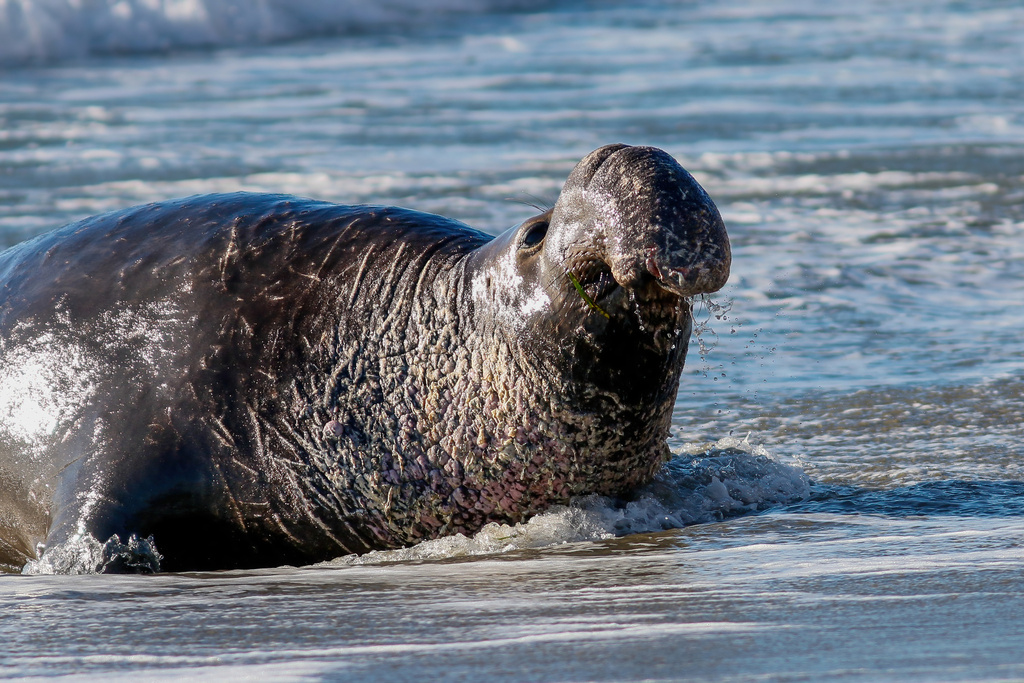
Northern Elephant Seal
Mirounga angustirostris
The northern elephant seal (Mirounga angustirostris) is one of two species of elephant seal (the other is the southern elephant seal). It is a member of the family Phocidae ("true seals"). Elephant seals derive their name from their great size and from the male's large proboscis, which is used in making extraordinarily loud roaring noises, especially during the mating competition. Sexual dimorphism in size is great: The males can grow to 14 ft (4 m) and 5,000 lb (2,300 kg),...
From the article Northern elephant seal on Wikipedia (CC BY-SA), quoted section by section
Description
The huge male northern elephant seal typically weighs 1,500–2,300 kg (3,300–5,100 lb) and measures 4–5 m (13–16 ft), although some males can weigh up to 3,700 kg (8,200 lb). Females are much smaller and can range from 400 to 900 kg (880 to 1,980 lb) in weight, or roughly a third of the male's bulk, and measure from 2.5 to 3.6 m (8.2 to 11.8 ft). The bull southern elephant seals are, on average, larger than those in the northern species, but the females in both are around the same size, indicating the even higher level of sexual dimorphism in the southern species. Although a few females have been observed to reach 23 years of age and a few males to reach 14, most die much younger. Pups are born with dark, almost black fur that they shed after weaning to turn silvery grey. As they develop, both juveniles and adults go through a molting period in which their initially black fur is replaced with a coat that ranges from silver to deep grey, finally fading to tan. Adult males' necks and chests are furless and have a speckled pattern of pink, white, and light brown. This thicker, calloused skin on the neck builds a protective shield in preparation for fights they participate in during the mating season. The eyes are large, round, and black. The width of the eyes and a high concentration of low-light pigments suggest sight plays an important role in the capture of prey. …
Range & habitat
The northern elephant seal lives in the eastern Pacific Ocean. They spend most of their time at sea, and usually only come to land to give birth, breed, and molt. These activities occur at rookeries that are located on offshore islands or remote mainland beaches. The majority of these rookeries are in California and northern Baja California, ranging from Point Reyes National Seashore, California to Isla Natividad, Mexico. Significant breeding colonies exist at Channel Islands, Año Nuevo State Reserve, Piedras Blancas Light, and the Farallon Islands in the US, and Isla Guadalupe, Isla Benito del Este and Isla Cedros in Mexico. In recent decades the breeding range has extended northwards. In 1976 the first pup was found on Point Reyes and a breeding colony established there in 1981. Since the mid-1990s some breeding has been observed at Castle Rock in Northern California and Shell Island off Oregon, and in January 2009 the first elephant seal births were recorded in British Columbia at Race Rocks. The California breeding population is now demographically isolated from the population in Baja California. Northern elephant seals exhibit extreme sexual dimorphism in their feeding behaviours. When the males leave their rookeries, they migrate northwards to their feeding grounds along the continental shelf from Washington to the western Aleutians in Alaska. …
Wikipedia: “Range and ecology”
What it does
Northern elephant seals return to their terrestrial breeding ground in December and January, with the bulls arriving first. The bulls haul out on isolated or otherwise protected beaches, typically on islands or very remote mainland locations. It is important that these beach areas offer protection from the winter storms and high surf wave action. The bulls engage in fights of supremacy to determine which few bulls will achieve a harem. After the males have arrived on the beach, the females arrive to give birth. Females fast for five weeks and nurse their single pup for four weeks; in the last few days of lactation, females come into estrus and mate. Mating behavior relates to a social hierarchy, and stronger males are considered higher rank than those smaller and weaker. In this polygynous society, a high-ranking bull can have a harem of 30–100 cows, depending on his size and strength. Males unable to establish harems will wait on the periphery, and will try to mount nearby females. Dominant bulls will disrupt copulations of lower-ranking bulls. They can mount females without interference, but commonly break off to chase off rivals. While fights are not usually to the death, they are brutal and often with significant bloodshed and injury; however, in many cases of mismatched opponents, the younger, less capable males are simply chased away, often to upland dunes. …
Wikipedia: “Social behavior and reproduction”
In human culture
Beginning in the 18th century, northern elephant seals were hunted extensively, almost to extinction by the end of the 19th century, being prized for oil made from their blubber, and the population may have fallen as low as only 20–40 individuals. In 1874, Charles Melville Scammon recorded in Marine Mammals of the Northwestern Coast of America, that an 18-foot (5.5 m) long bull caught on Santa Barbara Island yielded 210 US gallons (795 L; 175 imp gal) of oil. They were thought to be extinct in 1884 until a remnant population of eight individuals was discovered on Guadalupe Island in 1892 by a Smithsonian expedition, who promptly killed several for their collections. The elephant seals managed to survive, and were finally protected by the Mexican government in 1922. Since the early 20th century, they have been protected by law in both Mexico and in the United States. Subsequently, the U.S. protection was strengthened after passage of the Marine Mammal Protection Act of 1972, and numbers have now recovered to over 200,000. Nevertheless, a genetic bottleneck experienced by northern elephant seals during the nineteenth century made them more susceptible to disease, environmental changes and pollution. Such a small initial population of around 20–40 also meant that extensive inbreeding occurred within the species, leading to a whole other onset of issues. …
Wikipedia: “History and status”
Listen
Looking for field recordings…
Where it lives
Recorded sightings
—
geo-referenced records in GBIF, from museums, herbaria and field observers.
Drag the globe to turn it. Dots are where records exist, not a range map; darker means more records.
In the stacks
Searching the stacks…
Every page naming Mirounga angustirostris in the Biodiversity Heritage Library →
This page is assembled live from iNaturalist, GBIF, Wikipedia, the Source Library and the Internet Archive. It is not yet part of the hand-edited codex. iNaturalist taxon 41728.