- Animals
- ›Chordates
- ›Vertebrates
- ›Mammals
- ›Therians
- ›Placental Mammals
- ›Ungulates, Carnivorans, and Allies
- ›Carnivorans
- ›Raccoons, Coatis, and Allies
- ›Bassariscus
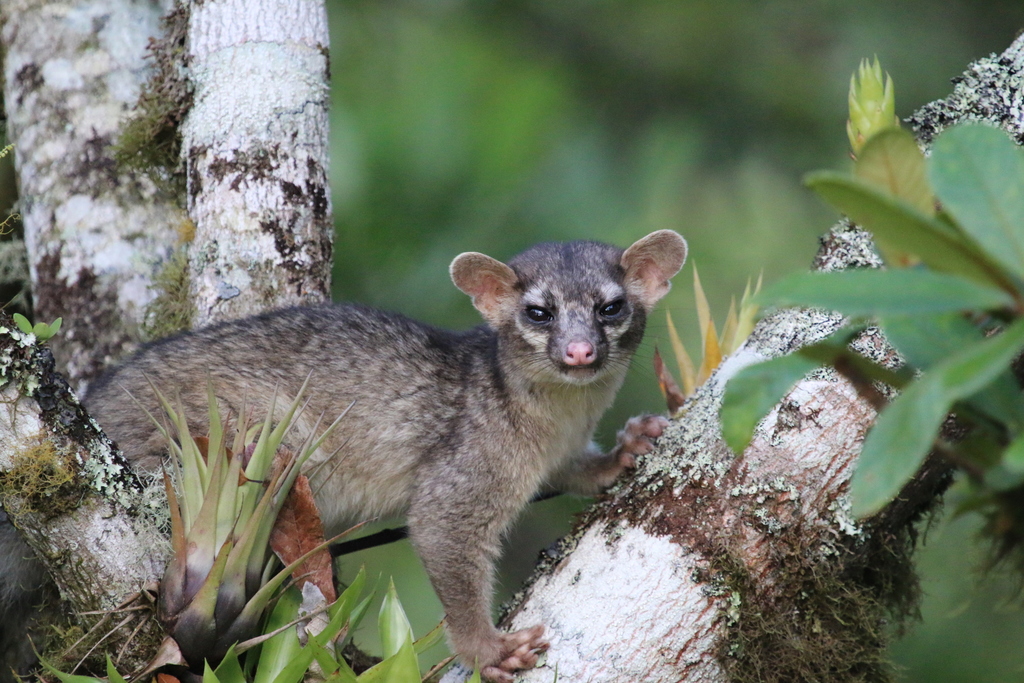
Cacomistle
Bassariscus sumichrasti
The cacomistle (; Bassariscus sumichrasti), also spelled cacomixtle, is a primarily nocturnal, arboreal, omnivorous member of the carnivoran family Procyonidae (coatis, kinkajous and raccoons). Depending on the location, its preferred habitats are humid and tropical evergreen jungle and montane cloud forests; seasonally, it may venture into drier, deciduous forests.
Although its total population is listed as being of "least concern" (i.e., stable), the cacomistle is still a highly cryptic, secretive animal, and generally an uncommon sight throughout much of its range (from southern México to western Panamá); this fact is especially true in Costa Rica, where it inhabits only a very small area. Additionally, the species is completely dependent on trees and dense vegetation for habitat, making it particularly susceptible to deforestation.
From the article Cacomistle on Wikipedia (CC BY-SA), quoted section by section
Description
Bassariscus sumichrasti can grow to around 38–47 cm long, followed by a tail of roughly the same length or longer, adding an additional 39–53 cm to the entire animal's body length. The male cacomistle is often slightly longer-bodied than the female; however, both males and females weigh about the same, usually between 1 and 1.5 kg. Their bodies are usually covered in grey or light brownish fur, in stark contrast to the black-and-white, striped tail. The tail markings are most defined near the animal's posterior end, gradually fading to a solid black at the tip of the tail. To the untrained eye, Bassariscus sumichrasti may be visually confused with its close relative, Bassariscus astutus, the ringtail; however, in addition to a more northerly distribution, the ringtail, unlike the cacomistle, does not have retractable claws. The cacomistle can also be identified by its faded tail markings and ears that end in a distinct point.
Range & habitat
The cacomistle inhabits the tropical and subtropical forests of North America (Mexico) and south into Central America, ranging through Panama. These animals are quite solitary and thus spread themselves out, with each cacomistle having a home range of at least 20 hectares (an area equivalent to 20 sports fields) and are typically seen in the middle and upper levels of the canopy. Throughout their broad range this species is found to inhabit a wide variety of different forest ecosystems. In Mexico, the cacomistle tends to avoid oak forests, secondary forest, and overgrown pastures, but in Costa Rica, the cacomistle has been shown to favor those exact habitats.
Wikipedia: “Distribution and habitat”
What it does
The cacomistle is usually considered a generalist species, as it can survive on a wide variety of different foods. Their diet varies from season-to-season, consisting primarily of fruits, flowers, nectar, invertebrates and also some small vertebrates, such as lizards, frogs, toads, and rodents. The specificity of these food options depends on what is available in the particular habitat in which an individual dwells. The various genera of bromeliads (Bromeliaceae family) found throughout the cacomistle's range are often an excellent source for food, especially in the southern end of the species' range, as these plants naturally collect rain water, which in turn brings insects and many small animals found high in the canopy; in addition, the bromeliad itself is often consumed by some omnivorous species.
Wikipedia: “Diet”
Listen
Looking for field recordings…
Where it lives
Recorded sightings
—
geo-referenced records in GBIF, from museums, herbaria and field observers.
Drag the globe to turn it. Dots are where records exist, not a range map; darker means more records.
In the stacks
Searching the stacks…
Every page naming Bassariscus sumichrasti in the Biodiversity Heritage Library →
This page is assembled live from iNaturalist, GBIF, Wikipedia, the Source Library and the Internet Archive. It is not yet part of the hand-edited codex. iNaturalist taxon 41675.