- Animals
- ›Chordates
- ›Vertebrates
- ›Mammals
- ›Therians
- ›Placental Mammals
- ›Ungulates, Carnivorans, and Allies
- ›Carnivorans
- ›Raccoons, Coatis, and Allies
- ›Procyon
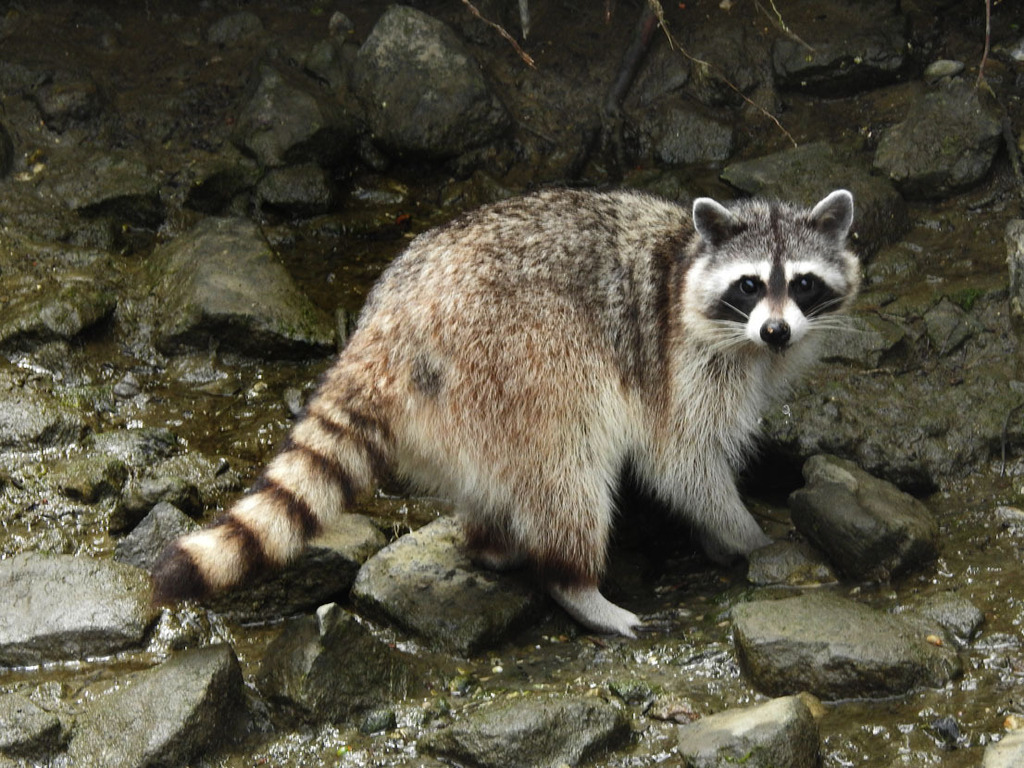
Common Raccoon
Procyon lotor
The raccoon ( or US: , Procyon lotor), sometimes called the North American, northern or common raccoon (also spelled racoon) to distinguish it from other species of raccoon, is a mammal native to North America. It is the largest of the procyonid family, having a body length of 40 to 70 cm (16 to 28 in), and a body weight of 5 to 26 kg (11 to 57 lb). Its grayish coat mostly consists of dense underfur, which insulates it against cold weather. The animal's most distinctive features include its extremely dexterous front paws, its facial mask, and its ringed tail, which are common themes in the mythologies of the Indigenous peoples of the Americas surrounding the species. The raccoon is noted for its intelligence, and studies show that it can remember the solution to tasks for at least three years. It is usually nocturnal and omnivorous, eating about 40% invertebrates, 33% plants, and 27% vertebrates.
The original habitats of the raccoon are deciduous and mixed forests. Still, due to their adaptability, they have extended their range to mountainous areas, coastal marshes, and urban areas, where some homeowners consider them to be pests. As a result of escapes and deliberate introductions in the mid-20th century, raccoons are now also distributed across central Europe, the Caucasus, and Japan. In Europe, the raccoon has been included on the list of Invasive Alien Species of Union Concern since 2016. This implies that this species cannot be imported, bred, transported, commercialized, or intentionally released into the environment in the whole of the European Union.
From the article Raccoon on Wikipedia (CC BY-SA), quoted section by section
Range & habitat
Although they have thrived in sparsely wooded areas in the last decades, raccoons depend on vertical structures to climb when they feel threatened. Therefore, they avoid open terrain and areas with high concentrations of beech trees, as beech bark is too smooth to climb. Tree hollows in old oaks or other trees and rock crevices are preferred by raccoons as sleeping, winter, and litter dens. If such dens are unavailable or accessing them is inconvenient, raccoons use burrows dug by other mammals, dense undergrowth, or tree crotches. In a study in the Solling range of hills in Germany, more than 60% of all sleeping places were used only once, but those used at least ten times accounted for about 70% of all uses. Since amphibians, crustaceans, and other animals around the shore of lakes and rivers are an important part of the raccoon's diet, lowland deciduous or mixed forests abundant with water and marshes sustain the highest population densities. While population densities range from 0.5 to 3.2 animals per square kilometer (1.3 to 8.3 animals per square mile) in prairies and do not usually exceed 6 animals per square kilometer (15.5 animals per square mile) in upland hardwood forests, more than 20 raccoons per square kilometer (51.8 animals per square mile) can live in lowland forests and marshes.
Wikipedia: “Habitat”
What it does
Studies in the 1990s by the ethologists Stanley D. Gehrt and Ulf Hohmann suggest that raccoons engage in sex-specific social behaviors and are not typically solitary, as was previously thought. Related females often live in a so-called "fission-fusion society"; that is, they share a common area and occasionally meet at feeding or resting grounds. Unrelated males often form loose male social groups to maintain their position against foreign males during the mating season—or against other potential invaders. Such a group does not usually consist of more than four individuals. Since some males show aggressive behavior towards unrelated kits, mothers will isolate themselves from other raccoons until their kits are big enough to defend themselves. Concerning these three different modes of life prevalent among raccoons, Hohmann called their social structure a "three-class society". Samuel I. Zeveloff, professor of zoology at Weber State University and author of the book Raccoons: A Natural History, is more cautious in his interpretation and concludes at least the females are solitary most of the time and, according to Erik K. Fritzell's study in North Dakota in 1978, males in areas with low population densities are solitary as well. The shape and size of a raccoon's home range vary depending on age, sex, and habitat, with adults claiming areas more than twice as large as juveniles. …
Wikipedia: “Social behavior”
At the table
While primarily hunted for their fur, raccoons were also a source of food for Native Americans and early American settlers. According to Ernest Thompson Seton, young specimens killed without a fight are palatable, whereas old raccoons caught after a lengthy battle are inedible. Raccoon meat was extensively eaten during the early years of California, where it was sold in the San Francisco market for $1–3 apiece. American slaves occasionally ate raccoon at Christmas, but it was not necessarily a dish of the poor or rural. The first edition of The Joy of Cooking, released in 1931, contained a recipe for preparing raccoon, and US President Calvin Coolidge's pet raccoon Rebecca was originally sent to be served at the White House Thanksgiving Dinner. Although the idea of eating raccoons may seem repulsive to most mainstream consumers, who see them as endearing, cute, or vermin, several thousand raccoons are still eaten each year in the United States, primarily in the Southern United States. Some people tout the taste of the meat.
Wikipedia: “Food”
In human culture
Names for the species include the common raccoon, North American raccoon, and northern raccoon. In various North American native languages, the reference to the animal's manual dexterity, or use of its hands, is the source for the names. The word raccoon was adopted into English from the native Powhatan term meaning 'animal that scratches with its hands', as used in the Colony of Virginia. It was recorded on John Smith's list of Powhatan words as aroughcun, and on that of William Strachey as arathkone. It has also been identified as a reflex of a Proto-Algonquian root *ahrah-koon-em, meaning '[the] one who rubs, scrubs and scratches with its hands'. The word is sometimes spelled as racoon. In Spanish, the raccoon is called mapache, derived from the Nahuatl mapachtli of the Aztecs, meaning '[the] one who takes everything in its hands'. The taxonomic name of the raccoon is Procyon lotor. The genus name, Procyon, derived from the Greek προ- (pro) 'before' and κύων (cyon) 'dog', was first given to the genus by Gottlieb Conrad Christian Storr in 1780. The full name Procyon lotor means, in Latin, 'before-dog washer'. The animal's observed habit of "washing" or "dousing" (see below) is the source of its name in other languages. …
Wikipedia: “Etymology”
Listen
Looking for field recordings…
Where it lives
Recorded sightings
—
geo-referenced records in GBIF, from museums, herbaria and field observers.
Drag the globe to turn it. Dots are where records exist, not a range map; darker means more records.
In the stacks
Searching the stacks…
Every page naming Procyon lotor in the Biodiversity Heritage Library →
This page is assembled live from iNaturalist, GBIF, Wikipedia, the Source Library and the Internet Archive. It is not yet part of the hand-edited codex. iNaturalist taxon 41663.