- Animals
- ›Chordates
- ›Vertebrates
- ›Mammals
- ›Therians
- ›Placental Mammals
- ›Ungulates, Carnivorans, and Allies
- ›Carnivorans
- ›Linsangs
- ›Prionodon
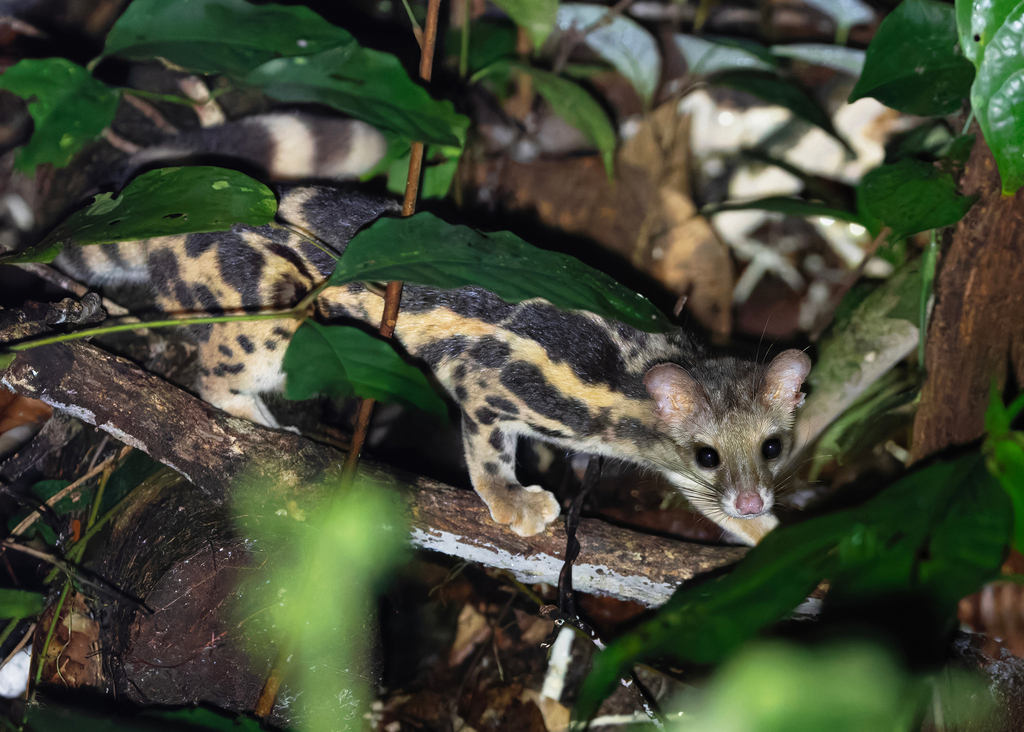
Banded Linsang
Prionodon linsang
The banded linsang (Prionodon linsang) is a linsang, a tree-dwelling carnivorous mammal native to the Sundaic region of Southeast Asia.
From the article Banded linsang on Wikipedia (CC BY-SA), quoted section by section
Description
The banded linsang is pale yellow with broad stripes on its neck and five dark bands. Its tail has seven to eight dark bands and a dark tip. Its sharp claws are retractile. Its head to body length is 35–41.1 cm (13.8–16.2 in), and its tail is up to 36.2 cm (14.3 in) long. The average weight is around 700 g (25 oz).
Range & habitat
The banded linsang occurs in Myanmar, Thailand, Peninsular Malaysia, Java, Bangka and Belitung Islands. Since 2006, it has been recorded by camera traps on the Sunda Islands of Borneo and Sumatra, and in southern Myanmar. It inhabits evergreen forests, deciduous forests, secondary forest at elevations of 11–2,700 m (36–8,858 ft), and was also recorded close to oil palm plantations.
Wikipedia: “Distribution and habitat”
What it does
The banded linsang is nocturnal and usually solitary. It is carnivorous, with its diet consisting of small vertebrates, such as birds, rats, and snakes.
Wikipedia: “Ecology and behaviour”
Listen
Looking for field recordings…
Where it lives
Recorded sightings
—
geo-referenced records in GBIF, from museums, herbaria and field observers.
Drag the globe to turn it. Dots are where records exist, not a range map; darker means more records.
In the stacks
Searching the stacks…
Every page naming Prionodon linsang in the Biodiversity Heritage Library →
This page is assembled live from iNaturalist, GBIF, Wikipedia, the Source Library and the Internet Archive. It is not yet part of the hand-edited codex. iNaturalist taxon 41620.