On eBird ↗
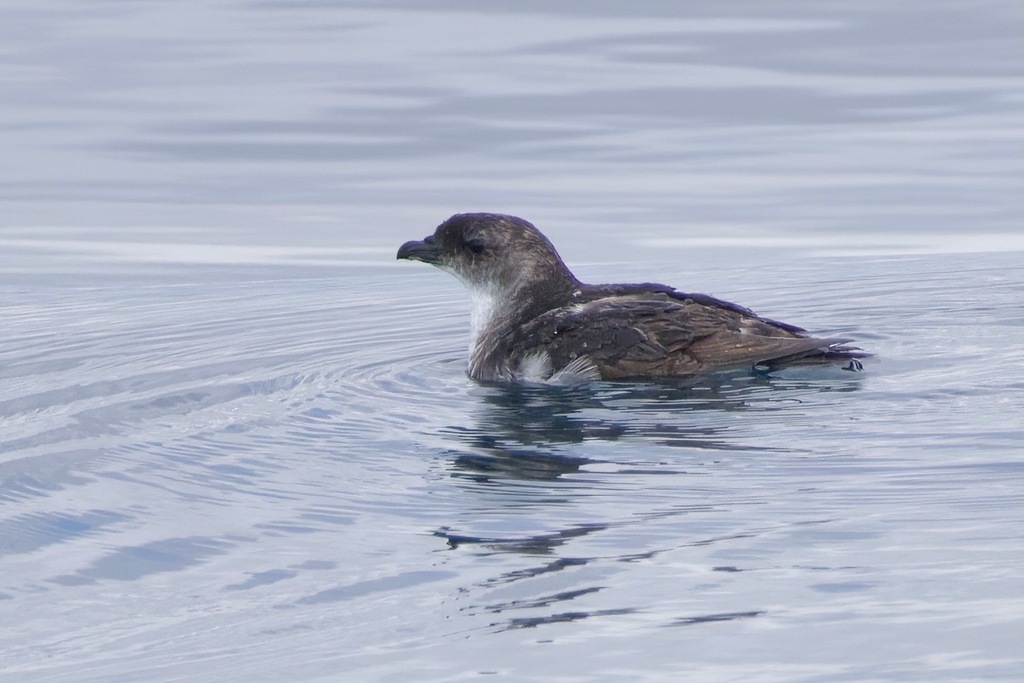
Common Diving-Petrel
Live sightings near you, the range map, bar charts of when it is seen, and Macaulay Library photos and recordings.
Common Diving Petrel
Pelecanoides urinatrix
The common diving petrel (Pelecanoides urinatrix), also known as the smaller diving petrel or simply the diving petrel, is a diving petrel, one of four very similar auk-like small petrels of the southern oceans. It is native to South Atlantic islands and islands of the subantarctic southern Indian Ocean, islands and islets off New Zealand and south-eastern Australian islands.
From the article Common diving petrel on Wikipedia (CC BY-SA), quoted section by section
Description
The common diving petrel is a small, plump petrel, 200 to 250 mm (7.9–9.8 in) in length and weighing around 86 to 186 g (3.0–6.6 oz). The plumage is black above and dull white below and it has a relatively short black bill. The wings have thin white strips. The face and neck can be more brown than black. The legs and feet are blue with blackish-brown webbing in between the toes. Unless seen very close, it is almost indistinguishable from the South Georgian diving petrel, P. georgicus. The common diving petrel has brown inner web primary feathers, whereas the South Georgia petrel has light inner web feathering. Common petrels have smaller and narrower bills than the South Georgia petrel. Another difference is that the South Georgia diving petrel has a posterior black line down the tarsi. The common species is also slightly larger than the South Georgian species.
Range & habitat
The common diving petrel is found between latitudes 35 and 55 degrees south, mostly around islands. While the population is decreasing, it is not believed to be rapid enough to be of concern. While 1.5 m (4.9 ft) burrows are usually dug in vegetated slopes, though they are occasionally built in flatland.
Wikipedia: “Distribution and habitat”
What it does
The common diving petrel feeds on the continental shelf during the breeding season, its movements during the non-breeding season are poorly known and whether it disperses more widely is not known. Like other members of their family they catch prey by wing-propelled diving, and are capable of diving to 60 m (200 ft). The diet of this species is dominated by crustaceans. They are known to forage at night on vertically migrating plankton. Feeding is mostly done in the ocean near the shore, but sometimes in the deeper pelagic zone during non-breeding season, which is only 2 months of the year.
Breeding. The mating habits are not well documented, although pairs form monogamous relationships. Breeding colonies are large and there is about one nest per 1 square metre (11 sq ft). The nest is a burrow around 50 cm long with a chamber at the bottom which may or may not be lined with dried grass. Females lay a single white egg, which measures 38 x 29 mm, and is incubated for 53–55 days. The young are brooded for 10–15 days and fledgling occurs at 45–59 days. Both parents take care of the young, which are grey-grown when hatched. The life expectancy is 6.5 years.
Wikipedia: “Behaviour”
Listen
Looking for field recordings…
Where it lives
Recorded sightings
—
geo-referenced records in GBIF, from museums, herbaria and field observers.
Drag the globe to turn it. Dots are where records exist, not a range map; darker means more records.
In the stacks
Searching the stacks…
Every page naming Pelecanoides urinatrix in the Biodiversity Heritage Library →
This page is assembled live from iNaturalist, GBIF, Wikipedia, the Source Library and the Internet Archive. It is not yet part of the hand-edited codex. iNaturalist taxon 4130.