On eBird ↗
Hutton's Shearwater
Live sightings near you, the range map, bar charts of when it is seen, and Macaulay Library photos and recordings.
Hutton's Shearwater
Puffinus huttoni
Hutton's shearwater (Puffinus huttoni; also known in Māori as kaikōura tītī) is a medium-sized ocean-going seabird in the family Procellariidae. Its range is Australian and New Zealand waters, but it breeds only in mainland New Zealand. Its conservation status is Endangered, because there are just two remaining breeding colonies, located in the Seaward Kaikōura Range. Six other shearwater colonies have been destroyed by introduced pigs. Hutton's shearwater is the only seabird in the world that is known to breed in alpine areas. Conservation measures for the bird include predator control at the breeding sites, establishing the Kaikōura Dark Sky Sanctuary, and community initiatives to rescue birds that crash-land at night on streets in Kaikōura. A protected breeding area has also been created on the Kaikōura Peninsula, including a pest-exclusion fence and man-made burrows, with the initial population established by translocating fledglings from the remaining breeding colonies.
From the article Hutton's shearwater on Wikipedia (CC BY-SA), quoted section by section
Description
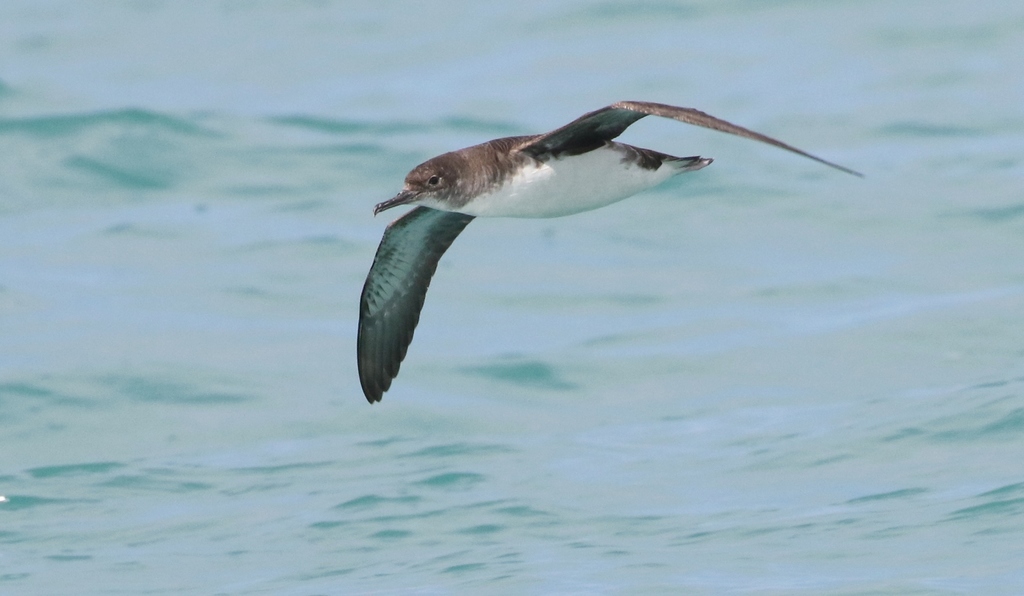
The bird's name commemorates Frederick Hutton, a former curator of the Canterbury Museum in Christchurch, New Zealand. A medium-sized (350 g) seabird, with a 75 cm wingspan, it is brown with a white underbelly and brown collar, dark borders to the underwing, dark grey bill, and pinkish dark-webbed feet. It can be distinguished from the fluttering shearwater by its dark grey "armpits". At a breeding colony it has a loud cackling call.
Range & habitat
These birds live entirely at sea except when breeding. During the September–March (spring and summer) breeding season, adults migrate to New Zealand waters. There have been individual sightings around the entire New Zealand coast, but most birds feed off the eastern South Island, especially between Cook Strait and Banks Peninsula. Large flocks can be seen off the Kaikōura coast during summer. Outside the breeding season, they are mostly found in Australian waters. Geo-locators fitted on young birds revealed that some circumnavigate Australia in an anti-clockwise direction in the 4–5 years leading up to sexual maturity.
Wikipedia: “Distribution”
What it does
Hutton's shearwater feeds in the open ocean largely on small fish and krill, diving up to 20 m. Puffinus huttoni have long bills, which are adapted to catch prey more or less underwater by plunging from a few metres above the surface or by paddling slowly forwards searching with their head submerged, then diving using partly opened wings for propulsion.
Wikipedia: “Ecology”
Listen
Looking for field recordings…
Where it lives
Recorded sightings
—
geo-referenced records in GBIF, from museums, herbaria and field observers.
Drag the globe to turn it. Dots are where records exist, not a range map; darker means more records.
In the stacks
Searching the stacks…
Every page naming Puffinus huttoni in the Biodiversity Heritage Library →
This page is assembled live from iNaturalist, GBIF, Wikipedia, the Source Library and the Internet Archive. It is not yet part of the hand-edited codex. iNaturalist taxon 4108.