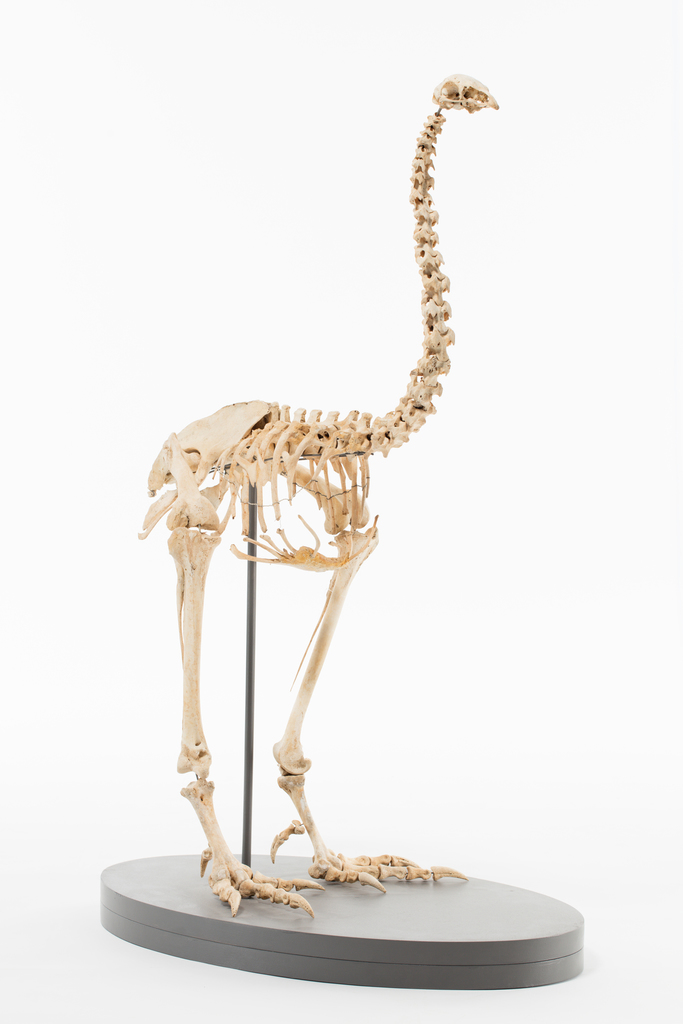
Upland Moa
Megalapteryx didinus
The upland moa (Megalapteryx didinus) or moa pukepuke (Māori), is an extinct species of moa that was endemic to New Zealand. Richard Owen described the species in 1883. It belongs to the ratites, a group of predominantly flightless birds characterized by a sternum lacking a keel. Megalapteryx didinus is known from well preserved specimens, several of which retain impressions of soft tissues. The upland moa inhabited the South Island, where it primarily favored alpine and subalpine environments. Its diet consisted mainly of flowers, herbs and other vegetation. Following the arrival of the Māori, the species was hunted and became extinct around 1500 CE. It was the last known surviving species of moa.
From the article Upland moa on Wikipedia (CC BY-SA), quoted section by section
Description
At less than 1 metre (3.3 ft) tall and about 17 to 34 kilograms (37 to 75 lb) in weight, the upland moa is among the smallest known moa species. Unlike other moas, it had feathers covering all of its body but the beak and the soles of its feet, an adaptation to living in cold environments. Scientists previously believed that the upland moa held its neck and head upright; however, more recent study has shown that it actually carried itself in a stooped posture, with its head level to its back. This would have helped it travel through the abundant vegetation present in its habitat, whereas an extended neck would have been more suited to open spaces. The upland moa had no wings or tail.
Soft tissue. The species has the best-preserved mummified remains of any moa species. Several specimens with soft tissue and feather remains are known:
British Museum A16, found at Queenstown in 1876, is the type of the species preserving a mummified head and partial neck along with two mummified partial hindlimbs. Otago Museum C.68.2A, leg with much muscle tissue, skin and feathers from the Old Man Range Museum of New Zealand Te Papa Tongarewa NMNZ S.000400, a skeleton with tissue on neck and head from the Cromwell area. MNZTPT NMNZ S.023808, a foot with some muscle and sinews, found on 7 January 1987 at Mount Owen. …
Range & habitat
The upland moa lived only on New Zealand's South Island, in mountains and sub-alpine regions. They travelled to elevations as high as 2000 m (7000 ft) above sea level.
Wikipedia: “Distribution and habitat”
What it does
The upland moa was herbivorous, its diet extrapolated from fossilised stomach contents, droppings, and the structure of its beak and crop. It ate leaves and small twigs, using its beak to "shear [...] with scissor-like moves". However, biomechanical testing of its beak and head has shown it was best suited to feed by pulling backwards, possibly while twisting its head to the side. Its food required grinding before it could be digested, as indicated by its large crop. Studies of the upland moa's coprolites have provided evidence that branchlets of trees such as Nothofagus, various lake-edge herbs, tussock, and nectar-rich flowers made up part of its diet. Based on the pollen present in the coprolites, it is suggested they had a similar lifestyle to the living takahē, feeding in high alpine areas during the summer and descending to lower altitude forests in the winter. They may also have played an important role in the seed dispersal of alpine plants.This moa usually laid only 1 to 2 blue-green coloured eggs at once, and was likely the only type of moa to lay eggs that were not white in colour. Like the emu and ostrich, male moa cared for the young. The upland moa's only predator before the arrival of humans in New Zealand was Haast's eagle (Hieraaetus moorei).
Distribution and habitat. The upland moa lived only on New Zealand's South Island, in mountains and sub-alpine regions. …
Wikipedia: “Behavior and ecology”
Listen
Looking for field recordings…
Where it lives
Recorded sightings
—
geo-referenced records in GBIF, from museums, herbaria and field observers.
Drag the globe to turn it. Dots are where records exist, not a range map; darker means more records.
In the stacks
Searching the stacks…
Every page naming Megalapteryx didinus in the Biodiversity Heritage Library →
This page is assembled live from iNaturalist, GBIF, Wikipedia, the Source Library and the Internet Archive. It is not yet part of the hand-edited codex. iNaturalist taxon 410554.