On eBird ↗
Fluttering Shearwater
Live sightings near you, the range map, bar charts of when it is seen, and Macaulay Library photos and recordings.
Fluttering Shearwater
Puffinus gavia
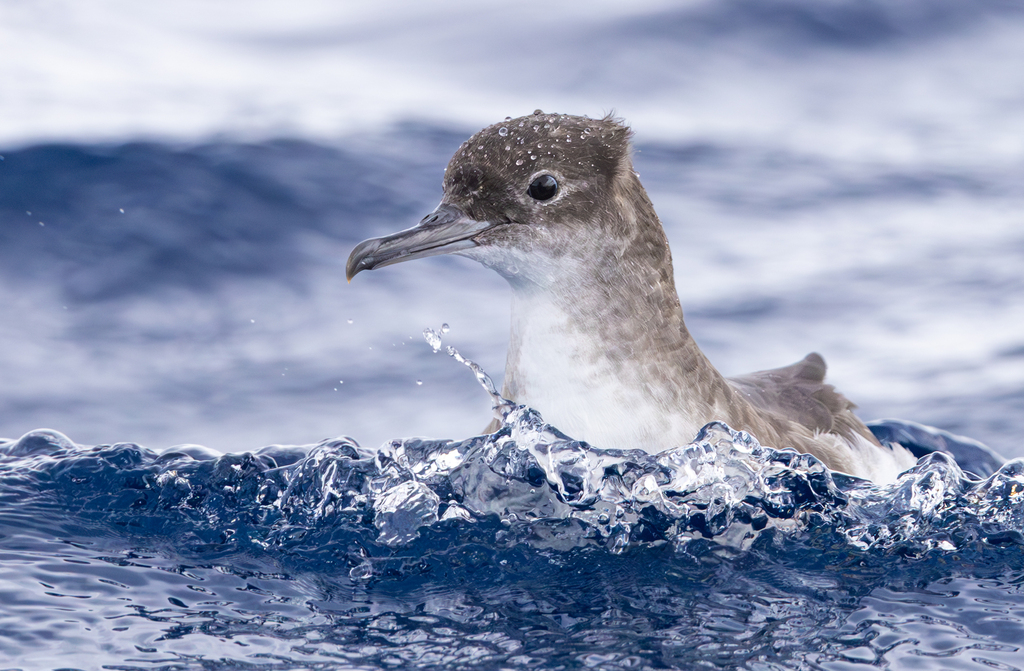
The fluttering shearwater (Puffinus gavia) is a species of seabird in the family Procellariidae. It is endemic to New Zealand and migrates to Australia and the Solomon Islands. Its natural habitats are open seas and rocky shores. It has been known as Forster's shearwater in the past.
From the article Fluttering shearwater on Wikipedia (CC BY-SA), quoted section by section
Description
This is a medium to small-sized shearwater with a dark-brown-and-white body. The upper parts, including neck, wings and tail, are uniformly dark brown. The face and neck have a grey-brown colour gradually fading into white below the eye. The under body, from chin to the under-tail, is white except for a dark thigh patch that can be seen in flight. The bottom wing is commonly white while the axillary area is covered in grey-brown fur. Under light conditions, the appearance is different. The fluttering shearwater has pinkish-brown legs and feet with dark webs, and the feet extend beyond the tail in flight. The bill is long and thin with dark colour. The tail is fan-shaped and short in flight and it has mixed colours – dark brown and white. Moulting starts from late January and the dark upper surfaces fade to mid-brown quickly. The colour of birds close to moulting (February to April) is pale rusty brown and they appear ragged at this stage. Their voice is unusual and disjointed: ka-hek-ka-hek-ka-hek and usually made in flight. Their flight pattern is somewhat determined, low and fast. Rapid spurts of wing-beating interspersed by gliding. The average body mass of females is 302 g (10.7 oz) while males is 243 g (8.6 oz). Their eggs are pure white and oval. The young birds have the same colour as adult from the nest, but with lighter color in the margin of wing-coverts. …
Range & habitat
Fluttering shearwaters are an endemic species to New Zealand, where they breed throughout the warmer months of the year, from September to February. However, during the non-breeding months of the year, between March and August, vast numbers are seen throughout eastern and south–eastern Australia, though most seem to linger close to the breeding colonies. It is suspected that it is the juveniles that migrate, whereas the adults stay confined to the rich waters of New Zealand; however, this is not fully understood.
Wikipedia: “Global range”
What it does
Fluttering shearwaters have a habit of fluttering their wings quickly and beat the feet when they fly away from the sea. A large group of fluttering shearwaters gather together and sit on the water in rafts through the months of mid-December, January and February. Sometimes, rafts will form just near the coastline.
Wikipedia: “Behaviour”
Listen
Looking for field recordings…
Where it lives
Recorded sightings
—
geo-referenced records in GBIF, from museums, herbaria and field observers.
Drag the globe to turn it. Dots are where records exist, not a range map; darker means more records.
In the stacks
Searching the stacks…
Every page naming Puffinus gavia in the Biodiversity Heritage Library →
This page is assembled live from iNaturalist, GBIF, Wikipedia, the Source Library and the Internet Archive. It is not yet part of the hand-edited codex. iNaturalist taxon 4102.