- Animals
- ›Chordates
- ›Vertebrates
- ›Mammals
- ›Therians
- ›Placental Mammals
- ›Ungulates, Carnivorans, and Allies
- ›Bats
- ›Yinpterochiroptera
- ›Pteropodoidea
- ›Old World Fruit Bats
- ›Flying-foxes, Monkey-faced Bats and allies
- ›Flying-foxes and allies
- ›Pteropus
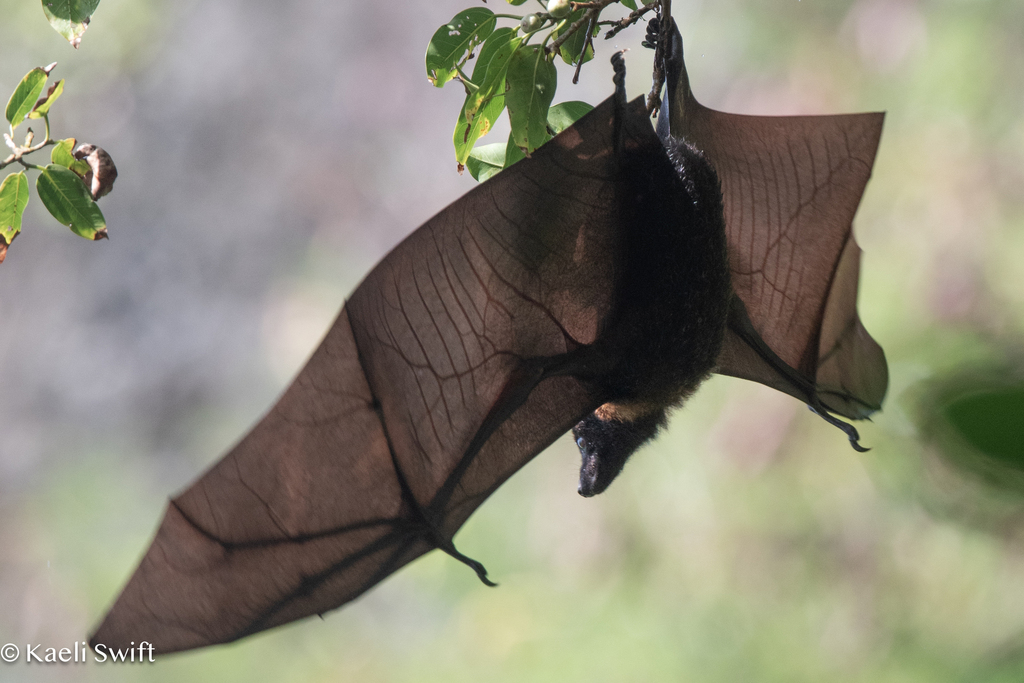
Mariana Flying-fox
Pteropus mariannus
The Mariana fruit bat (Pteropus mariannus), also known as the Mariana flying fox, and the fanihi in Chamorro, is a megabat found only in the Mariana Islands and Ulithi (an atoll in the Caroline Islands). Habitat loss has driven it to endangered status, and it is listed as threatened by the US Fish and Wildlife Service. Poaching, habitat loss, and the introduction of invasive species have contributed to the species' decline.
From the article Mariana fruit bat on Wikipedia (CC BY-SA), quoted section by section
Description
The Mariana fruit bat is a mid-sized bat which weighs 0.6 to 1.1 lb (270 to 500 g), and has a forearm length of 5.3 to 6.1 in (13.4 to 15.6 cm). Males are slightly larger in size than females. Their abdomens are colored from black to brown, while also having gray hairs. The mantle and the neck are a brighter brown to golden brown color and the head varies from brown to black. Their ears are rounded and their eyes large, giving them the features of a canid, so many megabats are called flying foxes.
What it does
Johnson and Wiles described roosting behavior: "Sarigan's population differs from those of larger islands in the archipelago by usually having smaller roost sizes, typically 3–75 bats, and large numbers of solitary bats that at times comprise up to half of the population. Colonies and smaller aggregations were composed primarily of harems with multiple females, whereas a nearly equal sex ratio occurred among solitary animals."
Wikipedia: “Behavior”
Listen
Looking for field recordings…
Where it lives
Recorded sightings
—
geo-referenced records in GBIF, from museums, herbaria and field observers.
Drag the globe to turn it. Dots are where records exist, not a range map; darker means more records.
In the stacks
Searching the stacks…
Every page naming Pteropus mariannus in the Biodiversity Heritage Library →
This page is assembled live from iNaturalist, GBIF, Wikipedia, the Source Library and the Internet Archive. It is not yet part of the hand-edited codex. iNaturalist taxon 40925.