- Animals
- ›Arthropods
- ›Hexapods
- ›Insects
- ›Winged and Once-winged Insects
- ›Butterflies and Moths
- ›Pyralid and Crambid Snout Moths
- ›Crambid Snout Moths
- ›Moss-eating Crambid Snout Moths
- ›Scoparia
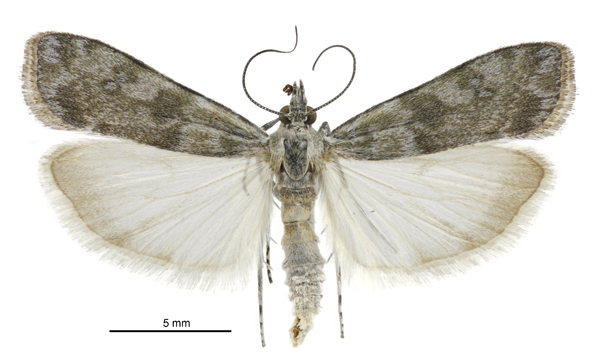
Scoparia asaleuta
Eudonia asaleuta is a moth of the family Crambidae. It was described by Edward Meyrick in 1907. It is endemic to New Zealand and has been collected in the South Island in the West Coast, Fiordland, Canterbury, Otago and Southland regions. This species inhabits bare shingle areas as well as tussock habitat with few trees or scrub at altitudes of under 1000 m. Adults are on the wing from November to February.
From the article Eudonia asaleuta on Wikipedia (CC BY-SA), quoted section by section
Description
Meyrick described this species as follows:
♀. 21-23 mm. Head, palpi, and thorax prismatic bronzy- grey, suffusedly irrorated with white; palpi 2+1⁄4. Antennae dark grey, suffusedly ringed with white. Abdomen pale ochreous, sprinkled with grey. Forewings very elongate, narrow, posteriorly dilated, costa subsinuate in middle, slightly arched posteriorly, apex obtuse, termen nearly straight, hardly oblique, rounded beneath; iridescent pale ochreous mixed with dark bluish-grey, wholly suffused or densely irrorated with white except dark markings as under — viz., an undefined subbasal fascia; a nearly direct fascia representing first line, dilated posteriorly above middle; an 8-shaped discal mark; a broadt erminal fascia, on which the second and subterminal lines appear as whitish shades confluent in middle and sometimes partially obsolete : cilla whitish-ochreous, tips whitish, with narrow basal and broader postmedian grey shades. Hindwings without hairs in cell; pale greyish-ochreous, with suffused dark-grey terminal fascia; cilia ochreous-grey-whitish, with grey basal line. This species has forewings that a coloured a bluish grey with a sheen that camouflages the moth against rocks.
Range & habitat
This species is endemic to New Zealand. It has been found in the West Coast, Fiordland, Canterbury, Otago and Southland. In particular it has been collected in Lake Wakatipu, Aoraki / Mount Cook, Waiho River bed, Lake Manapouri, Hope Arm in Fiordland, Danseys Pass, Makarora and Invercargill.
Wikipedia: “Distribution”
What it does
The adults of this species are on the wing from November to February but are more common in January and February. This species has been collected in light traps, Malaise traps, and pan traps.
== References ==
Wikipedia: “Behaviour”
Listen
Looking for field recordings…
Where it lives
Recorded sightings
—
geo-referenced records in GBIF, from museums, herbaria and field observers.
Drag the globe to turn it. Dots are where records exist, not a range map; darker means more records.
In the stacks
Searching the stacks…
Every page naming Scoparia asaleuta in the Biodiversity Heritage Library →
This page is assembled live from iNaturalist, GBIF, Wikipedia, the Source Library and the Internet Archive. It is not yet part of the hand-edited codex. iNaturalist taxon 409078.