- Animals
- ›Chordates
- ›Vertebrates
- ›Mammals
- ›Therians
- ›Placental Mammals
- ›Ungulates, Carnivorans, and Allies
- ›Bats
- ›Yinpterochiroptera
- ›Pteropodoidea
- ›Old World Fruit Bats
- ›Flying-foxes, Monkey-faced Bats and allies
- ›Flying-foxes and allies
- ›Pteropus
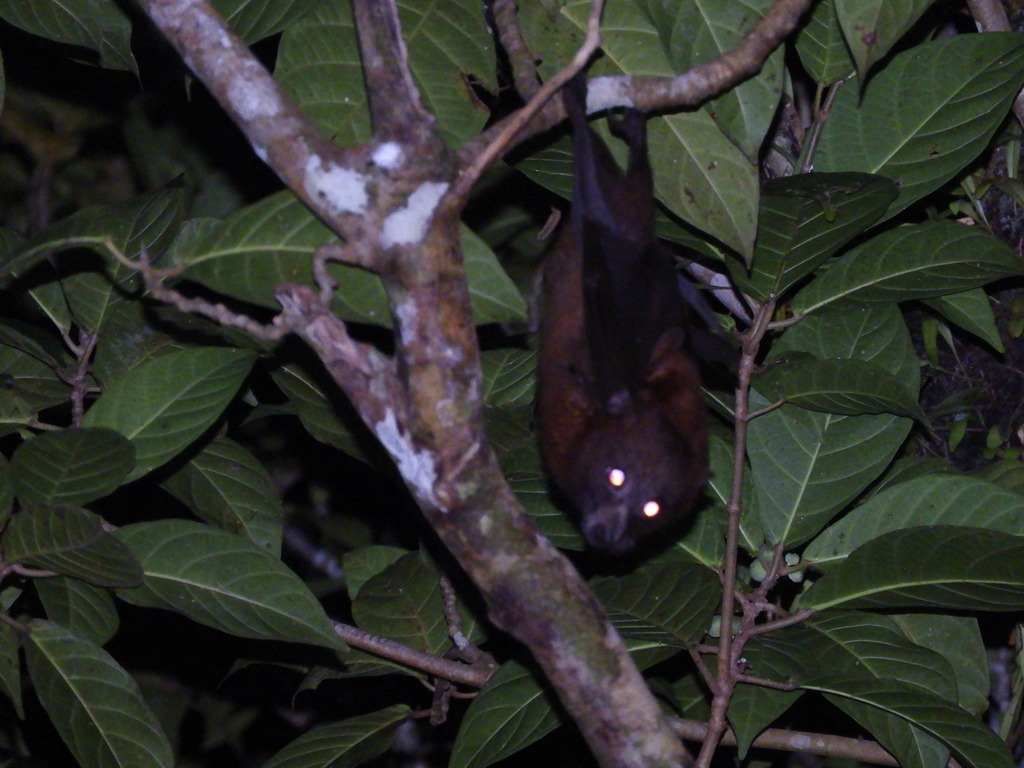
Admiralty Flying-fox
Pteropus admiralitatum
The Admiralty flying fox (Pteropus admiralitatum) is a species of fruit bat in the family Pteropodidae, the megabats. It is found in Papua New Guinea and the Solomon Islands.
From the article Admiralty flying fox on Wikipedia (CC BY-SA), quoted section by section
Description
It is similar in appearance to the small flying fox, though it is smaller. It is further distinguished by its much smaller ears and the fact that its chest and abdomen are the same color. The top of its head is pale gray, while the back of its neck is a reddish-brown. Its dorsal fur is brown, with some white hairs interspersed. The head and body length is approximately 180 mm (7.1 in); its forearm length is 121 mm (4.8 in); its ear length is 17.5 mm (0.69 in).
Range & habitat
It is found in several countries in Oceania, including Solomon Islands and Papua New Guinea.
Wikipedia: “Range and habitat”
In human culture
It was first described by British zoologist Oldfield Thomas in 1894, based on specimens collected by the Challenger Expedition in 1875. The type specimen is held at the Natural History Museum, London. The Admiralty flying fox is possibly a species complex of three species, with one species occupying the Admiralty Islands and the Solomon Islands from Buka Island to Malaita Island. A second species is thought to occupy Western Province, Guadalcanal, and Malaita Island. The third species is thought to occupy Mussau Island and Emirau Island. Its species name admiralitum is a Neo-Latin rendering of "admiralty", which is in reference to the Admiralty Islands where this species was first documented.
Wikipedia: “Taxonomy and etymology”
Listen
Looking for field recordings…
Where it lives
Recorded sightings
—
geo-referenced records in GBIF, from museums, herbaria and field observers.
Drag the globe to turn it. Dots are where records exist, not a range map; darker means more records.
In the stacks
Searching the stacks…
Every page naming Pteropus admiralitatum in the Biodiversity Heritage Library →
This page is assembled live from iNaturalist, GBIF, Wikipedia, the Source Library and the Internet Archive. It is not yet part of the hand-edited codex. iNaturalist taxon 40903.