On eBird ↗
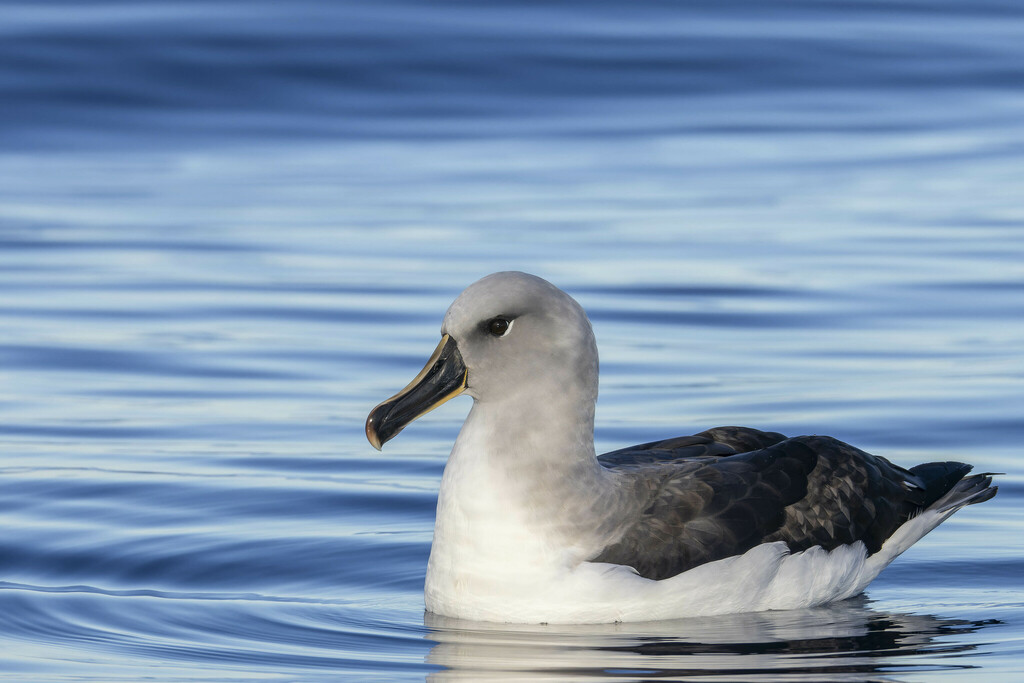
Gray-headed Albatross
Live sightings near you, the range map, bar charts of when it is seen, and Macaulay Library photos and recordings.
Gray-headed Albatross
Thalassarche chrysostoma
The grey-headed albatross (Thalassarche chrysostoma) also known as the grey-headed mollymawk, is a large seabird from the albatross family. It has a circumpolar distribution, nesting on isolated islands in the Southern Ocean and feeding at high latitudes, further south than any of the other mollymawks. Its name derives from its ashy-grey head, throat and upper neck.
From the article Grey-headed albatross on Wikipedia (CC BY-SA), quoted section by section
Description
The grey-headed albatross averages 81 cm (32 in) in length and 2.2 m (7.2 ft) in wingspan. Weight can range from 2.8 to 4.4 kg (6.2 to 9.7 lb), with a mean mass of 3.65 kg (8.0 lb). It has a dark ashy-grey head, throat, and upper neck, and its upper wings, mantle, and tail, are almost black. It has a white rump, underparts, and a white crescent behind its eyes. Its bill is black, with bright yellow upper and lower ridges, that shades to pink-orange at the tip. Its underwings are white with a lot of black on the leading edge and less on the trailing edge. Juveniles have a black bill and head and a darker nape. Its eye crescent is indistinct and its underwing is almost completely dark.
Range & habitat
Grey-headed albatrosses nest in colonies on several islands in the Southern Ocean, with large colonies on South Georgia in the South Atlantic, and smaller colonies on Islas Diego Ramírez, Kerguelen Islands, Crozet Islands, Marion Island, and Prince Edward Islands in the Indian Ocean, Campbell Island and Macquarie Island south of New Zealand, and Chile. While breeding, they will forage for food within or south of the Antarctic Polar Frontal Zone. Birds that roost in the Marion Island area forage for food in the sub-tropical zone. Juveniles or non-breeding adults fly freely throughout all the southern oceans, north to 35°S.
Wikipedia: “Range and habitat”
What it does
At sea the grey-headed albatross is highly pelagic, more so than other mollymawks, feeding in the open oceans rather than over the continental shelves. They feed predominantly on squid, taking also some fish, crustacea, carrion, cephalopods, and lampreys. Krill is less important as a food source for this species, reflecting their more pelagic feeding range. They are capable of diving as deep as 7 m (23 ft) to chase prey, but do not do so frequently.
Wikipedia: “Feeding”
In human culture
The name chrysostoma is derived from two Greek words. Khrusos means "gold" and stoma means "the mouth", in reference to its golden bill.
Wikipedia: “Etymology”
Listen
Looking for field recordings…
Where it lives
Recorded sightings
—
geo-referenced records in GBIF, from museums, herbaria and field observers.
Drag the globe to turn it. Dots are where records exist, not a range map; darker means more records.
In the stacks
Searching the stacks…
Every page naming Thalassarche chrysostoma in the Biodiversity Heritage Library →
This page is assembled live from iNaturalist, GBIF, Wikipedia, the Source Library and the Internet Archive. It is not yet part of the hand-edited codex. iNaturalist taxon 4090.